La
computació 3D ha evolucionat històricament amb una tecnologia i una
ciència d'arrel patriarcal i colonial. D'aquesta manera, aquesta tècnica
s'ha alineat amb el règim econòmic hegemònic i les seves pràctiques
d'optimització, normalització, taxonomització, propietat i ordre
mundial.
Els llegats del desenvolupament industrial comercial deixen rastre
d'aquell imaginari i expliquen les històries d'una viva tensió entre "el
probable" i "el possible". La volumetria, es defineix com un conjunt de
tècniques de producció de volums mitjançant la mesura de la matèria
(somàtica, ambiental); la volumetria digital fa el seguiment, captura,
modelatge i escaneig en 3D. El seu valor rau en (re)produir i accentuar
amb massa facilitat mons probables, i aquest procés encara s'intensifica
més dins la hipercomputació contemporània. 'x, y, z: Volumetric
Regimes' consta de tres fotogrames d'una pel·lícula que sempre està en
procés.
Aquesta pel·lícula que potser no es farà mai, demana angles
desobedients que poden anar més enllà de la rigidesa de les
tecno-ecologies de la volumetria digital. És un intent trans*feminista
de pensar a partir de l'agència de certs artefactes culturals, amb
l'esperança d'ampliar les seves possibilitats més enllà de les maneres
de fer i de ser predissenyades.
Bòlit, Girona, Del 10 de febrer al 30 d’abril de 2023
"Aquesta exposició i les activitats que l'acompanyen és una recerca
col·lectiva sobre qüestions culturals vinculades amb la identitat i el
gènere a partir d'un treball sobre el cos i l'anormalitat, és a dir,
sobre aquelles "alteritats radicals" que qüestionen les normes, les
figuracions i el que s'espera d'un cos."
+ info de la expo y sus activaciones: https://web.girona.cat/bolit/exposicions/2023/cantsinauditsdelcos
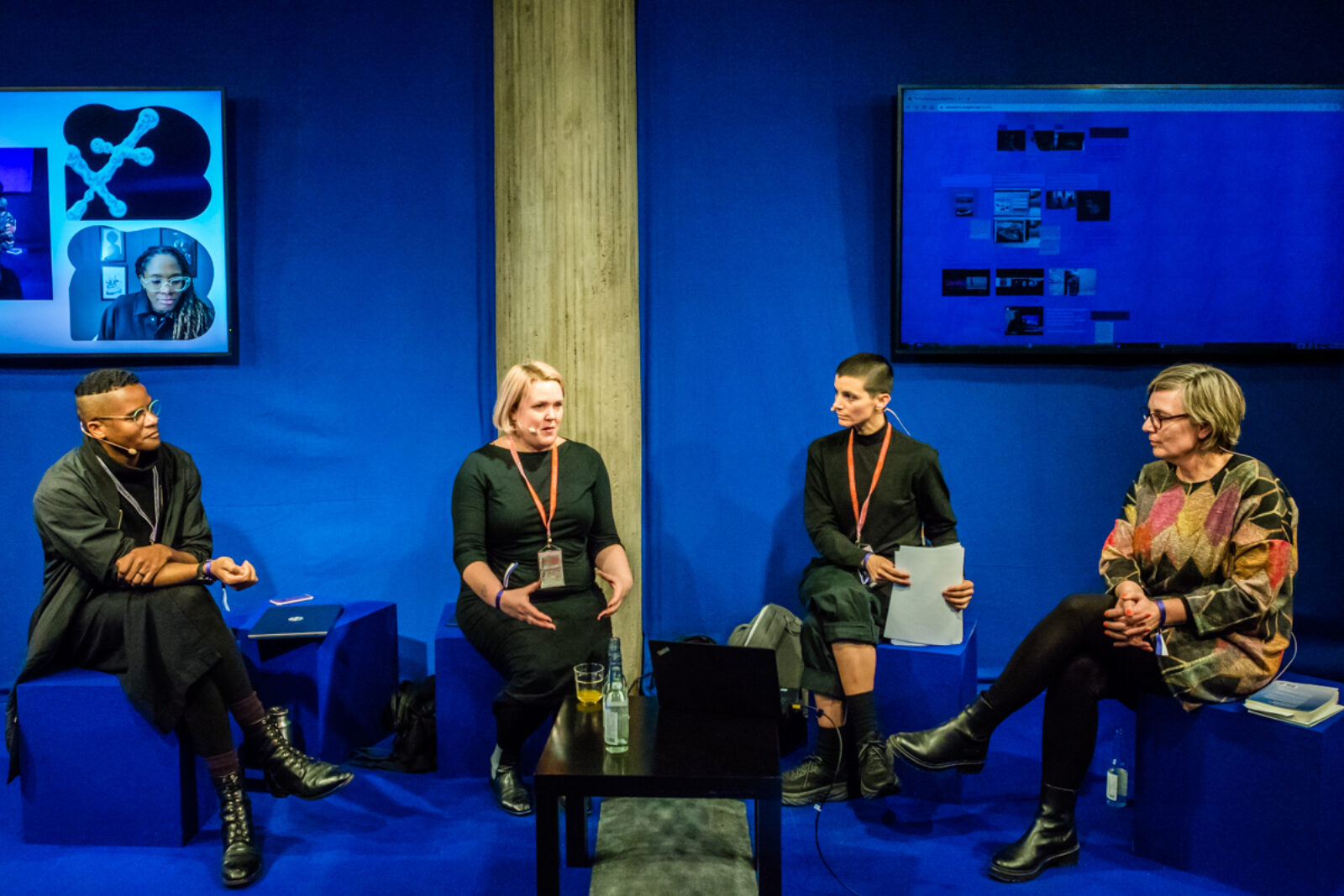
With Femke Snelting, Georgina Voss, Irene Fubara-Manuel, Jara Rocha
Moderated by
Romi Ron Morrison
02.02.202317:30 Akademie der Künste / Hanseatenweg / Club Room
Volumetric
technologies are increasingly sought after commodities in a wide range
of contexts from entertainment to city planning to military
surveillance. Rendering a reality of their own, instead of the one's
captured, volumetric technologies reflect a nested regime of
representations, truths, and ideologies, producing an affective
computational sublime. Hidden inside glossy renders and visual effects,
these representations proliferate explicit politics, taking up space,
volume and depth, minimising difference and the modes of representation.
In
this conversation, Femke Snelting, Georgina Voss, Irene Fubara-Manuel,
and Jara Rocha, with moderator Romi Ron Morrison, discuss the problems
and promises of volumetric technologies and their seamless movement
between entertainment, shopping, ikea catalogues, smart borders, and
wildlife preservation. Unpacking the affects of the computational
sublime, their conversation aims to bring bodies and data points and
spaces back into relation with each other.
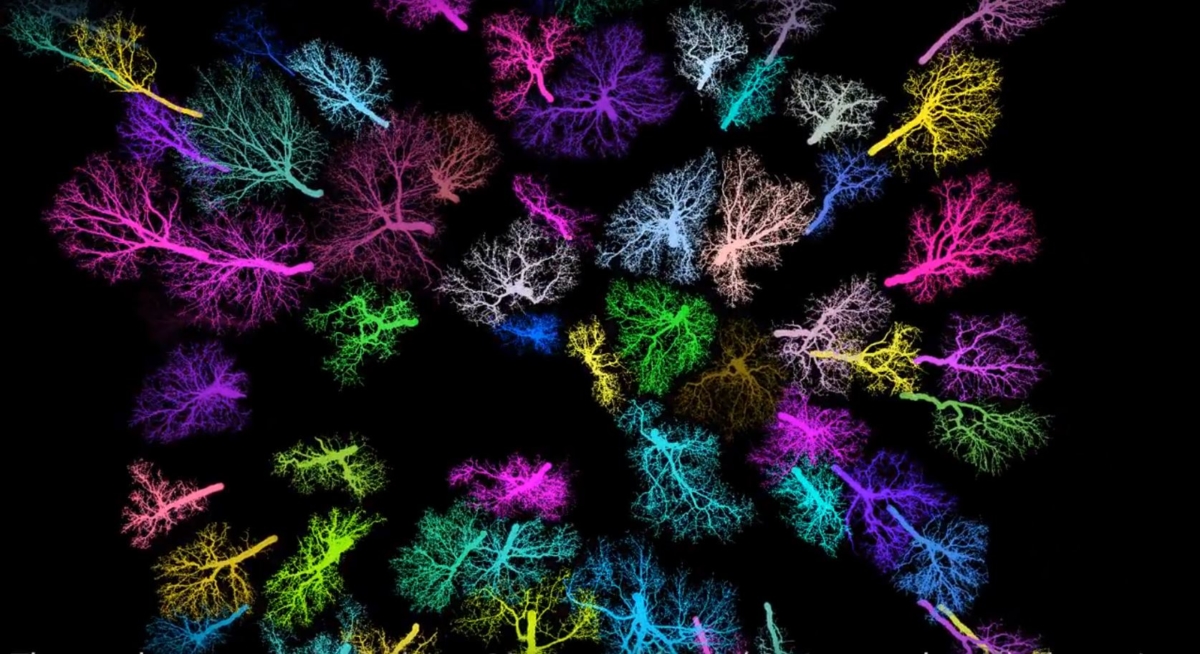
For this presentation, several “computational ecologies of practice”
were selected to “feel the borders” of how so-called plants are being
made present. The figure of “so-called plants” problematizes the
limitations of the ontological category of “plant”, and the isolation it
implies. So-called plants questions the various methods that biology,
computer science, 3D-modeling or border management put to work to create
finite, specified and discrete entities which represent the
characteristics of whole species, erasing the nuances of very particular
beings.
"In the age of Artificial Intelligence, on any given day, at some point most definitely, the Future has died.
The
Future, with capital F, seems to be perfectly synchronized, in line and
aligned with the global mode of technological production. In this kind
of Future in a hyper networked and digitized society, we witness new
modes of extraction, monopolizations, surveillance; new types of
environmental harm and damages as well as new codes of discriminations
and exclusions which bring more climate change-induced
provincialization, more competition and individualism. Not only does
this model of Future not provide enough space for the many(-folded), its
pretension lies in the misreading of the concept itself. Because in
contrast to its usual connotation, the Future does not necessarily and
always indicate a tomorrow or far away. But, as Michelle M. Wright and
Rasheedah Phillips brilliantly show in their works, it is about a
radical re-thinking of time and experiencing of temporalities that gives
way to a broader and better understanding of stories, past and present,
of todays, of tomorrows, of in-betweens (Fred Moten).
futures – without capital F and in their plural form – always also happen now.
With the Impossible Possibilities we think AI with Kara Keeling. We are
concerned with the presence of AI, with what goes beyond its expression
and produces a surplus that cannot be seen or understood, but is
nevertheless present: "Whatever escapes recognition, whatever escapes
meaning and valuation, exists as an impossible possibility within our
shared reality, however one describes that reality, and therefore
threatens to unsettle, if not destroy, the common sense on which that
reality relies for its coherence." (2019: 83). What is impossible to
recognize is the possibility of AI. For what defies re-cognition exists
in a world that is real but not fed into the normative discourse of AI
as predictive computation. With this conference, we turn our attention
to paradox as a condition of existence that has the potential to shake
the common sense of AI.
Impossible Possibilities does not stand
for exposing the binary in the conundrum but stands for an invitation
for exploring such a paradox productively."
Preliminary program (Register: any_one@hgb-leipzig.de).
Please keep Crashing (Workshop Documentation)
With students of Academy of Visual Arts Leipzig Organized by the Academy for Transcultural Exchange (AtA), facilitated by Anja Kaiser and Melina Weissenborn
[our panel:]
Sedimented Temporalities of Geodigital Landscapes (Panel) With The Underground Division (Jara Rocha and Femke Snelting) and Orit Halpern Moderation: Katrin Köppert
"Volumetric Regimes makes an essential contribution to the ways
in which we must rethink matter politically and ecologically. As the
book unfolds, ontological questions of intensities, dimensions, and
substance are denaturalised as mere properties of matter that can be
measured, modified, and thus computed, which today are exemplified by 3D
modelling and parametric design, but are shown to be part of
processional life-worlds that relational and mutually informed and
informing. Not the partitioning of bodies, particles, datapoints, and
spaces as techno-capital and techno-science would have it but a material
enmeshment that brings the volumetric into presence otherwise." – Susan Schuppli
“This radical multi-form collective investigation traces the
cutting edge of how bodies and subjects are rendered technologically. It
proposes multi-dimensional forms of intervention, and claims an
experimental horizon of the possible, shattering the mantra of
unavoidability.” — Olga Goriunova
To download the pdf and/or order a paper copy on-line:
Six years of trans*feminist disobedient action-research on 3D
technologies, paradigms and procedures culminated in Volumetric Regimes:
Material Cultures of Quantified Presence (Open Humanities Press 2022,
DATA-browser series, eds. Geoff Cox and Joasia Krysa). Compiled by Possible Bodies
(Femke Snelting and Jara Rocha), the publication brings together
diverse materials on the political, aesthetic, computational and
relational regimes in which volumes are calculated. The book foregrounds
technological practices that invite widenings of what is possible. With
contributions by Sophie Boiron, Maria Dada, Pierre Huyghebaert, Phil
Langley, Nicolas Malevé, Romi Ron Morrison, Simone C. Niquille, Helen V.
Pritchard, Jara Rocha, Sina Seifee, Femke Snelting and Kym Ward.
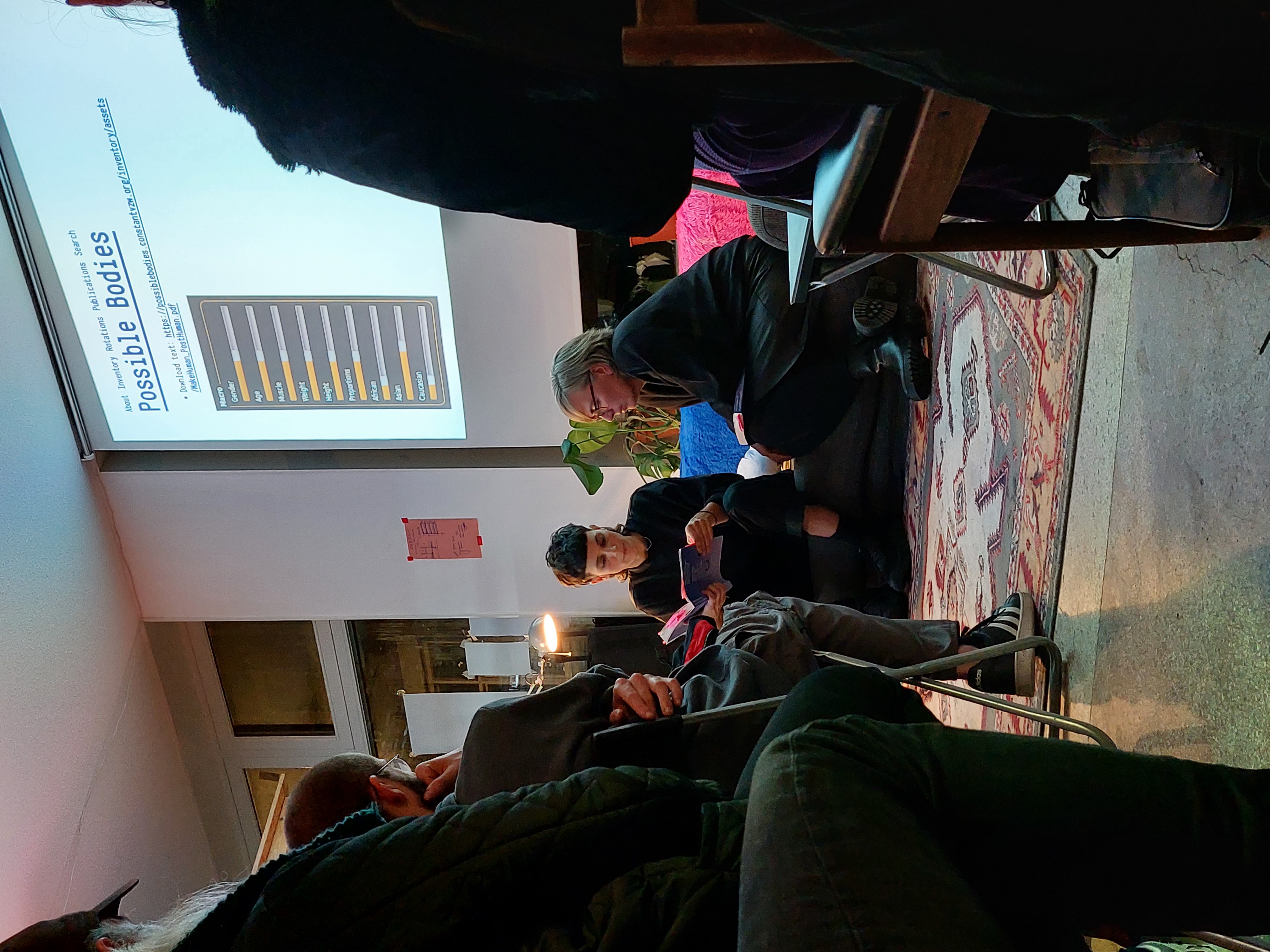
The event at Varia celebrates the wiki-to-print paper edition
designed and developed by Manetta Berends. It is a special moment in an
ongoing multi-local launch, made up of playful contributions, informal
responses and interactive formats proposed by comrades in the making of
technosciences otherwise.
The evening starts with a performative introduction by the editors,
followed by an intervention by designer, artist and researcher Alex Zakkas in conversation with Manetta Berends.
Books will be sold at the event at a reduced price.
All materials have also been published on a dedicated wiki: https://volumetricregimes.xyz/
Volumetric Regimes is produced with support from London South Bank University and Liverpool John Moores University.
(pic by Varia https://varia.zone/archive/2022-10-04-Volumetric-Regimes-booklaunch/)
Traducción y republicación por parte de nmenos1, a invitación de Juan Covelli.
Cada uno a su modo,
los ítems están relacionados con un mundo que está deviniendo oblicuo,
donde dentro y fuera o arriba y abajo están cambiando posiciones, y
donde nuevas perspectivas se hacen disponibles. Hablan de la mutua
constitución de cuerpos y tecnologías, materia y semiótica, naturaleza
y cultura; y de cómo se gestiona la orientación en las herramientas a
través de la matriz tecnológica de la representación.
+
Tratamos de experimentar su proceso de “hacer mundo” permaneciendo en
la exigencia de “entrar” en el software. Manteniendo un equilibrio
entre la comprensión y la confusión, utilizamos la sensación de
desorientación creada por los conceptos cambiantes de la palabra
“mundo” para medir lo que sucede cuando un término tan vertiginoso se
extrae del lenguaje coloquial para ser re-normalizado y
re-naturalizado. En el nauseabundo contexto semiótico del modelado de
3D, la palabra “mundo” comienza a funcionar en otro espacio,
igualmente real pero abstracto.
+
Todo parece demasiado imponente, demasiado normativo en el
sentido humanista, incluso demasiado esencialista. ¿Qué composiciones
corporales comparten una base horizontal, qué entidades tienen el don
de comportarse verticalmente? ¿Cómo afectan otras trayectorias a
nuestras condiciones semióticas-materiales de posibilidad y, por lo
tanto, a la misma política que los cuerpos co-componen?
+
Puede que sea necesario dejar de lado la
necesidad de “suelo” como elemento definidor de la propia existencia
del cuerpo, aunque esto nos hace preguntarnos acerca de las agencias
que trabajan en esta encarnación sin suelo. Si la tierra es para
aquellos que la trabajan, entonces ¿quién trabaja el suelo?
@Theory Stairs, FedLev Building (Sandberg Instituut)
Six
years of trans*feminist disobedient action research on 3D technologies,
paradigms and procedures are about to be published as “Volumetric
Regimes: Material Cultures of Quantified Presence” (Open Humanities
Press, DATA-browser series). The book foregrounds technological
practices that provide with a widening of the possible and brings
together diverse materials on the political, aesthetic and relational
regimes in which volumes are calculated. The ongoing multi-local launch
of Volumetric Regimes is made up of playful contributions, informal
responses and interactive formats proposed by known and unknown comrades
in the making of technosciences otherwise.
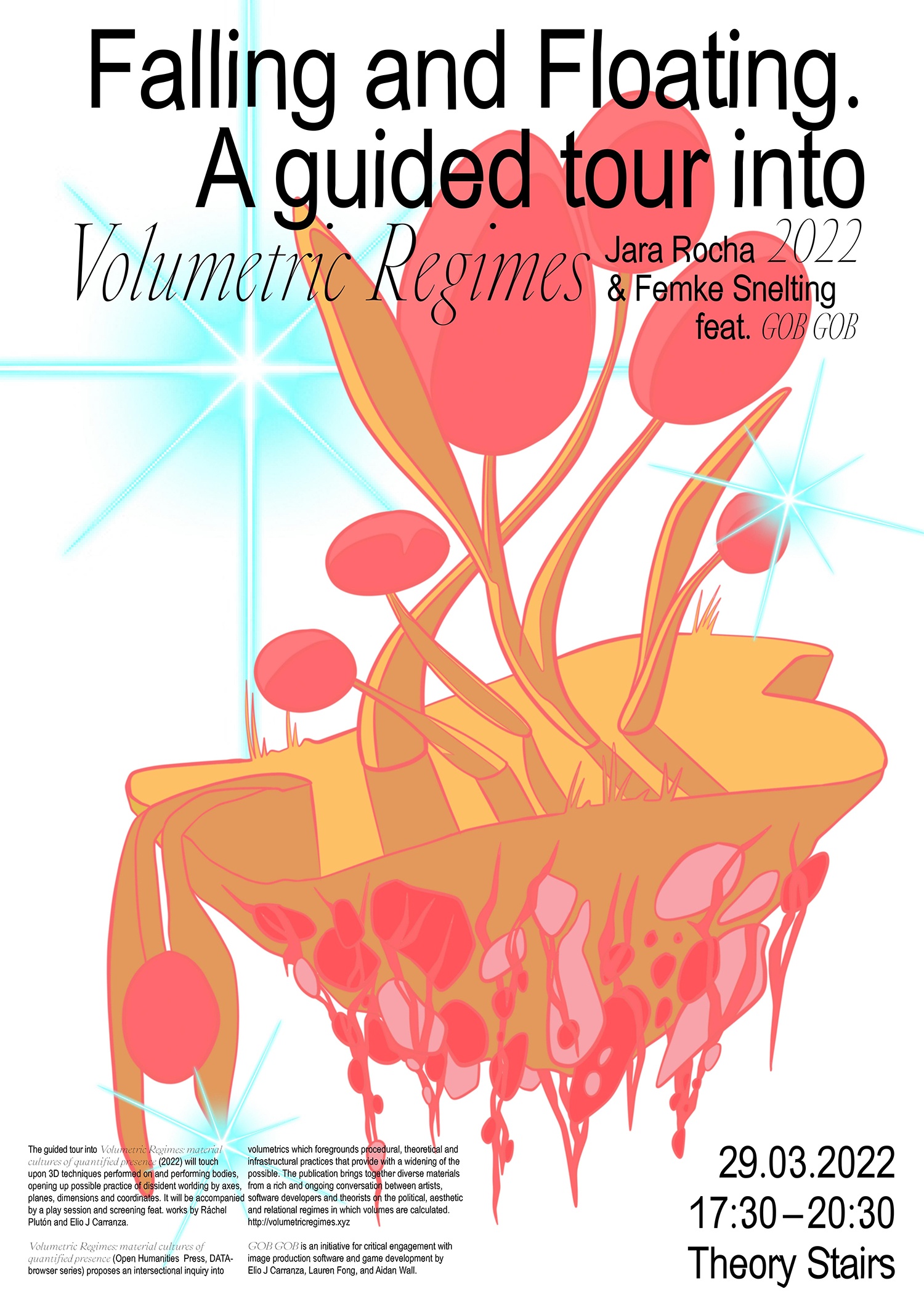
The guided tour into Volumetric Regimes: material cultures of quantified presence
(Open Humanities Press, 2022) at Sandberg Institute will touch upon 3D
image production tools and the possible practice of dissident worlding
by axes, planes, dimensions and coordinates. It will be matched with
play session and screening feat. works by Ráchel Plutón and Elio J
Carranza.
Possible Bodies (Jara Rocha, Femke Snelting) feat. Elodie Mugrefya will present their upcoming book Volumetric Regimes: Material Cultures of Quantified Presence on Thursday 24th March at 17.30, at ERG (école de recherche graphique), 87 rue du Page – 1050 Bruxelles – as part of the Rendering Research
workshop organized by DARC (Aarhus University), CSNI (London South Bank
University) and transmediale festival for art and digital culture. All
welcome.
The ongoing multi-local launch
of Volumetric Regimes is made up of playful contributions, informal
responses and interactive formats proposed by known and unknown comrades
in the making of technosciences otherwise. For the occasion of
Rendering Research we will be joined by Elodie Mugrefya, who we invited
to re-interpret, critique, and/or remix materials from Volumetric
Regimes through her sensibility for technocolonial knowledge production.
Elodie Mugrefya
is a member of Constant, Brussels where she takes part in its artistic
and collective researches while developing a writing practice that
intersects with Constant's themes of interest; notably notions
surrounding collectivity, technological infrastructures and
socio-political troubles. Constant develops projects across art and
technology and operates through its commitment to free/libre open source
cultures and intersectional perspectives. https://constantvzw.org/
Thursday, March 17th 2022 on Zoom from 15:00 - 16:00
Doctoral Seminar - Open to everyone!
Date:17th March
2022
Time: 15:00
- 16:00
"For the second installation of AaltoPhotoTalks,
we have invited artist and researcher duo Femke Snelting and Jara Rocha as our guest speaker.In
their forthcoming bookVolumetric
Regimes: material cultures of quantified presence(Open
Humanities Press, 2022), authors Jara Rocha and Femke Snelting bring
together several years of discussing and working with artists, software
developers and theorists who detect, track, print, model and render
volumes. During the talk, the duo will read and
discuss the chapter “Invasive Imagination and its Agential Cuts”. The
authors argue that tomography, a set of digital techniques which has
become ubiquitous in the medical imaging field, produces “exclusionary
boundaries,” i.e. that they generate outcomes
according to pre-established categorizations and norms of the human
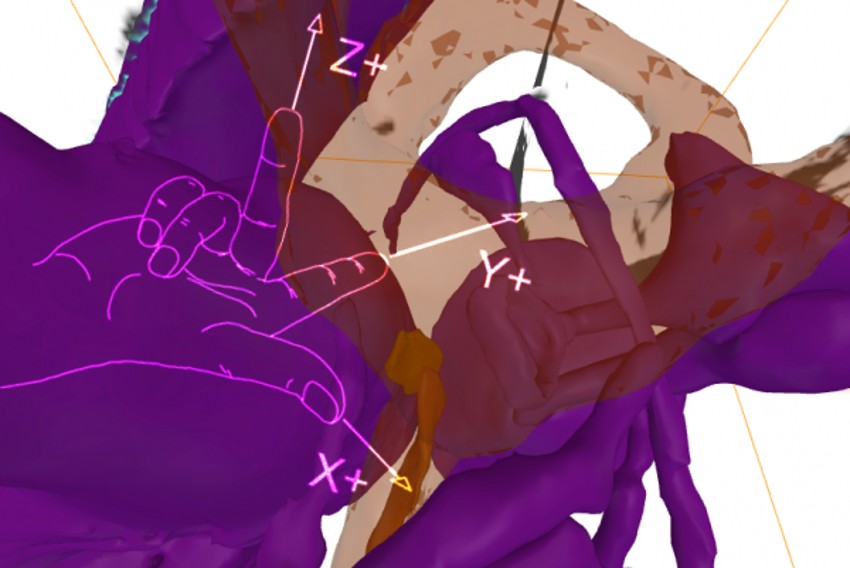
body. Zooming in on the example of the Open Source “3-D Slicer”
software, they show how digital cutting is part of a culture of
quantification, and naturalised as a scientifically objective
gesture. Rocha and Snelting challenge this dominant imagination of
biomedical informatics and mount an “affirmative critique” by proposing
technical tweaks and changes, thus opening up the possibility of
“oblique, deviating, unfinished and queer cuts.”
The talk is open to public and we welcome Aalto students
from the Department of Media and other disciplines to join us. Please also feel free to invite students from outside of Aalto.
The Center for the Study of the Networked Image (CSNI) is hosting a conversation about "The Industrial continuum of 3D":
Join us on Wednesday 3rd November 2021 at 14.00 (online) for our next research event hosted by Possible Bodies (Jara Rocha, Femke Snelting) in conversation with Martino Morandi.
The industrial continuum of 3D is a sociotechnical figuration and
phenomenon that can be observed when volumetric techniques and
technologies flow between diverse industries such as biomedical imaging,
wild life conservation, border patrolling and Hollywood computer
graphics. Its fluency is based on an intricate paradox: the continuum
moves smoothly between distinct, different or even mutually exclusive
fields of application, but leaves very little space for radical
experiments and the resulting combinations are all but surprising. This
conversation featuring Martino Morandi is an attempt to show how the
consistent contradiction is established, to see the way power gathers
around it, to get closer to what drives the circulation of industrial 3D
and to describe what settles as a result. What possible techniques,
paradigms and procedures for ‘computing otherwise’ can be activated
around the representation of space-time, and which other worldings might
be imagined?
Volumetric Regimes: material cultures of quantified presence (Open
Humanities Press, DATA-browser series) proposes an intersectional
inquiry into volumetrics which foregrounds procedural, theoretical and
infrastructural practices that provide with a widening of the
possible. The publication brings together diverse materials from a rich
and ongoing conversation between artists, software developers and
theorists on the political, aesthetic and relational regimes in which
volumes are calculated. http://volumetricregimes.xyz
Ada Lovelace Day feat. Possible Bodies (Femke Snelting, Jara Rocha)
Sábado, 9 de octubre de 16:00 a 21:00h
[ENG]
What
is going on with 3D!? This question, both modest and enormous,
triggered six years of trans*feminist research that are about to be
published as "Volumetric Regimes: Material Cultures of Quantified
Presence" (Possible Bodies, Eds.; forthcoming at Open Humanities Press).
The research trajectory was provoked by an intuitive but collective
concern about the way 3D computing quite routinely seems to render
racist, sexist, ableist, speciest and ageist worlds. Asking about what
is up with 3D is especially urgent when observing its application in
border-patrol devices, for climate prediction modeling, in advanced
biomedical imaging or throughout the gamify-all approach of overarching
industries, from education to logistics.
Trans*feminist
research (including feminist technosciences) is neither busy with the
celebration of the merits of so-called women* nor with the reproduction of binary categorizations.It is
rather about radical interdependence, mutual affection and solidary
transdisciplinarity. For this edition of Ada Lovelace Day we therefore
invited a gang of local thinkers-doers to respond to, re-interpret,
critique, remix and problematize materials from "Volumetric Regimes:
Material Cultures of Quantified Presence". The event proposes a
spacetime of intimacy with the project and its publication, as read
through the specific sensibilities of known and unknown comrades in the
making of technosciences otherwise. It will include playful
contributions, informal responses and interactive formats proposed by Carmen Romero Bachiller, Marta Echaves, Blanca Pujals and Alejandra López Gabrielidis.
*"Ada
Lovelace Day (ALD) is an international celebration of the achievements
of women in science, technology, engineering and maths (STEM). It aims
to increase the profile of women in STEM and, in doing so, create new
role models who will encourage more girls into STEM careers and support
women already working in STEM."
¿Qué está pasando con el 3D? Esta pregunta, tan modesta como enorme,
desencadenó seis años de una investigación trans*feminista que están a
punto de publicarse como "Volumetric Regimes: Material Cultures of
Quantified Presence" (Possible Bodies, Eds.; de próxima aparición en
Open Humanities Press). La trayectoria de la investigación fue provocada
por una preocupación intuitiva pero colectiva sobre el modo en que la
computación en 3D parece presentar y representar de forma rutinaria
mundos racistas, sexistas, capacitistas, especistas y edadistas.
Preguntarse qué pasa con el 3D es especialmente urgente cuando se
observa su aplicación en dispositivos de patrullaje fronterizo, para el
modelado de predicciones climáticas, en la obtención de imágenes
biomédicas avanzadas o en todo el enfoque de gamificación de los
procesos industriales en general, aplicado desde la educación hasta la
logística.
La investigación trans*feminista (incluidas las tecnociencias
feministas) no se ocupa de celebrar los méritos de las llamadas mujeres*
ni de reproducir las categorizaciones binarias. Por ello, en
esta edición del Ada Lovelace Day se ha invitado a un grupo de
pensadoras locales a responder, reinterpretar, criticar, remezclar y
problematizar los materiales de esta publicación. El evento plantea un espacio-tiempo de intimidad con el proyecto y su publicación, que será leída a
través de las sensibilidades específicas de compañeras conocidas y por
conocer en el hacer de las tecnociencias de otra manera. Así, contará con aportaciones experimentales, respuestas informales y formatos interactivos de Marta Echaves, investigadora y comisaria independiente; Alejandra López Gabrielidis, filósofa especializada en arte y tecnologías digitales; la arquitecta, investigadora espacial y escritora Blanca Pujals, y Carmen Romero Bachiller, doctora en Sociología y profesora en la UCM. Cada una de ellas mantendrá un debate posterior con les comisaries, Jara Rocha y Femke Snelting.
La publicación“Volumetric Regimes: Material Cultures of Quantified Presence”surge de Possible Bodies, un proyecto colaborativo sobre la intersección entre la investigación artística y académica
que se inició en 2016 para explorar las entidades concretas, y al mismo
tiempo complejas y ficticias, de los llamados "cuerpos" en el contexto
de la computación 3D. La investigación se centra en las genealogías de cómo los cuerpos y las tecnologías se han constituido mutuamente.La publicación reúne
diversos materiales de una conversación en curso entre artistas,
desarrolladores de software y teóricos que trabajan con técnicas y
tecnologías para detectar, rastrear, imprimir, modelar y renderizar
volúmenes.
ADA LOVELACE DAY
Reconocida como la primera programadora de la historia,Ada Augusta Byron King dedujo
la capacidad de los ordenadores para ir más allá de los simples
cálculos de números, lo que conocemos en la actualidad como “software”. El
Día de Ada Lovelace (ALD) es una celebración internacional de los
logros de las mujeres en ciencia, tecnología, ingeniería y matemáticas
(STEM). Su objetivo es aumentar el perfil de las mujeres en
STEM y, al hacerlo, crear nuevos modelos que animen a más niñas a seguir
estas carreras y apoyar a las mujeres que ya trabajan en estos campos.
Registro en vídeo del evento completo (a cargo de Raúl):
Programa
16:00 Bienvenida y contextualización Volumetric Regimes (Jara Rocha + Femke Snelting)
16:30 Intervención de Alejandra López Gabrielidis
17:30 Intervención de Carmen Romero Bachiller
18:30 Descanso
19:00 Intervención de Marta Echaves
20:00 Intervención de Blanca Pujals
21:00 Fin
[Presentación a cargo de Jara Rocha, de una investigación
colaborativa al cuidado tanto de Jara Rocha como de Femke Snelting, en
la que también participan muchxs otrxs]
La computación del 3D ha co-evolucionado históricamente con las
tecnociencias modernas y se ha alineado con los regímenes de
optimización, normalización y de orden mundial hegemónico. Los legados y
las proyecciones del desarrollo industrial dejan huellas de ese
imaginario y cuentan las historias de una tensión muy viva entre «lo
probable» y «lo posible». Definida como el conjunto de técnicas de
medición del volumen, la volumetría (re)produce y acentúa con demasiada
agilidad lo probable, y este proceso se intensifica en el ámbito
tecnocrático de la hipercomputación contemporánea.La
ubicuidad de las operaciones eficientes es profundamente perjudicial por
el modo en que gradualmente agota el mundo y lo despoja de toda
posibilidad de compromiso, interporosidad y potencia vitalista,
solidaria e inventiva. «Volumetric Regimes: Material Cultures of Quantified Presence«
es el esfuerzo de Jara Rocha y Femke Snelting para proponer una
investigación interseccional urgente sobre la volumetría, poniendo en
primer plano las prácticas procedimentales, teóricas, estéticas y de
infraestructura que proveen con una ampliación de lo posible.
Volumetric Regimes surge de Possible Bodies,
un proyecto de colaboración en la intersección entre la investigación
artística y la para-académica. El proyecto se inició en 2016 para
explorar las entidades muy concretas y al mismo tiempo complejas y
ficticias que suponen los llamados «cuerpos» en el contexto de la
computación 3D. Esta investigación ha reunido diversos materiales en una
conversación continua entre artistas, desarrolladorxs de software y
teóriquxs que trabajan con técnicas y tecnologías para detectar,
rastrear, imprimir, modelar y renderizar volúmenes.
Jara Rochatrabaja
a través de las situadas y complejas formas de distribución de lo
tecnológico con una sensibilidad antifa y trans*feminista. Con una
curiosa confianza en la logística transtextual y una clara tendencia a
la profanación de los modos, suele encontrarse en tareas de remediación,
investigación-acción y comisariado in(ter)dependiente. Las principales
áreas de estudio tienen que ver con las materialidades semióticas de las
urgencias políticas.
Femke Snelting
desarrolla proyectos en la intersección del diseño, los feminismos y el
software libre. En varias constelaciones, explora cómo las herramientas
y las prácticas digitales puedenco-construirse mutuamente. Femke es
miembro de Constant, asociación de arte y medios con sede en Bruselas, y
colabora con Possible Bodies, The Underground Division y The Institute
for Technology in The Public Interest.







![[proyecto] Altas latencias](https://blogger.googleusercontent.com/img/a/AVvXsEiBpD8AFlYRdLzeJ2Hsn_CW_e5gS2aqI95InyU5RVD32AgQq1pu7RkVfqaIVCx8HGOvz6-KsASWhMiTRiAOeMFuq_5CdJ4oBpbugFCz27q4naB5GwKSI6367EAzmdV7gwMJ3bsY49giAjtGaszVwN6XK8Jt9TGRgsuh4UAGYJiG6-BT5M8TUcuqDBvoOME=s220)

![[txt] A breeding ground for uncertainties](https://blogger.googleusercontent.com/img/a/AVvXsEj8Ul_82KszibGV8b6jg9LFyWXEGE4qp6ecSy5BMMylXRoJD3M9p69kVu-AzxnSX2giXA1KXDQK0N-9PgDXC3iiwOb8gbekKC9_uczQKXOnaWH8az3En1ZSVefP22hPQWRvsUBccZEqf9CI15VXUsq8xboFMelx4l9oFikZJpvUX3xTe4mnAAeXwpDzIg0=s330)
![[Bugreport] to Frontier Climate](https://post.lurk.org/system/media_attachments/files/111/901/018/803/503/560/original/1075209e931cabe8.png)
![[zine] Ancho](https://blogger.googleusercontent.com/img/a/AVvXsEgxhMNpFpNTQs8-WPjqQ4xMJ3_BZJbszhAfiHl63dmkzEof-nuHBGdzLZzpneNz9vTWNnw4k1RBBRlY8Lku7gu3bPCmoB58oyB8p0m85z8G4vsPwQWrNDmDhPrcLyvW0SP8AVn6WTAkKi6967tUChbVAl73hP9Umq097rixVNbci22Ua_iZFxOiunVkTjE=s312)
![[radio] naturoculturas son disturbios](https://blogger.googleusercontent.com/img/b/R29vZ2xl/AVvXsEh1vf5WGEHGsX7aYwBLxMSY5_yPI3DzKWwCdqAOOIDKz0yFkISa81hx2ljEMCPPb6bRtYCCtoOb89SdCQET4P_BJoQeYy5990dZ2FmiqJL_Sb_ROngQphHGA9wnu3rIZyUkI7LPLNDqRXE/s220/tapiz.jpg)
![[Journal] La composición activa de la presencia](https://blogger.googleusercontent.com/img/a/AVvXsEgWJBnXgfCm300uKPAr-n4sEqPCBHxy2Hxheu2bFuYCl0IgeJCmJ_7U6SwP01cDamYTfgGpbMtgeSS6KtRm5j85_bclhQ4wn7f8DfSKu7C3_AM87wNHhELUwQ_VXIemDotxFy_h2kiZuqa1h2vLKHeMUALEg63BeR_dbpHh4Y7DEfZgKekOA0eCxPT_lJk=s320)
![[fellowship] LaaS (Life as a Service)](https://blogger.googleusercontent.com/img/a/AVvXsEijogwX9jgADqQ9A00tu8fCFaF8ARU8Sq0EXI0Z_PBE8M-SVpgMWAUiHJjw4-QwLjz-KCQlOgyvJNwpvBLe41Gr7xN0xlWzvyrGxZg9mUIH9-q3xEF51MSk6UnyUkD--ZptqoMcp7XSlgD8wV5MVeUaN8o7X34SnScuLZ4C76XyW6U8JDneHWrSw8vZ=s220)


![[associate membership] TITiPI](https://blogger.googleusercontent.com/img/a/AVvXsEjcMlj6-I_3r2L84w6kGyECKoYCgG_clIbPgkJU643pGFonPn9P-UV_qnNI3V-pjgEVFigNgse4IABpsD7WRie8evGe1jdLZOV92rg_McRtrbSIJOTVzyUW5Xx4ITTYM3JL-d90tF-XGKpKscmUYcnrts654lnj1hVbrHZUBvKA8X5pZPXL6DIoILz9=s341)
![[escuela] Elefantes en la habitación](https://blogger.googleusercontent.com/img/a/AVvXsEgg8WMXXVVHA5uHIAlHGUstKTSRhzQEhEORdROKz8QBgLMPCtYxyNIyCnuFkFwDAoixgS1XMLDeGEtm5P0cXW3AUi6AB179S0Ei6BueXW8NXbREYnik1VICivjPvl7G2Ti597fcw2OQ38cWzV0BpfG3MijQiSAzCdVmj67HS4VIiCsQV5dLgdOubMvIGiM=s220)
![[book] Volumetric regimes: material cultures of quantified presence](https://blogger.googleusercontent.com/img/a/AVvXsEgmU-TcPBoSAK-bYjc2IS1c3j6YaoY0bAmoWeJphwdAVgJ1vRcZP_dg5Ki_GWBYPakurYUpM6XIlUGJKAKALaYhdx-sLtC-KlL3NocFIq5S3RzmuefQP1pCwpUTjJ4it_itZKmY1FLZ-GuvAE1PHWP90G9nxsDRdyPVaoyQxl6s3A0SQEeRxP5fNlcI=s332)
![[manual] Queering Damage. Methodologies for partial reparation... or not.](https://blogger.googleusercontent.com/img/b/R29vZ2xl/AVvXsEj8Q0pcpgV4ta3XRYXd7_TLrE-e8iIRW9gtbF-tRh5pKQClpqaw6qbr0dUadU7sASJ9ElOlYJwy4mPROA46dn7bGeTFwAb09LCR2yMuQOkeJUCeRUrAGKai3pPb9x7nvSaISuDx8FZlppg/s1600/QD.png)

![[project] the underground division, with Helen Pritchard & Femke Snelting](https://blogger.googleusercontent.com/img/b/R29vZ2xl/AVvXsEiP7ySE_-Ag-61vgRhsOgPJOVlvsnsupcriKB9x-nxLA_XjAYdkeYSOajqqqBnnGI82iX4wCbaDfnYfAc9lSHl0ny7ES0V1xTeJl3zW0sfLto6Ardt6AiZmYZlqizeDw98sijpGLY_K1p8/s1600/unthoughtinfrastructure.gif)

![[expo] Dorm en l'accident que provoca](https://blogger.googleusercontent.com/img/a/AVvXsEgjj7ASH7edRFh6yretcviCckrs19chm_iyuaa0PyNeRqKj6EWr5C8wRAUQXNsR0rSxSIY0-j_a0z1PfmEjabITfUBWfMwqCNKLo9Fvb65P31PtSbEiBBJ_HhiNrs1iVFZsD4LWicCfvZXM20ivsPoG2XfLBZYGBhv7Iavs2VPb0uGV2mYehjf7mzdm=s220)
![[exposición] La Irrupción](https://blogger.googleusercontent.com/img/a/AVvXsEiJnQT68iCPb08I1Bq9Cq8cGWfRLxF_cwD3tqfqovDvh1oy1L-Mj5DVkBsyBEezs9ydH0kVterKMClhihz3EkJgySfauazM8-YsPZRI2qUOQKSWKE8phvjFy5lPNqE5r60m0bbgm4eyMXVA4xktKU5hrJoQ6gBv22a7QRAhFlmFDxYQVATl6orDZ-oK=s311)
![[Fellowship] Spectral Infrastructure | Cell for digital Discomfort](https://www.bakonline.org/wp-content/uploads/2021/07/Spirit-Labour-1-web-2000x1335.jpg)

![[paper] Figurations of Timely Extraction](https://blogger.googleusercontent.com/img/b/R29vZ2xl/AVvXsEheNeBTv2n__LM26gVP5_NJsH4-vssVsRn3CspeiFnoCsUY4RmKBE1dTzYurmx73Nt5hceLv_zcORBxLnGV5AR3tJnb579NJ5194ThAdnH5itHI-e9W79rOLD5_sPpkmjjGb1RT1RVnmN0/s1600/hueco.png)
![[weft] The Relearning Series (with Martino Morandi)](https://constantvzw.org/site/local/cache-vignettes/L650xH614/arton3397-dd459.png?1609926532)

![[text] The Courier Bag Praxis of Friction](https://blogger.googleusercontent.com/img/b/R29vZ2xl/AVvXsEgBtBXr6VHozr_KsHsqSJ7_sMDHSSc0l0pD4wcrZJZzqX6IUeTjQEED64R-hg4QG0lK8RHN6J6j-BtRbsTDwI-R-5OlzwcCDYPHX_q7_yTCbgnJEqPic7LsADeclTIpqgX8SWZpdXdncKs/s1600/amz.png)
![[text] We Have Always Been Geohackers](https://blogger.googleusercontent.com/img/b/R29vZ2xl/AVvXsEg3_-X1JXUAU7D1PqsbnkyLFi1PAvVb4P9ZPszvgZkaI5q5lY4JDDPsjeBScyoev-cxl3DD9ocyeaj4ROLezLzA1RM00Ib3SGeaMUiNvnhsSOtRHVy9pK2WQ4p8gXBbDqEABMiaM6uhjzk/s1600/600px-Image04.png)
![[entrevista con Nerea Ubieto] unos corpus a través de otros](https://blogger.googleusercontent.com/img/b/R29vZ2xl/AVvXsEiUAX_3sRJEwxPRY1X9jmG1DxmZBTqhXRVHN3wcA4h_oO6HNIGt9uroK9oP9ktNm79nbj0z6Kt02SNIBynmRmAbxHJa3bWPttwiF1Iffm8azfPumTmr32-pC8bQJ1cRwFvUm5QRfYjiWrs/s1600/yaaun.hotglue.me.jpeg)
![[book] Iterations](https://blogger.googleusercontent.com/img/b/R29vZ2xl/AVvXsEg6AIPpC3jitHSZRTZUAUrI-C01YGIeyM7C7ZPDO0HQhUx0nqTOyVUdpOOJBVh66ZwBJk-Z_NLtlDZtIhB5zyj7lzi1psorzemK2pJKiRk75Z8_8K60nJcdJEz1nmUZqmTm-BId_XYjINo/s1600/iterations_img.png)
![[text] Depths and Densities: a bugged report](https://blogger.googleusercontent.com/img/b/R29vZ2xl/AVvXsEj2kAiZhHGbiApkAnVW086MP8Auew-PJjqA5m1dP0C0PQTv99laH46OO1-5K5YOzYQIYBpgG4SsC8ibvqLz2fkIBoUPi3_dL6dfOir_DosCim4oY2Tq9877vFU-6SSWLfps0rLs_v3wBCM/s1600/2.gif)
![[expo] ROCK REPO](https://blogger.googleusercontent.com/img/b/R29vZ2xl/AVvXsEjMCpx4QnmsTfWUtRNlzUOhGnEWqZozBYCPkzKG3cs29OniGUqAzXFMDp4EggGvEM1B3xDC-Kf9QFHKe2EqKL6QGLhttL6FzalmkJYo8f9_aKdnmiUf61_QMaoa7F228d5farlhzSeV1Ok/s1600/ROCKREPO.png)
![[ciclo] unsupervised imaginations](https://blogger.googleusercontent.com/img/b/R29vZ2xl/AVvXsEhjO8oPteLww8zP6OPAvLXOm4uiwvBIFJ0k9DWqK7YEfSau1A9E0RdvY0-qokscG-y_a9sgou1xkCNBSw_VvBOlsFqLbcR_HSDg7K3hRB5LqkOjTdwfaCWLsemvyyt1lttyqz3zgyuzGZY/s1600/done.png)
![[texto] O o no O](https://blogger.googleusercontent.com/img/b/R29vZ2xl/AVvXsEjW0TtZQPjFHfhxlODgGdVzgg68Ac0-ARhty2p_GLpS376bYEQzPCLV3rcfveLPHTKa5NayqjcU5tkEHR1XravZ0ELvayh3Llh-dTbLDoTzqCu2-o4_XL-x7BOorECQVHzvrAbPgArKd5I/s1600/OOO.png)

![[text] testing texting South: a political fiction](https://s-media-cache-ak0.pinimg.com/236x/ee/bb/77/eebb777b79c372e431f8f01a9f8c417e.jpg)

![[texto] connivencia km 0](https://a-desk.org/wp-content/uploads/2019/02/yCNQVn7-595x356.jpg)
![[texto] tendido topológico de opacidad](https://lh3.googleusercontent.com/blogger_img_proxy/AEn0k_u3jBXVoz6EkkDRUNulTdP5diVhA5_P41AxYEu1WGdkZZMb7geVY8U59wr-e3KnQJpSJXpdotzC1SHLw9pNw9MPEBLyECrLl1Lzi346PnrB5pNDeh431jkjLTF-AyxEr_ODc9K1b_GR_yNIJC1qJcQRtn_dA2wxL7MUAI3FFa39VQ=s0-d)

![[workshop] queering damage: methodologies for partial reparations... or not](https://hangar.org/webnou/wp-content/uploads/2018/09/fotoactivitat-448x197.jpeg)
![[text] ultrasonic dreams of aclinical renderings](https://blogger.googleusercontent.com/img/b/R29vZ2xl/AVvXsEgQ0Hyf8egbRwVzEbocuGIrXelXCAPHtrkb_7qMB6MbJQpI-ImX-BnGi1Gz6BBmBUJ6ikF14F0XEdxaRvoPF8fpfA_zK2nzYx3o4fhQ_6AxTaJvn_ONeJ7kO54Ht23J4coCzwb9VNhJ7lo/s1600/ada.png)
![[text] la Caníbal Mondothèque](https://blogger.googleusercontent.com/img/b/R29vZ2xl/AVvXsEgSPEAotBhGULLOoGt7ah32WUd5Uhq7OFyBOu0HMmhi_vXY1YhVzPzfhS6z-Q9xoAUayFSZ1T875S6PzU7hLfQuqpFSffkWSElVxere3sOffMK6uJVCu6rtwjcMF7VSL8IHMqewLUaRARw/s1600/sss.png)
![[taller] Signos de desorden clandestino en la multitud uniformada y codificada](https://blogger.googleusercontent.com/img/b/R29vZ2xl/AVvXsEh2NuAewDFzlY_WN91ef8C-irr-DsGHBdEOhztzIwEqDxv-BFgccpIu7wCcZQXrhqhc6eQJBaYLJwEWSxCpoDu4WSGYO6RP2oJDte-QD2B6xGpWy5_HHAj_na47Qr4JM2x99u_CErHbcgY/s1600/signos+de+desorden.png)
![[book scanner] hackthebiblio](https://blogger.googleusercontent.com/img/b/R29vZ2xl/AVvXsEhWvEJ8bLbWXegmJmJjy0IvTFE4zHz-PQXgbVtK3YexrUu0dGq1dvhuzekD6YgOcBDJqjJiZveoMSo9EwTJAZvNK1BZXwEvnSmzPk3v-8xuJyUxgTdyjFnLSQe-AZSS7kxnFzCsoM6my74/s1600/marron.png)


![[installation] somatopologies](https://lh3.googleusercontent.com/blogger_img_proxy/AEn0k_sl4NA0vVnzTKXinCtQvFkfCTU32z_U6w6e7zoBahPVO7_sJDkBOLx6q8unJNfXvlPuCVhPux6p_mDA_JZQJys_ags26jKcp3jUuY7bnXAp9mFU8kzsHP21Vgv1nrj8bM9nwFMPykrk2uqHA8vRZ_mERrOb2ujaFYShs_fVQphkUFo=s0-d)
![[workshop] ageing companions](https://blogger.googleusercontent.com/img/b/R29vZ2xl/AVvXsEgLEng19oM7Z1ABKaMNTvuNjr70o1HJvJtwCcBNQw-mN2p-j6LmAqGufemrhR2Bo_vca7ps4MYHDxpVfpbMpy3kH2pgjyrN-qal4iSVOMZBquhe2Yr3c0Qj_mWNiCAPBtceZwOQqLjwGSM/s1600/ageing+companions.png)
![[curso] ya aún (con Laura Benítez)](https://blogger.googleusercontent.com/img/b/R29vZ2xl/AVvXsEj5BUUemTv0dcKlSWxoe-95jPAn8EwoM_w0sxSEqGr2sxMN1WWY61oAFm3rkmZj-PynKmvxFGr0mu7IKZpa_mYb1AdlQoaKLXUhkTYlNXrNy-A2Zbf274hmC4iCs9pzCYl8D80VyIxTgD8/s1600/yaaun.png)
![[text] MakeHuman @ posthuman glossary](https://blogger.googleusercontent.com/img/b/R29vZ2xl/AVvXsEjAxY9qjS-hUJzSbUY4EvX-FZ6gRgbrXq0ehjWtRXZnjJvN8HEfQq1-RG8Fi-5-9JCK9DG6SNi_iod-ARLMAHWpgL9XdQFISHjvahpFJhn6dxFKMuVovjuMICweTAJV0tApChjht-ZXCVE/s1600/posthuman+gloss.jpg)
![[taller] Las promesas de los algos: una visión inapropiada/ble (con Nicolas Malevé)](https://hangar.org/webnou/wp-content/uploads/2018/01/tensorflow-448x298.jpg)
![[text] dis-orientation and its aftermath](https://media.giphy.com/media/L35lnVzYLgHFS/giphy.gif)
![[artwork] UKI, a viral game (with Shu Lea Cheang)](https://lh3.googleusercontent.com/blogger_img_proxy/AEn0k_uVbbQCKMEYniGSrp_HV1hOiB7ClyFMS_0tsVO4CQpAVyN4M4zDLsVw4eYsnqSbYbBkR7eMu9_OPFcTczn-848PVEKPnJF1bNiw23U2ltZnhW-q3BdWHJV5sUYLfwGqL3U-dlUVtZmmIQr8uLzO5DnANrv1nsPi=s0-d)
![[curso] fonaments del disseny](https://blogger.googleusercontent.com/img/b/R29vZ2xl/AVvXsEgD02few_onlQayFaMENECRZYVjbfJ-1BivdgWn_PntkkwCCG8jUGdswJyugFctCcFRBB3lwSXUZotFCc5EnxqfxSKywMrdfAVfBXvPsb7vcdIdr2RUowODsgri4EReXMudK_3IAStF_3w/s1600/fonaments3.jpg)
![[revista] L/EN/G/U/A/J/E/o](https://blogger.googleusercontent.com/img/b/R29vZ2xl/AVvXsEgdBBru_p5K4zK77CmgtRcK2hLubFw46lHgQqqXqJoMuEeIDJr1933trw0vcve7q3b9Mhjy96nYQDPxWYddDZ60RbtwCZcUoIYJq_F7WWd9xsnfoqhXgyZNquQLkFNbsbz7dDJoaXRZZWc/s320/Captura+de+pantalla+2017-09-10+a+la%2528s%2529+21.46.40.png)
![[methodology] workshop à la carte](https://blogger.googleusercontent.com/img/b/R29vZ2xl/AVvXsEirP91N_kdgle-XhzJxTu9qeU4rnpcG-tl-z6em-_ecKjZpIsTgRgOQn19a5SLVkW3SJ6rbkWNg7gCHdRFtXMkc4gE4OpWRGHcch_ylyVaNDjSXLkXPrRD8wf02542DxRh07xWwc54Hbxw/s1600/teo.png)
![[text] tongues in the making](https://blogger.googleusercontent.com/img/b/R29vZ2xl/AVvXsEgXl-8Ave1Yx3VqxhcrI24uG_fzX8Ohc8LNjgv8KkTq4s1W9J0LH_iVG22E22ojnNFUauSMGvN9M_JMRod7iHqahzkJMHjWvHPV0B4v1i14iRtGWNga8NmZ-LdXXlOPqAtdISnR2MQFd1Q/s1600-r/Captura+de+pantalla+2016-02-04+a+las+13.53.52.png)

![[texto] altas tensiones, saberes menores](https://lh3.googleusercontent.com/blogger_img_proxy/AEn0k_vToFSZgskN0mXBx3Tgj5Ry_qMFg2MJEfESpTSrqXwL9T0cWQKbkEId_F0DeIbO2YQn1UKI6U1BQYb_jrrofFvbiSHMURVLDjpNZpgfBSKIIJlVuny823SCWvVj4hVOwv3iNrvgpNwEP1r48DuZEmT28inx6dxABiymm8FYVTky=s0-d)
![[text] new criticals: cadavre exquis](https://lh3.googleusercontent.com/blogger_img_proxy/AEn0k_tFBAf0f7oooA8co5e1INfahyVYX7_7C6upT8iGhEee_9cqBtMNvlTxh2Zo1On7qtOFAHWvxrltrCERDVOZyvwiK9Er-I-KNbio-ziYBClLa3BXaeH3PutNZzRC_QunmVPrhYN4kAGBKRdj_9Qs3dbOWJmUNo9I-mk=s0-d)

![[article] Let's first get things done! / Fiberculture Journal #26](https://blogger.googleusercontent.com/img/b/R29vZ2xl/AVvXsEhaDyKgtq30kos1sAGxvccGpJru0lFDJpNdr2Znui0GZq-uBP4rv7qq4wxZIHlAqGloQcjpEfhYlftguJHCfQakT3_ddO8Rs5opBTGClnrALMsSpNtDyR2ljW37LPnBtUfJ1gEO_aZqvt0/s1600-r/graph.png)
![[post] chismes del aprender](https://lh3.googleusercontent.com/-ECXXUPo6Pyyh40LLcwXtRvV95OpS-w6misVn0DL7n1jkl7tYKBDhyPVtRayTBEARSvAIFlvR0Ajv1PdHLgBIs8un7fymWjqZRhedhJiizk6HodrTJYwICBn2w)

![[paper] "La materia contraataca: una tentativa objetológica"](https://blogger.googleusercontent.com/img/b/R29vZ2xl/AVvXsEhqled-DehDpXZnTMEkO0WSjozmkdTcjnEaTT27rrnu1q69whrT275w3Hs7zzeUtLfNJXs73mXB1Q0lwJjR2AGzInb6WpEUfRFWRui5s-YhE7CAf89z1j3TDKQMAmIyDr_XF22DcA9506I/s1600-r/m%25C3%25A1quina_cuadruple+haz.jpg)
![[expo] not yet know: ontologías sorpresa y agencia-ficción](https://lh3.googleusercontent.com/blogger_img_proxy/AEn0k_sgo7WlDfKSIWY6S6X4tj9we6C9UrUIU6gnd6dJYF3cMwLcmYAeBv3GK-HFRh37NzF3wPkTMKFf6HVmU9XTJrdjHvRk0Ttfx40saaUdsAxPcnRNm1_Uw9Zt-zmXp_71SnadNxpO1jhkP91--ESCyKrMMeLXgfUXvFEM8vprIpEARn9A=s0-d)

![[libro] "El futuro de los centros culturales en la europa creativa"](https://blogger.googleusercontent.com/img/b/R29vZ2xl/AVvXsEjkwzqzUznKska3wNFn9G6GyFhyphenhyphen6v2ptsM6suKRqoeq6FUzv7Rs8mx3YQABu9QFWpj0XPZs32NhE2DNCgRSMEnnhPw4SQjSKsm1MuMrEvBDnO7z__-iWxNqt1Mn61h00R-4Co76tF7EdXY/s1600/euroz.jpg)
![[zine] catálogo restrospectivo de una soberanía objetual](http://40.media.tumblr.com/474e97cd6589b57032fbb079230ae643/tumblr_nkr05twfSL1tu5ph3o1_1280.jpg)
![[wiki] protocol for interdisciplinary research / Hangar / Grid_Spinoza](https://blogger.googleusercontent.com/img/b/R29vZ2xl/AVvXsEjmi8Df_v7kPAefpI6pLe-Xl-NhQx3VsKNEiZGO_tB1E2HCbKmQY69oI6SkN36aCFzzlI0ihwKUevFeZbmEAT-YBIGGCTfE_XlHvVbRHrnAAJS7_aCsOZW9bmeIzv1U06IVz_ik6btFPfM/s1600-r/Pantallazo.png)


![[monográfico] Laboratorios de Procomún](https://blogger.googleusercontent.com/img/b/R29vZ2xl/AVvXsEjjbDSQa0RdXhfgnejeyUgQL7ae7l7d3rC5-NoyRkrNiLiMGdo27hBA2NIiJTGDVDwkJ1JZuVh9rnQYhvbdZf8ru5Ou1W-trOX7QfMPS0h3t57HEiY3wu4CeXrWW9TfDk7VpKP6rvb17HU/s1600-r/teknokultura.png)
![[libro] Teknokultura: tecnociencia, arte y cultura](https://lh3.googleusercontent.com/blogger_img_proxy/AEn0k_spD7QhVRAYSEMLZnYwliA7KyOUJBVS2v5RhAsLF5vyo7RV8RPmj_6-640mTPCzACMV2S2jLaIvbk81tMGqiON7oWv7mZRJCYxr4YgHOrjH4ID7mekB4VRkniJbG9yRF23l_dGaL7FXeZevwnynD70AmI9KgcKqfcvoNY9HK6ze=s0-d)


