Out now @ Lagoonscapes Journal: We Are Tectonic! A Queer Geophysics for Intra-Solidarities and Resisting the Cloud Regime
Img: The Underground Division / TITiPI
[abstract]
This paper analyses how Big Tech and global consultancy firms are
asserting control over carbon removal certification and governance
through infrastructure solutions and technical standards. We argue that
defining gaps in the underground constitutes a global takeover of
material sovereignty, encompassing both knowledge and geological
formations. We unearth Big Tech’s strategies of infra-solutionism to
demonstrate, drawing on the work of inhuman geographer Kathryn Yusoff,
how this takeover reinforces geological grammars and essentialises
racialised and sexualised categories that disconnect us from the Earth.
Drawing on queer poetry together with work of Marxist agronomist Amílcal
Cabral we advocate for resistance to dominant geopower and form
transnational solidarities against the cloud regime.
Session in English, informal translations facilitated.
The event is free of charge. Please register by e-mail: kontakt @ maiz.at
How are digital technologies changing our collective lives? What
techno-politics do we practice, and which dependencies can we afford?
In this first episode*, we will look into machine translation tools
and how they keep transforming everyday language. Together we will pay
attention to the vast systems of capture and extraction that are
involved in "saying" things across languages, online.
"From lost to the river" is the machinic translation into English of
the Spanish expression "de perdidos al río", which refers to an attitude
of not giving up trying, as there's nothing left to lose. We could also
think of this expression as a call for finding the courage to imagine
other types of digital tools, tools that contribute to social and
environmental justice instead of the opposite.
Translation tools, automatic transcription, captioning and
algorithmic speech-to-text set up relations full of losses and
dependencies but at the same time they open up possibillities for
bordercrossings and trans-local organising. How to practice linguistic
complexity in daily digital landscapes?
This online workshop is for everyone who aims to crack open the box
of digital languaging. We will exchange practices of translation
on-line, and study some of the technologies involved. We will also
experiment with machinic transcriptions, closed captions and automated
translations. Special guest: digital artist Aggeliki Diakrousi.
*from lost to the river ≠ de perdidos al río is a pilot for a series-in-the-making developed by maiz and The Institute for Technology in the Public Interest.
Working towards anti-colonial and anti-fascist technologies, the
sessions are an occasion to discuss, study and reimagine digital
infrastructures across many interests and forms of knowledge. Graphic
design: Emma Geslot
Este documento presenta el informe solicitado por Hamaca a Karl Moubarak, Jara Rocha, y Femke Snelting para reunir los principales aspectos que una pagina web de una entidad cultural debería o podría tener en cuenta en torno a criterios de sostenibilidad. El encargo esta vinculado a la renovacion de la pagina web de Hamaca (proyecto que inicia en 2024), pero pretende servir de referencia para cualquier tipo de proyecto que documente y comparta materiales culturales, con una especial dedicacion a los que incorporan vídeo.
El documento incluye una reflexion y posicionamiento técnico-político de partida; a continuacion analiza las distintas dimensiones infraestructurales, de uso y mantenimiento de la web que podrían ser tenidas en cuenta partiendo del caso de estudio hamacaonline.net; por ultimo plantea un cuestionario en torno a criterios que pueden ayudar a tomardecisiones a la hora de reestructurar un servicio web.
→ para leer la version en espanol, ve a la pagina 3
*** Aquest document presenta l’informe sol·licitat per Hamaca a Karl Moubarak, Jara Rocha, i Femke Snelting per a reunir els principals aspectes que una pàgina web d’una entitat cultural deuria o podria tenir en compte entorn de criteris de sostenibilitat. L’encàrrec està vinculat a la renovacio de la pàgina web d’Hamaca (projecte que inicia en 2024), pero pretén servir de referència per a qualsevol tipus de projecte que documenti i comparteixi materials culturals, amb una especial dedicacio als quals incorporen vídeo.
El document inclou una reflexio i posicionament tècnic-polític de partida; a continuacio analitza les diferents dimensions infraestructurals, d’us i manteniment de la web que podrien ser tingudes en compte partint del cas d’estudi hamacaonline.net; finalment planteja un qüestionari entorn de criteris que poden ajudar a prendre decisions a l’hora de reestructurar un servei web.
→ per a llegir la versio en català, veu a la pàgina 31
*** This document presents the report commissioned by Hamaca to Karl Moubarak, Jara Rocha, and Femke Snelting to gather the main aspects that a website of a cultural entity should or could take into account around sustainability criteria. The assignment is linked to the renovation of Hamaca’s website (a project that starts in 2024), but is intended to serve as a reference for any type of project that documents and shares cultural materials, with a special dedication to those that incorporate video. The document includes a reflection and a technical-political starting position; analyzes the different infrastructural, usage and maintenance dimensions of the web that could be taken into account based on the hamacaonline.net case study; finally, it poses a questionnaire around criteria that can help to make decisions when restructuring a web service.
En Foto Colectania, jueves 30 de noviembre de 2023, de 18h a 21h
El
primer encuentro de la nueva edición de DONE abordará las mutaciones
del ecosistema de la imagen por el repentino auge de nuevos modelos de
creación y representaciones sintéticas, entre las que se encuentran las
generadas con herramientas de Inteligencia Artificial (IA).
¿Qué
métodos podríamos adoptar para entender las imágenes sintéticas? ¿Cómo
podemos aprender a convivir con ellas y a intervenirlas? ¿De qué forma
podemos reconstruir imaginarios o epistemologías, evolucionando hacia
otros modos de ver?
... compartiremos la propuesta ¡Muerte a la frescura mortífera! , resultado de un método sintético co-elaborado con Femke Snelting.
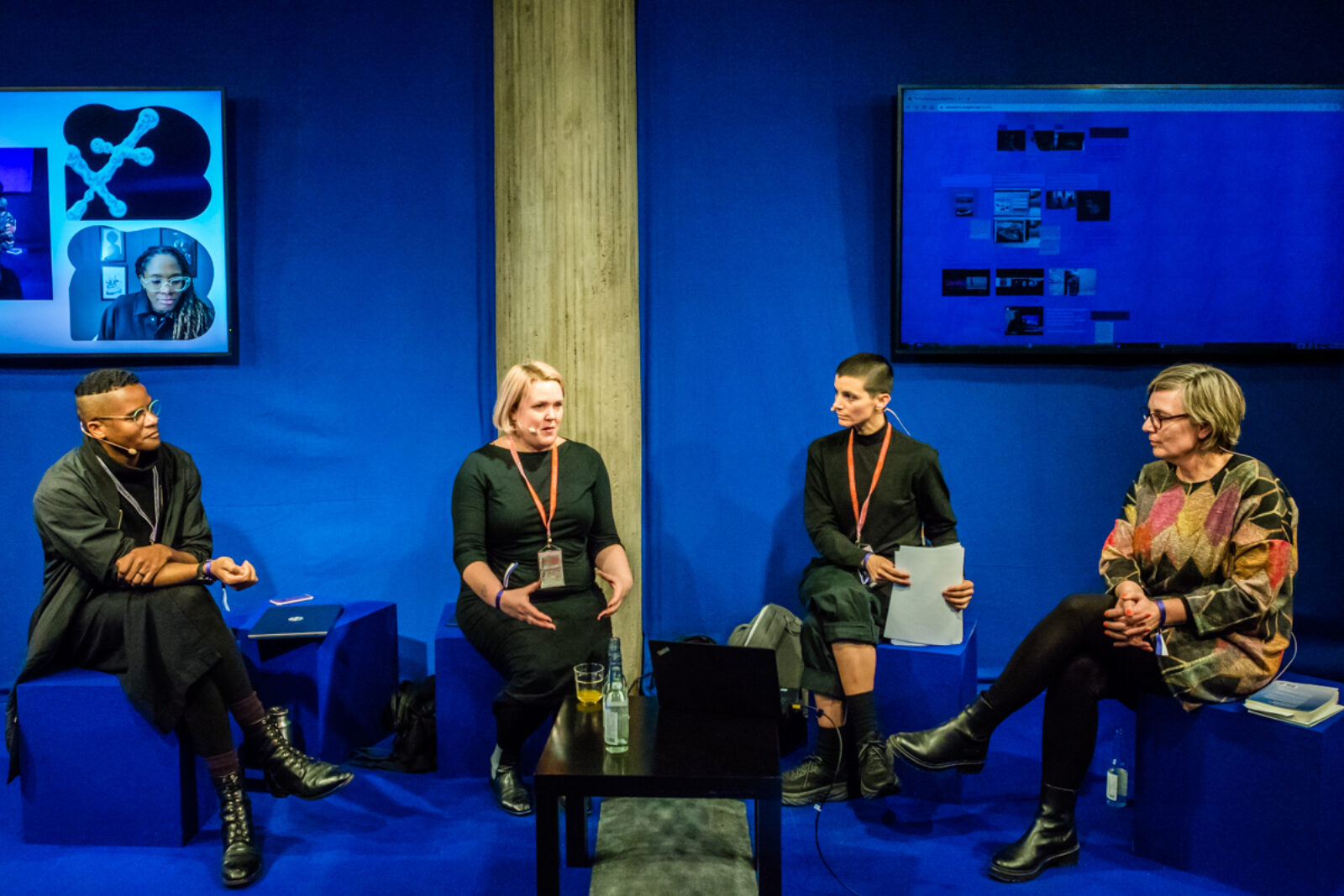
With Femke Snelting, Georgina Voss, Irene Fubara-Manuel, Jara Rocha
Moderated by
Romi Ron Morrison
02.02.202317:30 Akademie der Künste / Hanseatenweg / Club Room
Volumetric
technologies are increasingly sought after commodities in a wide range
of contexts from entertainment to city planning to military
surveillance. Rendering a reality of their own, instead of the one's
captured, volumetric technologies reflect a nested regime of
representations, truths, and ideologies, producing an affective
computational sublime. Hidden inside glossy renders and visual effects,
these representations proliferate explicit politics, taking up space,
volume and depth, minimising difference and the modes of representation.
In
this conversation, Femke Snelting, Georgina Voss, Irene Fubara-Manuel,
and Jara Rocha, with moderator Romi Ron Morrison, discuss the problems
and promises of volumetric technologies and their seamless movement
between entertainment, shopping, ikea catalogues, smart borders, and
wildlife preservation. Unpacking the affects of the computational
sublime, their conversation aims to bring bodies and data points and
spaces back into relation with each other.
"Volumetric Regimes makes an essential contribution to the ways
in which we must rethink matter politically and ecologically. As the
book unfolds, ontological questions of intensities, dimensions, and
substance are denaturalised as mere properties of matter that can be
measured, modified, and thus computed, which today are exemplified by 3D
modelling and parametric design, but are shown to be part of
processional life-worlds that relational and mutually informed and
informing. Not the partitioning of bodies, particles, datapoints, and
spaces as techno-capital and techno-science would have it but a material
enmeshment that brings the volumetric into presence otherwise." – Susan Schuppli
“This radical multi-form collective investigation traces the
cutting edge of how bodies and subjects are rendered technologically. It
proposes multi-dimensional forms of intervention, and claims an
experimental horizon of the possible, shattering the mantra of
unavoidability.” — Olga Goriunova
To download the pdf and/or order a paper copy on-line:
Six years of trans*feminist disobedient action-research on 3D
technologies, paradigms and procedures culminated in Volumetric Regimes:
Material Cultures of Quantified Presence (Open Humanities Press 2022,
DATA-browser series, eds. Geoff Cox and Joasia Krysa). Compiled by Possible Bodies
(Femke Snelting and Jara Rocha), the publication brings together
diverse materials on the political, aesthetic, computational and
relational regimes in which volumes are calculated. The book foregrounds
technological practices that invite widenings of what is possible. With
contributions by Sophie Boiron, Maria Dada, Pierre Huyghebaert, Phil
Langley, Nicolas Malevé, Romi Ron Morrison, Simone C. Niquille, Helen V.
Pritchard, Jara Rocha, Sina Seifee, Femke Snelting and Kym Ward.
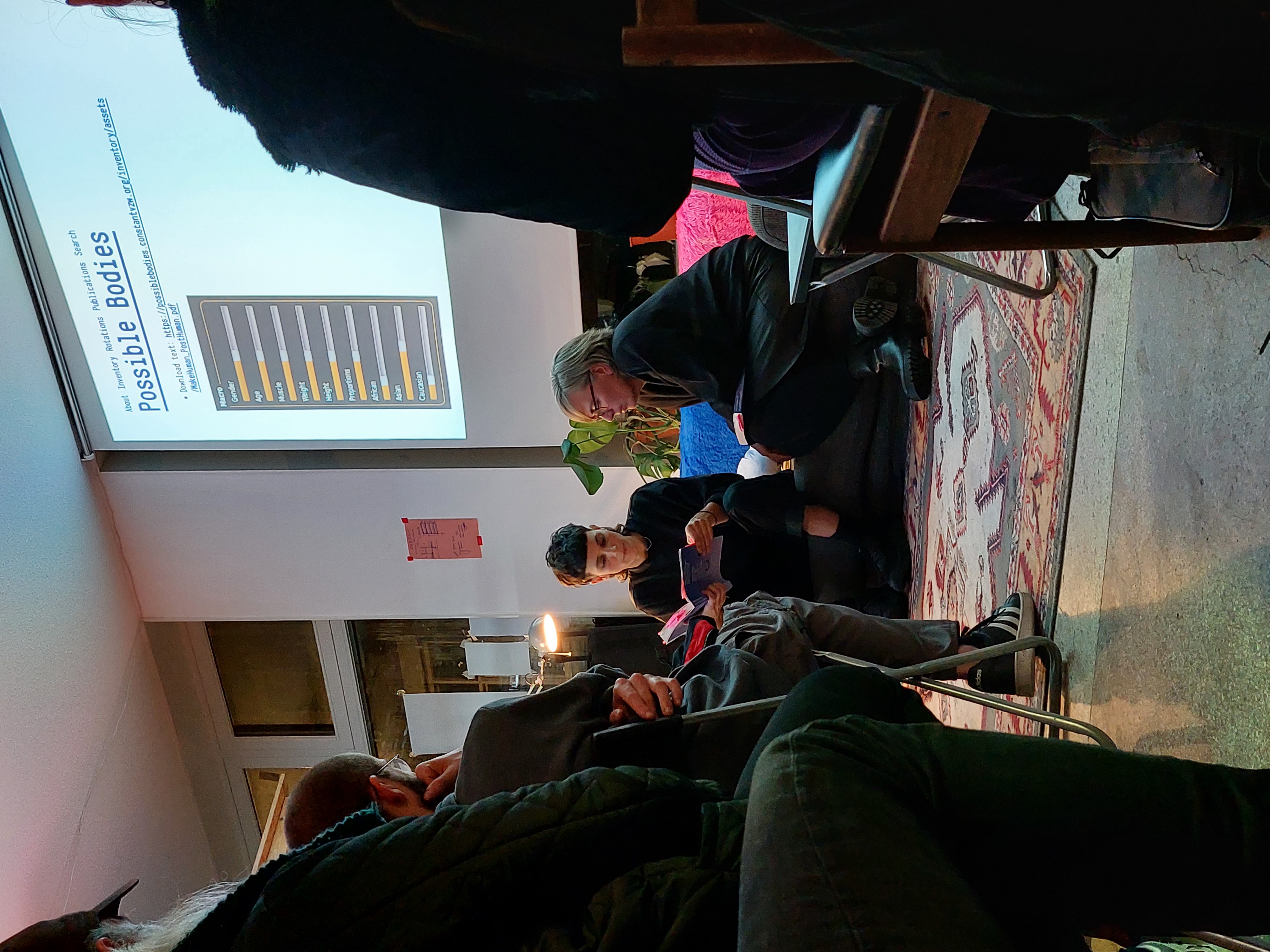
The event at Varia celebrates the wiki-to-print paper edition
designed and developed by Manetta Berends. It is a special moment in an
ongoing multi-local launch, made up of playful contributions, informal
responses and interactive formats proposed by comrades in the making of
technosciences otherwise.
The evening starts with a performative introduction by the editors,
followed by an intervention by designer, artist and researcher Alex Zakkas in conversation with Manetta Berends.
Books will be sold at the event at a reduced price.
All materials have also been published on a dedicated wiki: https://volumetricregimes.xyz/
Volumetric Regimes is produced with support from London South Bank University and Liverpool John Moores University.
(pic by Varia https://varia.zone/archive/2022-10-04-Volumetric-Regimes-booklaunch/)
Ada Lovelace Day feat. Possible Bodies (Femke Snelting, Jara Rocha)
Sábado, 9 de octubre de 16:00 a 21:00h
[ENG]
What
is going on with 3D!? This question, both modest and enormous,
triggered six years of trans*feminist research that are about to be
published as "Volumetric Regimes: Material Cultures of Quantified
Presence" (Possible Bodies, Eds.; forthcoming at Open Humanities Press).
The research trajectory was provoked by an intuitive but collective
concern about the way 3D computing quite routinely seems to render
racist, sexist, ableist, speciest and ageist worlds. Asking about what
is up with 3D is especially urgent when observing its application in
border-patrol devices, for climate prediction modeling, in advanced
biomedical imaging or throughout the gamify-all approach of overarching
industries, from education to logistics.
Trans*feminist
research (including feminist technosciences) is neither busy with the
celebration of the merits of so-called women* nor with the reproduction of binary categorizations.It is
rather about radical interdependence, mutual affection and solidary
transdisciplinarity. For this edition of Ada Lovelace Day we therefore
invited a gang of local thinkers-doers to respond to, re-interpret,
critique, remix and problematize materials from "Volumetric Regimes:
Material Cultures of Quantified Presence". The event proposes a
spacetime of intimacy with the project and its publication, as read
through the specific sensibilities of known and unknown comrades in the
making of technosciences otherwise. It will include playful
contributions, informal responses and interactive formats proposed by Carmen Romero Bachiller, Marta Echaves, Blanca Pujals and Alejandra López Gabrielidis.
*"Ada
Lovelace Day (ALD) is an international celebration of the achievements
of women in science, technology, engineering and maths (STEM). It aims
to increase the profile of women in STEM and, in doing so, create new
role models who will encourage more girls into STEM careers and support
women already working in STEM."
¿Qué está pasando con el 3D? Esta pregunta, tan modesta como enorme,
desencadenó seis años de una investigación trans*feminista que están a
punto de publicarse como "Volumetric Regimes: Material Cultures of
Quantified Presence" (Possible Bodies, Eds.; de próxima aparición en
Open Humanities Press). La trayectoria de la investigación fue provocada
por una preocupación intuitiva pero colectiva sobre el modo en que la
computación en 3D parece presentar y representar de forma rutinaria
mundos racistas, sexistas, capacitistas, especistas y edadistas.
Preguntarse qué pasa con el 3D es especialmente urgente cuando se
observa su aplicación en dispositivos de patrullaje fronterizo, para el
modelado de predicciones climáticas, en la obtención de imágenes
biomédicas avanzadas o en todo el enfoque de gamificación de los
procesos industriales en general, aplicado desde la educación hasta la
logística.
La investigación trans*feminista (incluidas las tecnociencias
feministas) no se ocupa de celebrar los méritos de las llamadas mujeres*
ni de reproducir las categorizaciones binarias. Por ello, en
esta edición del Ada Lovelace Day se ha invitado a un grupo de
pensadoras locales a responder, reinterpretar, criticar, remezclar y
problematizar los materiales de esta publicación. El evento plantea un espacio-tiempo de intimidad con el proyecto y su publicación, que será leída a
través de las sensibilidades específicas de compañeras conocidas y por
conocer en el hacer de las tecnociencias de otra manera. Así, contará con aportaciones experimentales, respuestas informales y formatos interactivos de Marta Echaves, investigadora y comisaria independiente; Alejandra López Gabrielidis, filósofa especializada en arte y tecnologías digitales; la arquitecta, investigadora espacial y escritora Blanca Pujals, y Carmen Romero Bachiller, doctora en Sociología y profesora en la UCM. Cada una de ellas mantendrá un debate posterior con les comisaries, Jara Rocha y Femke Snelting.
La publicación“Volumetric Regimes: Material Cultures of Quantified Presence”surge de Possible Bodies, un proyecto colaborativo sobre la intersección entre la investigación artística y académica
que se inició en 2016 para explorar las entidades concretas, y al mismo
tiempo complejas y ficticias, de los llamados "cuerpos" en el contexto
de la computación 3D. La investigación se centra en las genealogías de cómo los cuerpos y las tecnologías se han constituido mutuamente.La publicación reúne
diversos materiales de una conversación en curso entre artistas,
desarrolladores de software y teóricos que trabajan con técnicas y
tecnologías para detectar, rastrear, imprimir, modelar y renderizar
volúmenes.
ADA LOVELACE DAY
Reconocida como la primera programadora de la historia,Ada Augusta Byron King dedujo
la capacidad de los ordenadores para ir más allá de los simples
cálculos de números, lo que conocemos en la actualidad como “software”. El
Día de Ada Lovelace (ALD) es una celebración internacional de los
logros de las mujeres en ciencia, tecnología, ingeniería y matemáticas
(STEM). Su objetivo es aumentar el perfil de las mujeres en
STEM y, al hacerlo, crear nuevos modelos que animen a más niñas a seguir
estas carreras y apoyar a las mujeres que ya trabajan en estos campos.
Registro en vídeo del evento completo (a cargo de Raúl):
Programa
16:00 Bienvenida y contextualización Volumetric Regimes (Jara Rocha + Femke Snelting)
16:30 Intervención de Alejandra López Gabrielidis
17:30 Intervención de Carmen Romero Bachiller
18:30 Descanso
19:00 Intervención de Marta Echaves
20:00 Intervención de Blanca Pujals
21:00 Fin
On Wednesday 24th of June Hackers & Designers will launch their online platform, a website dedicated to publishing works from the BodyBuilding exhibition commissioned by Tetem. BodyBuilding was a process-driven exhibition curated by H&D, with the aim to investigate the intersection of technology and the agency of the (human, post-human, non-human) body from a maker's perspective. The physical and interactive structure, through which visitors were able to move, view, experience, and interact with the different artworks was on view only for a short duration due to the outbreak of COVID-19.
Join us on 24 June at 19.30 on the self-built streaming platform by H&D for a conversation with The Underground Division (Helen Pritchard, Femke Snelting and Jara Rocha) about their work ROCK REPO - questioning inhuman materialities and how they matter [in] the world, the crushing exploitations and extractions of normative 3D processes of geocomputation, and the act of translating between the 'physical' and the 'digital'. In addition to our conversations, we'll also listen together to a sound recording of 'Ultrasonic dreams of aclinical renderings' by The Underground Division and have a talk by Anja Groten on the notion of the platform and platformization. The audience will be able to join in the conversation via the chat.
With this website launch, and accompanying online event, H&D aims to translate the physical installation at Tetem into a digital space, taking the occasion to discuss digital platforms and hosting initiatives that currently gain a lot of attention. The event will pay attention to self-hosted video streaming and live video chat possibilities, as well as less conventional formats for online encounter, and invites the audience to join the discussion about the importance of challenging proprietary, commercial platforms such as Zoom, Teams and Google Hangouts that exploitat users' reliances on communication infrastructures in times of crisis.
As the so-called earth spun before us, the universalist geologic commons emerged.A particular regime embedded within the software that imbues the histories of colonial earth-writing and a geologics in
which “[e]xtractable matter must be both passive (awaiting extraction
and possessing of properties) and able to be activated through the
mastery of white men.”
In these scenes of turbocapitalism, the making present of fossil fuels
and metals as waiting for extraction heavily depend on software tools,
such as Gplates, for handling, interpreting and 3-D visualization
of geological data. These entangled softwares form an infrastructural
complex of mining and measuring. Such tools belong to what we refer to
as “the contemporary regime of volumetrics,” meaning the
enviro-socio-technical politics––a computational aesthetics––that emerge
with the measurement of volumes and generation of 3-D objects. A regime
full of bugs. We Have Always Been Geohackers, To be published in: How to Relate, UdK (Universität der Künste), Berlin [forthcoming]
The Underground Division (Helen Pritchard, Femke Snelting, and Jara Rocha) contributes to BodyBuilding, an exhibition curated by Hackers & Designers @ Tetem, Enschede. Opening 20 February 2020.
Change detection based on LiDAR data. In: Hutchinson, D. Jean,
Matthew Lato, Dave Gauthier, Ryan Kromer, Matthew Ondercin, Megan van
Veen, and Rob Harrap. “Applications of remote sensing techniques to
managing rock slope instability risk.” In Canadian Geotechnical Conference, Quebec City, pp. 20-23. 2015.
ROCK REPO
The ROCK REPO is a device built by a team of trans*feminist
post-normal scientists for thinking with rock. Managing rock slope
instabilities by LiDAR, optimising strata modelling for fracking,
rendering cavities in 3D for gaming, and algorithmically smoothed rock
shaders are all deposited in the REPO. The REPO inquires into these
banal, exquisite, kitsch, static, carbonivourous figurations to fracture
the normative 3D processes of geocomputation and their crushing
exploitations and extractions.
Through making a collection of ROCKS, The Underground Division
gets close to particular ROCKS and their unstable stories, as told
through scientific and technological practice. Recognising that rocks
have their own lively forces, the unruly team studies rocks’ 3D
imaginings, the softwares and hardwares that rocks intervene on and
builds new glossaries on the go. Their studies operate as a chipping
away at what limits the resistant and destructive capacities of
rocks.The ROCK REPO device crosscuts with rocks as ‘bodies’ in a
purposeful move away from the somatic corporealities of individual
humans. This shift allows the team to ask about inhuman materialities
and how they matter [in] the world.
The REPO is an inquiry into what ROCK is, what it could be and the
ways in which ROCK is seen or considered as an entity separate from its
environment. It works with the ‘deep implicancies’* of this moving
between figure and ground, asking what happens as result of this cut,
and what other formations could appear. Sharpened by queer and
anticolonial sensibilities, investigates the way ROCKS are quarried,
measured, quantified, historicized, visualized, predicted, classified,
modelled. The REPO as an instrument itself crystallizes other stories of
spatial and temporal geologic processes and throws rocks through the
glaciated windows of turbocapitalism.
* A term Denise Fereira Da Silva and Arjuna Neuman borrow from
forensic genetics to talk about implications and entanglement in a
non-linear way.
Also contributing: Kiki Mager and Nazanin Karimi. In collaboration with architect and designer Thomas Rustemeyer, H&D
has developed an interactive exhibition structure which will host the
works and invite you to actively participate in the (de) constructing
the works.
Bringing together researchers, artists and theorists
to investigate the implications and possibilities of volumetric
imaginaries of environments.
Building up or digging down, simulating
more-than-human bodies, imagining new and fantastical volumes or
managing resources, volumetrics are continuously figuring and refiguring
life and living. From the fossil fuel industry to the so-called
creative industries, computational practices are being deployed to
imagine and materialise new volumes to exploit and inhabit.
Computational arts practices such as 3D Scanning, Rendering and
Animation, Augmented Reality and Virtual Reality have been a significant
agent in shaping this volumetric turn. Consequently these new
volumetric practices are in relentless dialogue with both the
calculation and measurement of environments and the extraction and
entertainment industries. This event seeks to explore critical
volumetric practices capable of generating new political and affective
ecologies and challenging dominant forms of geopolitical and industrial
volumetric power.
With this in mind, Volumetric Ecologies brings together
researchers, artists and theorists to investigate the implications and
possibilities of volumetric imaginaries of environments. As part of the
volumetric turn we explore more-than-human immersive technologies and
the ways in which they figure environments across an expanded field of
practice. The workshop will critically reflect on the agency of
computational arts practices as a significant force in shaping the
volumetric turn. The evening keynote by Deborah Levitt will explore how
the world-building capacities of animation and VR technologies bring
into being new forms of cosmotechnics. This two-day explorative forum
presents a diversity of perspectives and practices which reimagine and
recast the constructs of environment, bodies and mediated worlds through
the articulation of volumetric practices.
Hosted by ICE, Computational Arts at Goldsmiths, and in
partnership with the Vasari Research Centre for Art and Technology at
Birkbeck, University of London. Organised by Helen Pritchard, Rachel
Falconer and Joel McKim.
Friday June 14
11.00am - 1.00pm | Volumetric Demo open to public | VR Lab
1.00pm - 5.00pm | Workshop | VR Lab
Demo and research workshop providing an opportunity to engage
with current practice and research across the volumetric field.
Including work by artists and practitioners Nishat Awan, Marta Di
Francesco, Clareese Hill, Hyperbation, Hyphen-Labs, Maggie Roberts aka
mer, Possible Bodies: The Underground Division (Jara Rocha, Helen
Pritchard and Femke Snelting), Jane Prophet and more tba.
With responses from Maria Dada, Claudia Dutson, Rebecca Coleman,
Federico Fasce, Deborah Levitt, Joel McKim, Shela Sheikh, Chaired by
Rachel Falconer.
Taking as its starting point a
framing of optimization and its miscontents, this one day-long workshop
takes a deep dive into the technologies and applications underlying
optimization logic. Participants examine artworks and scholarly projects
that attempt to gauge and broaden our conception and understanding of
optimization systems, and offer techniques to expand our political
agency under these circumstances. Through these counter-political
strategies, participants situate our relationship with these systems and
explore the means at our disposal—be they subversion, queering,
resistance, or militancy—for engagement within and outside of the
optimization regime.
Participating contributors: Ramon Amaro, Dia Kayyali, Dmytri Kleiner,
Ben Miller, Phoebe V. Moore, Conrad Moriarty-Cole, Rebekah Overdorf,
Martin Pasek, Helen Pritchard, Jara Rocha, Clemens Schöll, Femke
Snelting
+++++++++++++++++++++++++++++++++++++++++++
Case: Panoramic Unknowns
Proposed by: Possible Bodies (Jara Rocha, Femke Snelting)
Unknown Object Tracking [1] is being applied on an industrial scale in robotics, car traffic control and 'intelligent' surveillance systems; think Amazon warehouses and Google street view. This technique employs panoramic cameras, which provide 360-degree views that are processed by specialised software in order to locate volumes in space. But when surveying areas like factories, big halls, streets or even a single room, there are always many 'blind spots' and 'unknown objects'. Machine Learning is currently being employed to optimize such known unknowns.
Possible Bodies [2] is a collaborative research on the very concrete and at the same time complex and fictional entities that "bodies" are, asking what matter-cultural conditions of possibility render them volumetrically present. For Optimization and its miscontents we invite participants to use their political/aesthetic/technical sensibilities towards the computation of volumetrics. We invite you to attend to Unknown Object Tracking [UOT] as a spacetime mattering that is not necessarily organized from the outside to the inside (as the optimised god-like sight) but from the inside-out, somehow both adjusting to and reversing a 3D paradigm of convergence into a "point of origin".
The seamlessness that a 360 capture demands is based on the analysis of tiny 'features' that are sophisticatedly attended to by Computer Vision agencies. Features are differences, anomalies, visual anchors, identifiers that are considered to be specific for a single capture.
UOT depends on processing past data and simulations that are kept, learned and trained before being projected into the future, while real time data from the camera is used to adapt to changes. Their predictive claim is based on past measurements that make optimization systems vulnerable to unexpected change and/or wild surprises, as the unknown can only be detected if it falls within the boundaries of the probable. Where is the possible in considering panoramic unknowns? What if we consider the unknown not only as risky but fundamental to an orchestation of spacetime that is not necessarily harmonic and predictable, but also dissonant and accidented?
The contemporary
infrastructural complex of mining and measuring soil depends on software
tools for geological data handling, interpretation, and
3D-vizualisation. Such tools power techno-colonial subsurface
exploration with computational techniques and paradigms. Possible
Bodies (Jara Rocha, Femke Snelting, and featuring Helen Pritchard)
invites you to collectively study open source tools for geo-modelling
while attending to the different regimes they operate within. It will
inject resistant vocabularies, misuses and/or f(r)ictions that could
affect the extractivist bias embedded in the computation of earth’s
depths and densities. The workshop is a trans*feminist experiment and an
act of affirmative responsibility-taking for this turbocapitalist
momentum. Possible Bodies is a collaborative research, interrogating the
concrete and, at the same time, the fictional entities of “bodies” in
the context of 3D-tracking, -modelling, -rendering and -scanning.
La semana que viene, en el precioso espacio de Azala (Lasierra, Vitoria), Femke y yo trabajaremos en una película que aún no tiene título. Sí sabemos que
tratará sobre las condiciones materiales y culturales de la computación
contemporánea de los volúmenes corporales: tomografía por ordenador,
procesamiento de geodatos y modelado de criaturas en 3D. A través de una
lectura trans*feminista de software cotidiano y más especializado, su
arquitectura, vocabulario e interfaces, la película rastreará las formas
probables en que el tiempo y la temporalidad (legados, proyecciones,
duraciones, mediciones...) operan en la computación. Difractará este vector para permitir que aparezcan otros posibles. Las
imágenes se renderizarán computacionalmente (sin lente). El sonido
también puede seguir las mismas condiciones.
In Posthumanist Performativity: Toward an Understanding of How Matter Comes to Matter, feminist theorist Karen Barad examines how apparatuses stabilize and destabilize boundaries. “Apparatuses
are dynamic (re)configurings of the world, specific agential
practices/intra-actions/performances through which specific exclusionary
boundaries are enacted.” she writes.
As an ‘external guest’
invited into the research center from January until April 2018, I would
like to turn Barad’s parental advisory into an invitation to
experiment, speculate and reflect on the intra-actions through which in-
and exclusionary boundaries are performed in a.pass itself.
Boundaries do not sit still
follows from a long interest in the interdependent relations between
technology and practice, resulting in a series of projects and questions
that have been invited into dialogue with a.pass at several occasions.
How
do digital tools and artistic research co-construct each other? How are
gestures, discourses and behaviours shaped, oriented, communicated and
defined through the (digital) apparatuses at work? How is research
articulated and in what way are its boundaries enacted through software,
infrastructures and devices?
These questions will be addressed in mentorings, informal meetings within/around a.pass and in research activities related to The Possible Bodies inventory. In addition, I will host five Monday Readings (with Martino Morandi, Seda Guerses and Sina Seifee).
*
At the start of 2018, Possible Bodies is one-and-a-half year
under-way. It will have had rotations in an art institution in
Stuttgart (Schloss Solitude), a technology-oriented centre for arts
production and research (Hangar) and a design college (Bau) in
Barcelona. From January onward, we open up the inventory in and to
a.pass as a resource to be reworked, annotated, appropriated and
expanded. Possible Bodies changes rhythm in order to prepare a fourth rotation in the fall that might take the shape of a publication.
The presence of the Possible Bodies
inventory, its methodologies and some of its agents at a.pass can
hopefully allow further inquiries into the tensions between ‘probable’
and ‘possible’. As an object of study, we will for example be exploring
the workings and worldings of Slicer, an open source software platform
for medical image informatics, image processing, and three-dimensional
visualization. The software ecology of Slicer interests us because it
allows us to explore processes of articulation, dissection, separation,
segmentation, segregation and difference.
Este verano, el Inventario de Possible Bodies rota hacia Hangar para
una residencia de dos semanas. Esta investigación bienal opera a lo
largo de un inventario que contiene piezas artísticas, scripts,
documentación, manuales, visitas guiadas, interfaces, vocabularios,
performances, software – demos, herramientas, objetos físicos,
animaciones, conceptos matemáticos, juegos, renders, etc. Esta colección
móvil es un contexto para prestar atención a los dispositivos
dimensionales, notacionales, escalables y organizativos que hacen que
los “llamados cuerpos” aparezcan y se co – relacionen.
La segunda rotación se centra en la imagen biomédica 3D y cómo en
torno a ella se modelan, escanean y representan los “cuerpos reales”. A
PossibleBodies le preocupa la forma en que las industrias
farmacopornográficas, hollywoodianas y militares confunden técnicas y
tecnologías. En este paisaje tecnocolonial y heteropatriarcal, violentas
representaciones capacitistas, antropocéntricas, misóginas y xenófobas
siguen emergiendo. En una serie de fanzines, se van a mutar rendiciones
de cuentas ficticias de proyectos reales de código abierto como
3D-Slicer, ITK y echOpen con trabajos teóricos de sensibilidad
transfeminista. Queremos preguntarnos: ¿cómo la imagen biomédica, tanto
en contextos industriales como DIWO, compone, desplaza y segmenta a los
“cuerpos”?
Del 20 al 30 de julio, Possible Bodies trabajará
desde Hangar, on y offline, con Mercé Ardévol, Ona Bros, Sara Lafuente,
Max Lehner, Nicolas Malevé, Peter Westenberg, Kym Ward y otras
compañías, estirando y editando el inventario en una serie de fanzines
que serán publicados en la web de Hangar y también distribuidos
físicamente tras la residencia.
Si te interesa acercarte, estaremos en
La Plaza todos los días. Estás invitada a visitar físicamente el
inventario y sumarte al proceso de inventariado. Para dar con nosotras,
escribe a [jara at riseup dot net].
El jueves 27 de julio a las 17:00 y a las 18:00,
Jara Rocha y Femke Snelting harán visitas guiadas a través de los ítems y
discutirán algunos asuntos clave del proyecto. El primer tour explorará
críticamente varias técnicas de imaginación biomédica; el segundo (en
colaboración con Kym ward) usará la noción de “Circluding” como un
dispositivo de (des)orientación. Esta actividad es abierta al público, y
la entrada es gratuita.
“Possible Bodies Rotation I: Collective Inventorying” tuvo lugar en
mayo de 2017 en la Akademie Schloss Solitude / Projektraum Römerstraße,
Stuttgart y reunió a performers de software, artistas en bruto,
desarrolladoras somáticas, activistas sensibles y académicas
desobedientes.
Following Sara Ahmed’s invitation “to think how queer politics might involve disorientation, without legislating disorientation as a politics”, the collective enquiry Possible Bodies research team inventoried three items related to 3D artifacts, following through the implications of the contemporary renderings of “dis-orientation” they invoke. Each in their own way, the items relate to a world that is becoming oblique, where inside and outside, up and down are switching places and where new perspectives become available. They speak of the mutual constitution of technology and bodies, of matter and semiotics, of nature and culture and how orientation and the subjectivities that emerge from it are managed across the technocolonial matrix of representation in turbo-capitalism. The three items allow for a look at tools that represent, track and model “bodies” through diverse cultural means of abstraction, and eventually convoke their aftermath in a call for “disobedient action-research”.
Keywords:
3D, technology, possible bodies, disorientation, inventory
[CAST]
Continuando la invitación de Sara Ahmed a “pensar cómo las políticas queer podrían implicar desorientación, sin legislar la desorientación como una política”, el equipo de la investigación colectiva Possible Bodies inventarió tres ítems relacionados con artefactos 3D, dando seguimiento a las implicaciones que las actualizaciones contemporáneas de “des-orientación” puedan invocar. Cada uno a su modo, los items están en relación con un mundo que está deviniendo oblicuo, donde dentro y fuera o arriba y abajo están cambiando posiciones, y donde nuevas perspectivas se hacen disponibles. Hablan de la mutua constitución de cuerpos y tecnologías, materia y semiótica, naturaleza y cultura; y de cómo la orientación y las subjectividades que de ahí emergen están
gestionadas por medio de la matriz de representación tecnocolonial en el turbocapitalismo. Los tres ítems permiten observar herramientas que representan, monitorizan y modelan “cuerpos”a través de diversos medios culturales de abstracción, y eventualmente convocan sus consecuencias en una llamada a la “investigación-acción desobediente”.
The current distance between those who organize their activism to
develop “technical infrastructures” and those who bring their struggles
becomes especially evident in the pragmatic spirit of getting things
done. "Radical" activists may turn to services provided by Fortune 500
companies, while alternative tech initiatives sustained by a select
(visionary and male) few may remain insistent on crypto with 9-lives.
Through a close study of digital self-defense campaign sites, we want to
pause to explore other modes of collaboration.









![[proyecto] Altas latencias](https://blogger.googleusercontent.com/img/a/AVvXsEiBpD8AFlYRdLzeJ2Hsn_CW_e5gS2aqI95InyU5RVD32AgQq1pu7RkVfqaIVCx8HGOvz6-KsASWhMiTRiAOeMFuq_5CdJ4oBpbugFCz27q4naB5GwKSI6367EAzmdV7gwMJ3bsY49giAjtGaszVwN6XK8Jt9TGRgsuh4UAGYJiG6-BT5M8TUcuqDBvoOME=s220)

![[txt] A breeding ground for uncertainties](https://blogger.googleusercontent.com/img/a/AVvXsEj8Ul_82KszibGV8b6jg9LFyWXEGE4qp6ecSy5BMMylXRoJD3M9p69kVu-AzxnSX2giXA1KXDQK0N-9PgDXC3iiwOb8gbekKC9_uczQKXOnaWH8az3En1ZSVefP22hPQWRvsUBccZEqf9CI15VXUsq8xboFMelx4l9oFikZJpvUX3xTe4mnAAeXwpDzIg0=s330)
![[Bugreport] to Frontier Climate](https://post.lurk.org/system/media_attachments/files/111/901/018/803/503/560/original/1075209e931cabe8.png)
![[zine] Ancho](https://blogger.googleusercontent.com/img/a/AVvXsEgxhMNpFpNTQs8-WPjqQ4xMJ3_BZJbszhAfiHl63dmkzEof-nuHBGdzLZzpneNz9vTWNnw4k1RBBRlY8Lku7gu3bPCmoB58oyB8p0m85z8G4vsPwQWrNDmDhPrcLyvW0SP8AVn6WTAkKi6967tUChbVAl73hP9Umq097rixVNbci22Ua_iZFxOiunVkTjE=s312)
![[radio] naturoculturas son disturbios](https://blogger.googleusercontent.com/img/b/R29vZ2xl/AVvXsEh1vf5WGEHGsX7aYwBLxMSY5_yPI3DzKWwCdqAOOIDKz0yFkISa81hx2ljEMCPPb6bRtYCCtoOb89SdCQET4P_BJoQeYy5990dZ2FmiqJL_Sb_ROngQphHGA9wnu3rIZyUkI7LPLNDqRXE/s220/tapiz.jpg)
![[Journal] La composición activa de la presencia](https://blogger.googleusercontent.com/img/a/AVvXsEgWJBnXgfCm300uKPAr-n4sEqPCBHxy2Hxheu2bFuYCl0IgeJCmJ_7U6SwP01cDamYTfgGpbMtgeSS6KtRm5j85_bclhQ4wn7f8DfSKu7C3_AM87wNHhELUwQ_VXIemDotxFy_h2kiZuqa1h2vLKHeMUALEg63BeR_dbpHh4Y7DEfZgKekOA0eCxPT_lJk=s320)
![[fellowship] LaaS (Life as a Service)](https://blogger.googleusercontent.com/img/a/AVvXsEijogwX9jgADqQ9A00tu8fCFaF8ARU8Sq0EXI0Z_PBE8M-SVpgMWAUiHJjw4-QwLjz-KCQlOgyvJNwpvBLe41Gr7xN0xlWzvyrGxZg9mUIH9-q3xEF51MSk6UnyUkD--ZptqoMcp7XSlgD8wV5MVeUaN8o7X34SnScuLZ4C76XyW6U8JDneHWrSw8vZ=s220)


![[associate membership] TITiPI](https://blogger.googleusercontent.com/img/a/AVvXsEjcMlj6-I_3r2L84w6kGyECKoYCgG_clIbPgkJU643pGFonPn9P-UV_qnNI3V-pjgEVFigNgse4IABpsD7WRie8evGe1jdLZOV92rg_McRtrbSIJOTVzyUW5Xx4ITTYM3JL-d90tF-XGKpKscmUYcnrts654lnj1hVbrHZUBvKA8X5pZPXL6DIoILz9=s341)
![[escuela] Elefantes en la habitación](https://blogger.googleusercontent.com/img/a/AVvXsEgg8WMXXVVHA5uHIAlHGUstKTSRhzQEhEORdROKz8QBgLMPCtYxyNIyCnuFkFwDAoixgS1XMLDeGEtm5P0cXW3AUi6AB179S0Ei6BueXW8NXbREYnik1VICivjPvl7G2Ti597fcw2OQ38cWzV0BpfG3MijQiSAzCdVmj67HS4VIiCsQV5dLgdOubMvIGiM=s220)
![[book] Volumetric regimes: material cultures of quantified presence](https://blogger.googleusercontent.com/img/a/AVvXsEgmU-TcPBoSAK-bYjc2IS1c3j6YaoY0bAmoWeJphwdAVgJ1vRcZP_dg5Ki_GWBYPakurYUpM6XIlUGJKAKALaYhdx-sLtC-KlL3NocFIq5S3RzmuefQP1pCwpUTjJ4it_itZKmY1FLZ-GuvAE1PHWP90G9nxsDRdyPVaoyQxl6s3A0SQEeRxP5fNlcI=s332)
![[manual] Queering Damage. Methodologies for partial reparation... or not.](https://blogger.googleusercontent.com/img/b/R29vZ2xl/AVvXsEj8Q0pcpgV4ta3XRYXd7_TLrE-e8iIRW9gtbF-tRh5pKQClpqaw6qbr0dUadU7sASJ9ElOlYJwy4mPROA46dn7bGeTFwAb09LCR2yMuQOkeJUCeRUrAGKai3pPb9x7nvSaISuDx8FZlppg/s1600/QD.png)

![[project] the underground division, with Helen Pritchard & Femke Snelting](https://blogger.googleusercontent.com/img/b/R29vZ2xl/AVvXsEiP7ySE_-Ag-61vgRhsOgPJOVlvsnsupcriKB9x-nxLA_XjAYdkeYSOajqqqBnnGI82iX4wCbaDfnYfAc9lSHl0ny7ES0V1xTeJl3zW0sfLto6Ardt6AiZmYZlqizeDw98sijpGLY_K1p8/s1600/unthoughtinfrastructure.gif)

![[expo] Dorm en l'accident que provoca](https://blogger.googleusercontent.com/img/a/AVvXsEgjj7ASH7edRFh6yretcviCckrs19chm_iyuaa0PyNeRqKj6EWr5C8wRAUQXNsR0rSxSIY0-j_a0z1PfmEjabITfUBWfMwqCNKLo9Fvb65P31PtSbEiBBJ_HhiNrs1iVFZsD4LWicCfvZXM20ivsPoG2XfLBZYGBhv7Iavs2VPb0uGV2mYehjf7mzdm=s220)
![[exposición] La Irrupción](https://blogger.googleusercontent.com/img/a/AVvXsEiJnQT68iCPb08I1Bq9Cq8cGWfRLxF_cwD3tqfqovDvh1oy1L-Mj5DVkBsyBEezs9ydH0kVterKMClhihz3EkJgySfauazM8-YsPZRI2qUOQKSWKE8phvjFy5lPNqE5r60m0bbgm4eyMXVA4xktKU5hrJoQ6gBv22a7QRAhFlmFDxYQVATl6orDZ-oK=s311)
![[Fellowship] Spectral Infrastructure | Cell for digital Discomfort](https://www.bakonline.org/wp-content/uploads/2021/07/Spirit-Labour-1-web-2000x1335.jpg)

![[paper] Figurations of Timely Extraction](https://blogger.googleusercontent.com/img/b/R29vZ2xl/AVvXsEheNeBTv2n__LM26gVP5_NJsH4-vssVsRn3CspeiFnoCsUY4RmKBE1dTzYurmx73Nt5hceLv_zcORBxLnGV5AR3tJnb579NJ5194ThAdnH5itHI-e9W79rOLD5_sPpkmjjGb1RT1RVnmN0/s1600/hueco.png)
![[weft] The Relearning Series (with Martino Morandi)](https://constantvzw.org/site/local/cache-vignettes/L650xH614/arton3397-dd459.png?1609926532)

![[text] The Courier Bag Praxis of Friction](https://blogger.googleusercontent.com/img/b/R29vZ2xl/AVvXsEgBtBXr6VHozr_KsHsqSJ7_sMDHSSc0l0pD4wcrZJZzqX6IUeTjQEED64R-hg4QG0lK8RHN6J6j-BtRbsTDwI-R-5OlzwcCDYPHX_q7_yTCbgnJEqPic7LsADeclTIpqgX8SWZpdXdncKs/s1600/amz.png)
![[text] We Have Always Been Geohackers](https://blogger.googleusercontent.com/img/b/R29vZ2xl/AVvXsEg3_-X1JXUAU7D1PqsbnkyLFi1PAvVb4P9ZPszvgZkaI5q5lY4JDDPsjeBScyoev-cxl3DD9ocyeaj4ROLezLzA1RM00Ib3SGeaMUiNvnhsSOtRHVy9pK2WQ4p8gXBbDqEABMiaM6uhjzk/s1600/600px-Image04.png)
![[entrevista con Nerea Ubieto] unos corpus a través de otros](https://blogger.googleusercontent.com/img/b/R29vZ2xl/AVvXsEiUAX_3sRJEwxPRY1X9jmG1DxmZBTqhXRVHN3wcA4h_oO6HNIGt9uroK9oP9ktNm79nbj0z6Kt02SNIBynmRmAbxHJa3bWPttwiF1Iffm8azfPumTmr32-pC8bQJ1cRwFvUm5QRfYjiWrs/s1600/yaaun.hotglue.me.jpeg)
![[book] Iterations](https://blogger.googleusercontent.com/img/b/R29vZ2xl/AVvXsEg6AIPpC3jitHSZRTZUAUrI-C01YGIeyM7C7ZPDO0HQhUx0nqTOyVUdpOOJBVh66ZwBJk-Z_NLtlDZtIhB5zyj7lzi1psorzemK2pJKiRk75Z8_8K60nJcdJEz1nmUZqmTm-BId_XYjINo/s1600/iterations_img.png)
![[text] Depths and Densities: a bugged report](https://blogger.googleusercontent.com/img/b/R29vZ2xl/AVvXsEj2kAiZhHGbiApkAnVW086MP8Auew-PJjqA5m1dP0C0PQTv99laH46OO1-5K5YOzYQIYBpgG4SsC8ibvqLz2fkIBoUPi3_dL6dfOir_DosCim4oY2Tq9877vFU-6SSWLfps0rLs_v3wBCM/s1600/2.gif)
![[expo] ROCK REPO](https://blogger.googleusercontent.com/img/b/R29vZ2xl/AVvXsEjMCpx4QnmsTfWUtRNlzUOhGnEWqZozBYCPkzKG3cs29OniGUqAzXFMDp4EggGvEM1B3xDC-Kf9QFHKe2EqKL6QGLhttL6FzalmkJYo8f9_aKdnmiUf61_QMaoa7F228d5farlhzSeV1Ok/s1600/ROCKREPO.png)
![[ciclo] unsupervised imaginations](https://blogger.googleusercontent.com/img/b/R29vZ2xl/AVvXsEhjO8oPteLww8zP6OPAvLXOm4uiwvBIFJ0k9DWqK7YEfSau1A9E0RdvY0-qokscG-y_a9sgou1xkCNBSw_VvBOlsFqLbcR_HSDg7K3hRB5LqkOjTdwfaCWLsemvyyt1lttyqz3zgyuzGZY/s1600/done.png)
![[texto] O o no O](https://blogger.googleusercontent.com/img/b/R29vZ2xl/AVvXsEjW0TtZQPjFHfhxlODgGdVzgg68Ac0-ARhty2p_GLpS376bYEQzPCLV3rcfveLPHTKa5NayqjcU5tkEHR1XravZ0ELvayh3Llh-dTbLDoTzqCu2-o4_XL-x7BOorECQVHzvrAbPgArKd5I/s1600/OOO.png)

![[text] testing texting South: a political fiction](https://s-media-cache-ak0.pinimg.com/236x/ee/bb/77/eebb777b79c372e431f8f01a9f8c417e.jpg)

![[texto] connivencia km 0](https://a-desk.org/wp-content/uploads/2019/02/yCNQVn7-595x356.jpg)
![[texto] tendido topológico de opacidad](https://lh3.googleusercontent.com/blogger_img_proxy/AEn0k_tvItJzpOzcNhOL-l_jbS9WINtgNxUXF3CFlYe0aQGkggkS64hIv7coR7izRRjVl4Tvwqrlv_ryD8Q7AncfKtt5mfGEgM0ZQ0P1WhG2roJg7zolD5kRn5C14x8zsbctxDx9AvBFWqzIKzErsTmzsY2bgZeiNWWb1icbiNcaOh-I9w=s0-d)

![[workshop] queering damage: methodologies for partial reparations... or not](https://hangar.org/webnou/wp-content/uploads/2018/09/fotoactivitat-448x197.jpeg)
![[text] ultrasonic dreams of aclinical renderings](https://blogger.googleusercontent.com/img/b/R29vZ2xl/AVvXsEgQ0Hyf8egbRwVzEbocuGIrXelXCAPHtrkb_7qMB6MbJQpI-ImX-BnGi1Gz6BBmBUJ6ikF14F0XEdxaRvoPF8fpfA_zK2nzYx3o4fhQ_6AxTaJvn_ONeJ7kO54Ht23J4coCzwb9VNhJ7lo/s1600/ada.png)
![[text] la Caníbal Mondothèque](https://blogger.googleusercontent.com/img/b/R29vZ2xl/AVvXsEgSPEAotBhGULLOoGt7ah32WUd5Uhq7OFyBOu0HMmhi_vXY1YhVzPzfhS6z-Q9xoAUayFSZ1T875S6PzU7hLfQuqpFSffkWSElVxere3sOffMK6uJVCu6rtwjcMF7VSL8IHMqewLUaRARw/s1600/sss.png)
![[taller] Signos de desorden clandestino en la multitud uniformada y codificada](https://blogger.googleusercontent.com/img/b/R29vZ2xl/AVvXsEh2NuAewDFzlY_WN91ef8C-irr-DsGHBdEOhztzIwEqDxv-BFgccpIu7wCcZQXrhqhc6eQJBaYLJwEWSxCpoDu4WSGYO6RP2oJDte-QD2B6xGpWy5_HHAj_na47Qr4JM2x99u_CErHbcgY/s1600/signos+de+desorden.png)
![[book scanner] hackthebiblio](https://blogger.googleusercontent.com/img/b/R29vZ2xl/AVvXsEhWvEJ8bLbWXegmJmJjy0IvTFE4zHz-PQXgbVtK3YexrUu0dGq1dvhuzekD6YgOcBDJqjJiZveoMSo9EwTJAZvNK1BZXwEvnSmzPk3v-8xuJyUxgTdyjFnLSQe-AZSS7kxnFzCsoM6my74/s1600/marron.png)


![[installation] somatopologies](https://lh3.googleusercontent.com/blogger_img_proxy/AEn0k_ub13FXd25MlCjWOU7Q_JhMwRRjuHVZ3t7jgwG7pdW6VhBq-iPpfvDoMmrho9qdMQvLlrzelubPHE9Mesr1uKMyuTGieGyEIY3fvfRY0W4oJV-T_vmNWxfC1P40u6RJZGHv3XavOzf7MvZhWo-aiTxPoEffOIO6RZv1n4CX5LPEaeE=s0-d)
![[workshop] ageing companions](https://blogger.googleusercontent.com/img/b/R29vZ2xl/AVvXsEgLEng19oM7Z1ABKaMNTvuNjr70o1HJvJtwCcBNQw-mN2p-j6LmAqGufemrhR2Bo_vca7ps4MYHDxpVfpbMpy3kH2pgjyrN-qal4iSVOMZBquhe2Yr3c0Qj_mWNiCAPBtceZwOQqLjwGSM/s1600/ageing+companions.png)
![[curso] ya aún (con Laura Benítez)](https://blogger.googleusercontent.com/img/b/R29vZ2xl/AVvXsEj5BUUemTv0dcKlSWxoe-95jPAn8EwoM_w0sxSEqGr2sxMN1WWY61oAFm3rkmZj-PynKmvxFGr0mu7IKZpa_mYb1AdlQoaKLXUhkTYlNXrNy-A2Zbf274hmC4iCs9pzCYl8D80VyIxTgD8/s1600/yaaun.png)
![[text] MakeHuman @ posthuman glossary](https://blogger.googleusercontent.com/img/b/R29vZ2xl/AVvXsEjAxY9qjS-hUJzSbUY4EvX-FZ6gRgbrXq0ehjWtRXZnjJvN8HEfQq1-RG8Fi-5-9JCK9DG6SNi_iod-ARLMAHWpgL9XdQFISHjvahpFJhn6dxFKMuVovjuMICweTAJV0tApChjht-ZXCVE/s1600/posthuman+gloss.jpg)
![[taller] Las promesas de los algos: una visión inapropiada/ble (con Nicolas Malevé)](https://hangar.org/webnou/wp-content/uploads/2018/01/tensorflow-448x298.jpg)
![[text] dis-orientation and its aftermath](https://media.giphy.com/media/L35lnVzYLgHFS/giphy.gif)
![[artwork] UKI, a viral game (with Shu Lea Cheang)](https://lh3.googleusercontent.com/blogger_img_proxy/AEn0k_sm5v-oaOL9c1O8zWenL_Og8jogiJ2rFce7ngmPTsbMRy1wRkM3PoOAwevvXirQttiANc7lcIGFHA6Z4itZLD-XLSdlR3Ubq_yjq4zH9FtdnTTAHPJg60wjbf-2gq6FhGKrqiJTAgQPNpOjBZp1ZQNjmW30AZ4C=s0-d)
![[curso] fonaments del disseny](https://blogger.googleusercontent.com/img/b/R29vZ2xl/AVvXsEgD02few_onlQayFaMENECRZYVjbfJ-1BivdgWn_PntkkwCCG8jUGdswJyugFctCcFRBB3lwSXUZotFCc5EnxqfxSKywMrdfAVfBXvPsb7vcdIdr2RUowODsgri4EReXMudK_3IAStF_3w/s1600/fonaments3.jpg)
![[revista] L/EN/G/U/A/J/E/o](https://blogger.googleusercontent.com/img/b/R29vZ2xl/AVvXsEgdBBru_p5K4zK77CmgtRcK2hLubFw46lHgQqqXqJoMuEeIDJr1933trw0vcve7q3b9Mhjy96nYQDPxWYddDZ60RbtwCZcUoIYJq_F7WWd9xsnfoqhXgyZNquQLkFNbsbz7dDJoaXRZZWc/s320/Captura+de+pantalla+2017-09-10+a+la%2528s%2529+21.46.40.png)
![[methodology] workshop à la carte](https://blogger.googleusercontent.com/img/b/R29vZ2xl/AVvXsEirP91N_kdgle-XhzJxTu9qeU4rnpcG-tl-z6em-_ecKjZpIsTgRgOQn19a5SLVkW3SJ6rbkWNg7gCHdRFtXMkc4gE4OpWRGHcch_ylyVaNDjSXLkXPrRD8wf02542DxRh07xWwc54Hbxw/s1600/teo.png)
![[text] tongues in the making](https://blogger.googleusercontent.com/img/b/R29vZ2xl/AVvXsEgXl-8Ave1Yx3VqxhcrI24uG_fzX8Ohc8LNjgv8KkTq4s1W9J0LH_iVG22E22ojnNFUauSMGvN9M_JMRod7iHqahzkJMHjWvHPV0B4v1i14iRtGWNga8NmZ-LdXXlOPqAtdISnR2MQFd1Q/s1600-r/Captura+de+pantalla+2016-02-04+a+las+13.53.52.png)

![[texto] altas tensiones, saberes menores](https://lh3.googleusercontent.com/blogger_img_proxy/AEn0k_ueJu4KX17Sk9QkjfHxvSU7iJ6PXp6_CVPG8n6BKQvC_5L6KZnJ3Vt6i5BP7dLZTGs2Oecm3I7lGfivbbqV36MKWhoOIISEMQ5pQxbOkLuc9vAs76vCmcDcHcXyIimvMcNhijlXk3nGkMISG6SZx3DufGIKC3YqU7GEMgHlgZGQ=s0-d)
![[text] new criticals: cadavre exquis](https://lh3.googleusercontent.com/blogger_img_proxy/AEn0k_sGlf0Sg90dBZ9phbVeHKN3WUh37eKUF6Bc1a27BYQGDB6k6kOaSkCDdrq6sg8K52hqgumcAO9gCM20wt7IEtMl5l-48HQvn-yfELymOSZZsx7xB5KCaABPzFeYLQO12GjfM--309lL6fE-rq9wwK91SixQrszzz4E=s0-d)

![[article] Let's first get things done! / Fiberculture Journal #26](https://blogger.googleusercontent.com/img/b/R29vZ2xl/AVvXsEhaDyKgtq30kos1sAGxvccGpJru0lFDJpNdr2Znui0GZq-uBP4rv7qq4wxZIHlAqGloQcjpEfhYlftguJHCfQakT3_ddO8Rs5opBTGClnrALMsSpNtDyR2ljW37LPnBtUfJ1gEO_aZqvt0/s1600-r/graph.png)
![[post] chismes del aprender](https://lh3.googleusercontent.com/-ECXXUPo6Pyyh40LLcwXtRvV95OpS-w6misVn0DL7n1jkl7tYKBDhyPVtRayTBEARSvAIFlvR0Ajv1PdHLgBIs8un7fymWjqZRhedhJiizk6HodrTJYwICBn2w)

![[paper] "La materia contraataca: una tentativa objetológica"](https://blogger.googleusercontent.com/img/b/R29vZ2xl/AVvXsEhqled-DehDpXZnTMEkO0WSjozmkdTcjnEaTT27rrnu1q69whrT275w3Hs7zzeUtLfNJXs73mXB1Q0lwJjR2AGzInb6WpEUfRFWRui5s-YhE7CAf89z1j3TDKQMAmIyDr_XF22DcA9506I/s1600-r/m%25C3%25A1quina_cuadruple+haz.jpg)
![[expo] not yet know: ontologías sorpresa y agencia-ficción](https://lh3.googleusercontent.com/blogger_img_proxy/AEn0k_t9AH_djv_fJzZSQ9yJhK_r-VqiiC7BMShMLp2XQ9_ypn006AECaVwcAxnBlXvw41XrE-PLtQ-umN11YTCWJVAAV2wmawzGZr_cWShutUhqd4-OA9DxSjF8yoKkkPoXm6WVDyRTR2qwYEPyWepBRNf3rEU0Wo2V5SN0vOOCDd6vpQT1=s0-d)

![[libro] "El futuro de los centros culturales en la europa creativa"](https://blogger.googleusercontent.com/img/b/R29vZ2xl/AVvXsEjkwzqzUznKska3wNFn9G6GyFhyphenhyphen6v2ptsM6suKRqoeq6FUzv7Rs8mx3YQABu9QFWpj0XPZs32NhE2DNCgRSMEnnhPw4SQjSKsm1MuMrEvBDnO7z__-iWxNqt1Mn61h00R-4Co76tF7EdXY/s1600/euroz.jpg)
![[zine] catálogo restrospectivo de una soberanía objetual](http://40.media.tumblr.com/474e97cd6589b57032fbb079230ae643/tumblr_nkr05twfSL1tu5ph3o1_1280.jpg)
![[wiki] protocol for interdisciplinary research / Hangar / Grid_Spinoza](https://blogger.googleusercontent.com/img/b/R29vZ2xl/AVvXsEjmi8Df_v7kPAefpI6pLe-Xl-NhQx3VsKNEiZGO_tB1E2HCbKmQY69oI6SkN36aCFzzlI0ihwKUevFeZbmEAT-YBIGGCTfE_XlHvVbRHrnAAJS7_aCsOZW9bmeIzv1U06IVz_ik6btFPfM/s1600-r/Pantallazo.png)


![[monográfico] Laboratorios de Procomún](https://blogger.googleusercontent.com/img/b/R29vZ2xl/AVvXsEjjbDSQa0RdXhfgnejeyUgQL7ae7l7d3rC5-NoyRkrNiLiMGdo27hBA2NIiJTGDVDwkJ1JZuVh9rnQYhvbdZf8ru5Ou1W-trOX7QfMPS0h3t57HEiY3wu4CeXrWW9TfDk7VpKP6rvb17HU/s1600-r/teknokultura.png)
![[libro] Teknokultura: tecnociencia, arte y cultura](https://lh3.googleusercontent.com/blogger_img_proxy/AEn0k_vAaqdflQVzK_9D8EhkyX1VlAX-8-oBxgtUwuny8Blkxl4G4wJD0E_cD9H9rnTC6pNeker4QAecZ2VEHni0ilJCUZcL6T8xx9uNtzTSJTFsSDwfLpgDAwcmulLmeuqT900bhQLwDDup0F-MmLfG3fF_-QCJ1Q7RT-UPH_eUzjLa=s0-d)


