Mostrando entradas con la etiqueta workshop. Mostrar todas las entradas

16.1.24

Digital Discomfort: Read-Write-Chaos

 Date: Friday, 19 January 2024 [NEW DATE]

Time: 13:00 - 18:00 (free dinner for participants)

Location: Varia, (Gouwstraat 3, Rotterdam)

Note: this session will be held in English

Participation: is limited, to join please send an email to info@varia.zone with [ Digital Discomfort ] in the subject.


The Digital Discomfort Working Group proposes a one-day gathering to collectivelly engage with the questions and praxis of discomfort aesthetics as a potential form of contemporary (techno)political resistance.

As a tentative situation, we propose read-write-chaos as a method, in order to provide ourselves and others with a spacetime for attending to the emisions, erasures, receptions and recursions of a multiplicity of computationally mundane inscriptions, semiotics and poethics. Digital Discomfort can be understood in many ways (geopolitically, somatically, informatically), but on this occasion we propose to stay close to the aesthetic component of it. Or in other words: to explore discomfort as a queer aesthetics with potential of performing resistance, underwhelmedness and resilience. It is perhaps capable of adding up to what circulates as sensible matter as well as what gets to be experienced by means of friction, slowness, fun difficulty and/or surprising obliqueness in a too linear, too seamless, tending-to-flattenness digital everyday. Read-write chaotic struggle for awlessness might emerge in the midst of spreadsheets, in the making of complex diagrams, in the mess of collective text annotation or in the middle of mumbling discussions.

Cared for by Cristina Cochior, Karl Moubarak and Jara Rocha, the open-ended research on Digital Discomfort learns, dialogues, and experiments with ways to refuse compliance with what science and technology scholar and ecofeminist Donna Haraway calls the “informatics of domination,” and what could be referred to as “totalitarian innovation.” From within and beyond specific (infra)structures, CfDD’s drive is to operate as an agitator of disobedient, practice-based, para-academic research on, across, and despite the techno-colonial establishment of BigTech. CfDD undertakes mundane but attentive experiments to collectively study non-Eurocentric/white origins of computational paradigms and to propose instead trans*feminist infrastructural entanglements, anti-extractivist connecting cultures, and intersectional notions of hosting and hostility in the online structures we inhabit. With “Digital Discomfort, CfDD continue their collective study of cultures and practices of computation and invites other reflections, grammars, and actions that contribute to a plurality of inter-dependent, anti-colonial, trans*feminist, anti-ableist, and environmentally just worldmaking practices of computation.

This event will take place on location at Varia and English will be the main language of operation. To sign up, please send an email to info[at]varia.zone with [ Digital Discomfort ] in the subject header and please indicate if you have any needs to access the events that are not addressed on this page: https://varia.zone/en/pages/accessibility.html or any dietary restrictions.

22.5.22

[workshop] Installing Ourselves into Libreplanet

RESCHEDULED: May 23

A workshop session to map out each of our current conditions of connecting and being together, the physical-political, and technological conditions using a diagrammatic methodology.

The workshop is geared towards installing ourselves into the conference's infrastructural spectralities by sharing, learning from and attuning to each others' conditions for connectivity, online participation and basic computer-mediated mundane day-to-day life. We want to pose this affirmation as an initial trigger: installing is about situating — attuning to our network of (inter)dependencies and attuning to the dependencies with our local and vernacular but also standardized and planetary networks.

This workshop was created in the context of the Fellowship for Situated Practice organized by BAK.

  + info: https://www.fsf.org/events/libreplanet-workshop-april-25-installing-ourselves-into-libreplanet


21.11.21

Cables, waves, hard drives and tattoos

 ... or how to trace the post-photographic image across networks

The project Critical Tracing and The Post-Photographic Image explores how images move across infrastructures. In this context, we propose a two-days workshop to approach the digital image as a transactional device that we can use to trace the infrastructure through which it circulates. This hybrid workshop will be hosted by the MediaDock at the Lucerne School of Art and Design and on a Telegram channel. It will take place on the 23rd and 24th of November 2021.

Guest speakers and tracers:
Irene Amerini, Anaïs Bloch, Marloes de Valk, Andrew Dewdney, Maurice Haedo, Geoff and Stephanie Hobbis, Sam Mercer, Nicolas Nova, Jara Rocha, Nestor Siré, Katrina Sluis, Gaia Tedone, Tiberio Uricchio, Mushon Zer Aviv.

The workshop is the second of a series developed as part of the project 'Critical Tracing and the Post-Photographic Image' supported by the Swiss National Science Foundation and the Lucerne School of Art and Design. It originates from the collaborative work between Gaia Tedone, Nicolas Malevé and Nestor Siré and is inspired by Siré's longterm research on the 'Cuban Paquete Semanal'.

In 20th century photographic history and criticism the notion of trace has consistently been associated with the medium's mechanical reproducibility and its indexical relationship to reality. Yet, with the ubiquitous adoption of digital technology, photography has moved away from the singularity of the analogue medium towards a networked technology with a computational structure. Hence the question arises: How can the concept of trace and the act of tracing be reframed to account for images' algorithmic structure and their circulatory patterns amongst different contexts of reception? What are the aesthetic and political implications of foregrounding such notions when rethinking parameters of production, dissemination and interpretation of networked images?

Once images ceased to be perceived primarily as visual surfaces but as a vectors of relations, the notion of infrastructure gains importance, as an essential concept for framing image practices as inseparable from their materiality. Our objective is to study how infrastructure permeates our concepts and ideas about the post-photographic image. We believe that infrastructure cannot be taken for granted and tracing requires different strategies according to the materialities through which images circulate under different geopolitical and socio-technical conditions. As such, our aim is to explore and complicate the idea that 'every act of seeing an image or reading a text on the Internet is registered and becomes traceable' (Groys, 2016:185).

In this two days workshop, we propose a transdisciplinary dialogue between ethnography, computer science, network activism, media and cultural studies in order to explore different methodologies of tracing/tracking images, patterns of circulation and various forms of 'invisibility'. To do this, we will learn about computer forensics and scrutinize the traces of image circulation via jpegs uploaded on social media. We will follow transactional networks of advertising and their ramifications. We will reflect on the problem of translating images from online to offline economies. We will follow their paths from websites to hard drives and USB keys, from cables to waves. And their financial adventures from personal credit cards to Pesos. Along the way, as we will move through infrastructures, we will pay attention to errors and glitches and the impressive work of maintenance of ad hoc infrastructures. We will trace the map of the knowledges emerging from the activities supporting image movements where shops become laboratories and where pocket infrastructures provide new patterns of connectivity.

During this hybrid workshop gathering participants from Europe, Israel and Latin America, presentations will take place both online and on site. The channel of choice will be Telegram for the remote presentations as well as to broadcast on site presentations. During the workshop, we have also planned hands-on moments of collaborative diagramming to reflect together on the relations between infrastructure and image circulation in a context of digital asymmetry.

Schedule

Day 1, Tuesday November 23
Themes: the networked image, tracing

10:00 – 10.15: Welcome and Introduction.
10.15 – 11.00: Mushon Zer-Aviv, AdNauseam – Obfuscation as a Privacy Counter-Measure, Remote Presentation + Q&A
11.00 – 11.15: Break
11.15 – 12.00: This image is Not Available in Your Country; glitches, errant t-shirts and the potential of an empty inbox, Gaia Tedone, On site Presentation + Q&A
12.00 – 12.45: Remote response by Katrina Sluis and Q&A
13.00 – 14.00: Lunch
14:00 – 14:45: Tracing the Networked Image, Andrew Dewdney, Remote Presentation + Q&A
14:45 – 15:30: Research/Creation : A visual exploration of digital repair practices, Anaïs Bloch, On site Presentation + Q&A
15:30 – 15:45: Break
15.45 – 16:45: Tracing Session [Hybrid]
16.45 – 17.30: Presentation + Q&A by Nestor Siré on the recent developments of the Sección Arte in El Paquete Semanal, Remote Presentation
17.30 - 18.00: Collective discussion & Wrap up, Hybrid
7:00 Pm: Dinner

Day 2, Wednesday November 24
Themes: digital divide, infrastructure, network

10:00 – 10.15: Summary of Day 1 & Introduction to Day 2.
10:15 – 11.00: Learning to trace imperceptible features in social media images, by Irene Amerini and Tiberio Uricchio, Remote Presentation + Q&A
11.00 – 11.45: The Girl with the Tribal Tattoo Jpeg: Stories from the Bush Internet , Geoff and Stephanie Hobbis, On Site Presentation + Q&A
11.45 – 12.00: Break
12.00 – 12.45: My store is a laboratory: smartphone repairers and their knowledge, by Nicolas Nova, Remote Presentation + Q&A
13.00 – 14.00: Lunch
14:00 – 15:30: Tracing Session
15:30 – 15:45: Break
15.45 – 16:45: Nestor Siré and collaborators, prototyping session, remote
16.45 – 17.30: Collective discussion, presentation of the tracings & Wrap up [hybrid, in Lucerne + Telegram]

The choice to use Telegram has been made to circumnavigate problems of connectivity with Cuba and to explore creative and social responses to instant messaging apps. Please download the latest update of the Telegram app ahead of the event. You can decide to follow the talk from either your phone or computer desktop. Just click on the above link to join the channel at the time of the event. If you don’t have Telegram, you can download the app for free here: https://telegram.org

+ info: http://functionariesofthecamera.net/packaging-across-networks/

3.2.21

Call for participation: 3rd Workshop on Obfuscation


=========================================
May 4 & 7, 2021. Online Gathering
http://www.obfuscationworkshop.org
=========================================


The 3rd Workshop on Obfuscation (WO2021)
Cosponsored by TPM, TU Delft and DLI, Cornell Tech
----------------------------------------------------------------------------------------------------------------------------------------------------------------------

In the Spring of 2020, as we were in full force preparing the 3rd Workshop on Obfuscation, COVID-19 was recognized by the World Health Organization as a pandemic, which led us to postpone indefinitely. Today we are pleased to announce that the 3rd Workshop on Obfuscation will finally take place online on May 4 and 7th, 2021. Everyone is welcome to participate, with or without submission. Please visit our website www.obfuscationworkshop.org to register and for other details!

CALL FOR PARTICIPATION
---------------------------------------

IMPORTANT DATES:
------------------------------
• Registration re-opens on: February 3, 2021
• Submissions due: March 15, 2021
• Notifications: April 1, 2021
• A vernissage will take place on May 4, 2021
• Workshop: May 7, 2021
• Study group meets on: April 30, May 6 and May 19, 2021

Overview and topics:
------------------------------

Obfuscation strategies represent creative ways to evade surveillance, protect privacy, improve security; as well as protest, contest, resist and sabotage technology. Obfuscation methods render data more ambiguous, difficult to exploit and interpret, less useful. They rely on the addition of gibberish, meaningless data; they pollute, add noise, randomize. Obfuscation invokes an intuitive form of protection: it distorts that which is visible to render it less (or in)visible. It hides the trees among the forest.

The aim of the 3rd Workshop on Obfuscation is to foster interaction among diverse communities of research, concern and practice interested in obfuscation. We convene researchers, scientists, policy makers, developers, journalists, activists, artists and other interested parties to discuss obfuscation in environments and conditions of asymmetrical power and information. We welcome and value a broad range of approaches, including theories, tools, simulations and experimental methods from diverse disciplines and spheres of practice. The workshop constitutes a wide umbrella welcoming a diverse family of related topics and efforts, including adversarial machine learning, protective optimization technologies (POTs) and obfuscation in behavioral decision-making contexts by humans and artificial agents. We encourage participants to contribute with ideas about how obfuscation may (or may not) serve people in the current context of ever greater power imbalances between people, societal institutions and technology companies.


Submission types:
------------------------------

• A (short) position paper or extended abstract of your work (this can be work in progress).
• A description of an interesting use case to be discussed (this may be an academic or policy/practice-based case).
• A description of a demo or prototype (of applications, hardware or other artifacts), performance, artwork (in any media) or journalistic piece relevant to the topic of obfuscation.
• A description of a hands-on workshop or other interactive format that engages with obfuscation. We welcome and encourage participants to organize their own session on a topic related to obfuscation. Please provide details on method and logistic needs. Note that we have allocated 1-hour slots for invited sessions; let us know if you need additional time so we can best accommodate your proposal. 

Submissions will be peer-reviewed by the Workshop’s Organizing Committee and accepted based on relevance and potential to contribute to workshop discussions and goals. The workshop will not publish formal (i.e. archival) proceedings. With authors' permission, accepted submissions will be included in the postscript we plan to release after the workshop.


Participate in the 3rd Workshop on Obfuscation Study Group:
------------------------------------------------------------------------------------

We invite junior researchers, artists, activists and other interested parties to join us in a study group that accompanies the Workshop on Obfuscation. Our goal is to provide an arena for deeper reflection and engagement, a more tight-knit and longer breathed space for collaboration for those interested in obfuscation. The study group will be mentored by leading researchers of obfuscation Finn Brunton and Helen Nissenbaum, as well as other invited artists and researchers. We hope this will provide the basis to collectively engage beyond the ephemeral and rectangled formats of online events. Participation in the study group is preconditioned on a submission.  A limited number of places will be allocated based on submission merit. For more details about what you can expect from the study group and a tentative schedule of activities, please visit the study group page on our website. 

Stipends:
------------------

In keeping with the Workshop on Obfuscation tradition of supporting artists and independent researchers, we have a limited number of stipends available. If you are an artist or independent researcher, please make sure your submission includes a funds request (including project description and production budget). We hope to provide stipends for 4-6 projects, with new works receiving €800 max and previosuly-produced works receiving a fixed amount of €400. 


ORGANIZING COMMITTEE
------------------------------------------

Ero Balsa (Cornell Tech)
Seda Gurses (Delft University of Technology)
Helen Nissenbaum (Cornell Tech) 
Jara Rocha (Independent Researcher)


For any questions, comments or requests, you can reach us at obfuscation@cornell.edu.
Please feel encouraged to share this call in your circles. We are looking forward to receiving your submissions and seeing you at the workshop!
 

25.9.19

Depths and Densities: a bugged report / Transmediale Journal


Possible Bodies is an ongoing collaborative research on the technical and lively tensions between so-called bodies and volumetric practices. The inquiry is ready to emerge at any possible intersection that lies between two vectors. One vector is constituted by physical bodies that might be somatic or not, human or not, isolated or not, named or not. The other vector is tensed by the calculation the volume bodies occupy with their very presence in space, being virtual—made of bits—or physical—made of atoms.

The project aims at problematizing the concrete and fictional entities that “bodies” are, in the context of 3D tracking, modelling, rendering, calibrating, and scanning operations towards them. Such operations have perhaps grown in sophistication and speed within the digital realm, but are certainly not new. The particular contemporary topology of volumetrics draws from intricate genealogies of many knowledge clusters of modernity (perspective setting procedures, occupation measuring techniques, scale calibration tools, average volume normalizing, position prediction methods). Protocols and paradigms proliferating and circulating confirm the limitations of how, when, where, and why bodies could or should be considered and measured. In other words, there is a continuum that facilitates the smooth flow of very specific volumetrics (and not others) from architecture to border surveillance—passing through the spectacularization of sports, biomedical practices—to the juridical, the military, and the pornographic. The technoscientific conditions for the smoothness of this flow constitute the rigidity of mere probable trajectories along the continuum of volumetrics and restrict the wild twists and surprising hacks needed to jump from the probable to the possible!

Of course scale affects the mathematics of presence very strongly. Take the scale leap from individual somatic corpo-realities (of, say, zoologically recognized organisms) towards the so-called body of earth. Quite a jump evidences how the infrastructural complex of geo-operations such as mining and the measuring of soil depends on software tool sibling to those used in the biomedical realm (like tomography), but adapted to a different field for geological data handling, interpretation and 3D-visualization. Such tools power both bio-medical imaging and techno-colonial subsurface exploration and keep corpuses of knowledge persistently affecting each other. In Possible Bodies there is an interest in attending to how these parallel technical developments contribute to a crystallization and standardization of such operations.

Under the guise of a one-afternoon workshop at transmediale 2019, Possible Bodies invited a group to collectively study open-source tools for geo-modelling while attending to the different regimes—of truth, of representation, of language or of political ideology—they operate within. It attempted to read those tools and a selection of texts in relation to one another, with the plan of injecting some resistant vocabularies, misuses and/or f(r)ictions that could affect the extractivist bias embedded in the computation of earth’s depths and densities. The workshop was a trans*feminist experiment and proposed to compile a “bug report” as an act of affirmative responsibility taking for this turbocapitalist momentum.

It was a hands-on situation that took the Gplates software platform as a case study. Gplates is an interactive plate-tectonics visualization program and an open-source application software that visually reconstructs very complex datasets of use for the geophysicist community.This platform was chosen as the affected, affective, and perhaps effective infrastructure to converge around—and attend to—for the workshop, while triangulating its visions of the Earth with software technology and bits of critical theory.

The Depths and Densities workshop was populated by a mix of known companions and just-met participants (in total, a convergence of circa 30 voices), each bringing her own particular intensities regarding the tools, the theories, the vocabularies, and the urgencies placed upon the table. The discussions were recorded on the spot and transcribed later. This publication cuts through a thick mass of written notes, transcriptions, and excerpted theoretical texts, sedimented along five vectorial provocations: on the standardisation of time, on software vocabularies, on the activation of geontologies, on the computation of velocities, and on the techniques of 3D visualizations. Each vectorial provocation was taken up by a sub-group of participants, who assumed the task of opening up a piece of the Gplates whole (such as a technical feature, a forum, a tutorial, an interface etc.) and tensioning it with some text matter from a reader pre-cooked by Helen Pritchard, Femke Snelting, and myself. The platform worked as a catalyst for our conversations and hence its community of developers would eventually become deferred interlocutors of a report.

The following cut was made to share a sample of that afternoon’s eclectic dialogues in what could be transferred as a polyphonic bugged report:

--> https://transmediale.de/content/depths-and-densities-a-bugged-report


6.6.19

Relearn curved. First curl: Rotterdam/Varia


For the Rotterdam control point on the Relearn curve, we propose to together attend to a subject zone (*) where different digital network practices intersect. This subject zone can morph into multiple directions throughout the session. Our specific interest is in how publishing formats (**) operate with/on/through this zone.

* There are many questions in the air when we start to speak about digital infrastructures, hosters, servers, services, networks and their technical realities. Instead of picking one and diving deeper, we thought it would be more interesting to present a range and explore different vocabularies, protocols, technologies, infrastructures. We invite you to join Relearn to stretch this zone, starting from or moving towards:
  • ▝   digital interdependencies
  • ▘   affective infrastructures
  • ▝   homebrew networks
  • ▗   networked entanglements
  • ▖   feminist servers
  • ▖   federated networks
  • ▝   and-and-networks
  • ▚   digital autonomy
  • ▖   transitional infrastructures
  • ▞   digital selves-organisations
  • ▖   so-and-sovereignty networks
  • ▝   out-of-the-cloud thinking
  • ▚   …
** We’re curious about learning through publishing formats. The different publishing formats serve as an invitation to embed ourselves within the subject zone of digital networks. How can these formats be our morphable lenses, that we use to relearn digital networks? Starting from or moving towards:
  • ▝   multiple readers
  • ▖   cross-readings created through algorithms
  • ▞   logbooks
  • ▝   syllabi
  • ▚   documentation
  • ▖   annotations
  • ▝   cookbooks
  • ▖   tutorials
  • ▚   README
  • ▖   bug reports
  • ▗   link dumps
  • ▝   scores
  • ▖   …
Many sub-trajectories can emerge from here during the days, without the need of taking the same path or agreeing about vocabularies or geometries altogether.

+ info: http://relearn.be/2019/
+: http://varia.zone/

6.10.18

[workshop] Queering damage

Workshop colaborativo con Helen Pritchard, Jara Rocha y Laura Benítez en el marco de la Biennal del Pensament.

Queering damage: metodologías para reparaciones parciales… o no
19 octubre 2018 / de 10 h a 18 h - Hangar


A medida que los organismos genéticamente modificados “diseñados” como componentes informáticos se inscriben en los devenires ambientales de la remediación, y proliferan nuestras salvajes fantasías de (micro)bio-analítica generando capital vivo, los enredos tecno-ambientales y sus ficciones políticas están invocando prácticas a la escala del “hacer-mundo”. La computación ambiental y su producción de nuevos arreglos ecológicos se extiende mucho más allá del laboratorio -explotando intensivamente las labores vivas y las fricciones de animales y organismos no humanos a través de prácticas afectivas, semióticas y materiales cada vez más aceleradas-. Nuestras co-composiciones/devenires tanto con internet como con otras redes y/o dispositivos digitales se enredan cada vez más en nuestros “nosotres” no-locales. Estas escenas explotan organismos no humanos para sostener modos particulares de vida; sin embargo, estas explotaciones también crean oportunidades para reparaciones y para la impugnación creativa – ¡lo que provoca la urgencia de queerificar los “cómo se hace”! Nuestro reto colectivo es que la tecnociencia queer no es lo suficientemente queer como práctica de investigación y necesita sacarse del medio algunas antroponormatividades. ¿Cómo podemos generar caminos que nos lleven más allá de las narrativas reparadoras o de la utopía benévola hacia una vida más que humana?

En un taller de un día, nos reuniremos temporalmente para indagar juntes sobre el potencial analítico queer de la tecnología microbiana, animal, vegetal, mineral y cosmológica, situándonos en estas escenas mundanas y seductoras — tomaremos el taller como una invitación a considerar estas labores e imaginar una vida colectiva diferente. Reflexionaremos sobre las posibilidades y limitaciones de la informática; y tomaremos en serio las fuerzas afectivas de máquinas y animales no humanos. Nos preguntamos ¿cómo podríamos desplegar teorías queer que se refieren lesiones no sólo a personas sino a conjuntos más que humanos para considerar los daños compartidos por humanos y no humanos? ¿Qué modos nos llevarían más allá de las narrativas reparitivas o del utopinaísmo benévolo hacia una vida más que humana?

Buscamos dotarnos de un “hacer” queer en entornos computacionales siniestros y en lugar de centrarnos en el co-florecimiento de seres humanos y no humanos, proponemos prestar atención a los daños, lesiones, sufrimientos y limitaciones que se imponen a las posibilidades de la vida y que se producen a través de la informática y las tec nociencias. Si nos centramos en una genealogía de lesiones en los estudios queer, ¿podemos reconocer la voluntad de investigar aspectos más oscuros de la experiencia? ¿Cómo podríamos redirigir las fricciones de la tecnociencia queer como algo que se relaciona con la poderosa negatividad de queer como una forma de política punk en lugar de un límite establecido o centrarse en las prácticas sexuales de cuerpos ontológicamente seguros y esencialmente fijos? Este taller se propone, por tanto, como una composición colectiva de “cómo hacer” investigación parcialmente reparadora, ¡¡sin garantía!!. El taller será absolutamente dependiente de los daños y dificultades metodológicas que cada participante traiga consigo.

Este taller es Anti-Copyright
Sucederá en inglés
Inscripción gratuita

Acceso por convocatoria abierta: por favor enviar un pdf antes del 8 d’octubre a laura[at] hangar[dot] org con la siguiente información:
  • Nombre
  • Información de contacto
  • Párrafo de motivación (en inglés)
 + info:

https://hangar.org/en/programa-hangar/formacio-continua/workshop-collaboratiu-amb-helen-pritchard-jara-rocha-i-laura-benitez/ 

https://www.biennalciutatoberta.barcelona/es/helen-pritchard

10.6.18

Ageing companions / Geprogrammeerde veroudering / Les cyborgs vieillissants

Ageing companions explores the interconnected ageing of bodies and technologies.

The lifecycles of different species are linked via electronic circuits with limited lifespan: accessories that measure biorhythms or monitor the growth-rate of specimens; interactive medical implants, networked pacemakers or wireless defibrillators are an everyday reality. As minerals, plants, animals, people and machines wear out, the technologies they carry and/or are part of, age as well. The ageing processes of biological and technological merge and it is not always so clear whether we are faced with physical or programmed obsolescence.


The worksession takes place from 17 until 23 June 2018 in the kunstenwerkplaats and gemeenschapscentrum De Pianofabriek, Brussels.

+ info: http://constantvzw.org/site/-Ageing-companions-.html

6.3.18

[workshop] Continuous corpo-realities <-> diagramming probabilities and possibilities!


During the one day workshop with Possible Bodies, participants will share their own work and collaborate to diagram and reimagine the continuum of 3D industries (from MRI scans to the pharmacopornographic, from military training suites to architectonic management software, from fossil fuel prospecting to ultrasound cross-sections in mining, from spectacular special effects to gaming engines ... and back). Together we will investigate the semiotic-material matrix where so-called bodies cohabit within the boundaries of the probable and... perhaps we will glimpse some potential voxels. How might 3D practices call for the reinvention of the theories used to talk of "corpo-reality"? What other possible bodies could emerge? The workshop will activate mapping and diagramming practices for collective research on the concrete and fictional entities that "bodies" are, asking what matter-cultural conditions of possibility render them present. Paying particular attention to the posthuman condition of the infrastructures, technologies and techniques of 3D tracking, modelling and scanning, it will invite the generation of concepts and experimental renderings, digital and non-digital prototypes for different embodiments.

1.5.17

[worksession] Possible Bodies I: Stuttgart

img.: "Circlusion", Bini Adamczak and Diane Haefner (2016)
From May 6 to 14, a transdisciplinary group of researchers gathers at Akademie Schloss Solitude to collaboratively activate an inventory of software, games, animations, concepts, artworks and digital documents. This activation happens through software performance, collective reading, bug reporting, and disobedient action research.

The project starts from the very concrete and at the same time fictional entities that »bodies« are. What are the material conditions of possibility that render them present? This question becomes especially pertinent in contact with the performative as well as representational practices of 3D-scanning, modeling and printing that shape the industrial production of imaginaries within the military, gamer, cinematic and pharmapornographic complex.

Possible Bodies interrogates the corpo-realities and their orientation through parametric interfaces and looks at anatomies that are computationally constrained by the requirements of mesh-modeling. It invites the generation of experimental renderings, wild combinations and digital and non-digital prototypes for different embodiments.


On Friday, May 12, the inventory will be opened up to the public with a workshop, guided tours and performative lectures:

10 am–1 pm           
Hands-on workshop – Sina Seifee, Brussels (interdisciplinary artist working in the field of computer art, writing, drawing and performance)
3 pm                      
Guided tour I / The Biovision Hierarchy FormatAdva Zakai, Brussels (choreographer and performer, interested in appearances and disappearances of the body: from private to public, from physical to digital and virtual) & Femke Snelting, Brussels (artist, designer, developing projects at the intersection of design, feminism and Free Software)
5 pm                         
Guided tour II / lecture – Helen Pritchard, London (artist, researcher, bringing together the fields of computational aesthetics, software studies, environmental practice, feminist technoScience and new feminist materialisms)
6 pm                        
Guided tour III / performance – Mar Medina, Barcelona (dancer, performer, somatic researcher) & Jara Rocha, Barcelona (cultural mediator, doing research and text logistics on the materialities of present cultures)
7 pm  Drinks

Possible Bodies is initiated by Jara Rocha and Femke Snelting. With: Maike Klein, Phil Langley, Maximilian Lehner, Mar Medina, Simone C. Niquille, Tirso Orive, Helen Pritchard, Sina Seifee, Sophie-Charlotte Thieroff, Wendy Van Wynsberghe, François Zajéga, Adva Zakai.

The event will be held in English. Admission is free. Place are limited. Please register until May 5, 2017 via e-mail to Luzi Gross, lg@akademie-solitude.de, + 49 (0) 711 99619 134

The event takes place as part of the 15th anniversary of the art, science & business program of Akademie Schloss Solitude and was developed by fellow Femke Snelting as part of her research period at the Akademie in 2015.

This iteration of Possible Bodies is made possible with support from Akademie Schloss Solitude and the Flemish Government.

http://possiblebodies.constantvzw.org/inventory/

24.4.17

[taller] escritura especulativa: tecnologías feministas

en Hack the Earth, Calafou 2017 -> https://cooperativa.cat/tag/hack-the-earth-2017/
organizado por las cooptècniques -> http://cooptecniques.net/

http://cooptecniques.net/taller-de-escritura-especulativa-tecnologias-feministas/


(qué lindo fue y qué urgente es)

+info -> http://cooptecniques.net/taller-de-escritura-especulativa-tecnologias-feministas/

18.4.17

[workshop] vibes and leaks

24-26 04 2017 at École de recherche graphique
rue du page, 87, Ixelles, 1050,BXL - Belgium


VIBES & LEAKS
(version français plus bas)
During the week's worksessions, we propose to look at the activity of organs & muscles that have previously been described in passive terms. We'll focus broadly on gender pedagogies, looking at what the implications are for biological development, when gender is learnt. The sessions will be discursive, but also body-based, priviledging bodily knowledge alongside concepts.
We'd be interested in looking at the various ways that tounges and gender are wrapped round each other - what is the reach of erasure of tongues, and how does this shape collective behaviour in terms of politics, aesthetics, and ethics? How can we trace that erasure back through counter-normalisation and identify material evidences all the way down to weak enunciation, perhaps not even communication, perhaps not even identification, perhaps not even discipline?
But understanding speech acts in broader terms - for example the "organ speech" of Elizabeth A. Wilson, we'd like to invite participants to create exercises that communally test our relation to being gendered, whether that is through the tounge, the diaphragm, the writing or the intestines.
We'd love a fluid movement between topics, excercises and rest, so while we propose to touch on the following, we are open to movements and interventions:
- Genealogies of the voice and other non-linear tales of tonges:
- Glottopolitics
- Somatopolitics of the voice
- Alexia and speechlessness
- What do we want fathers for, if we've got the internet?
- Circluding
------------------------------------------------------------------------------------------
Vibes and Leaks
(version française réduite)
Pendant cette worksession, nous vous proposons de regarder de plus près ce qui est dit dans le titre, sous la forme passive, de l'activité des muscles et organes buccaux. Plus largement, nous nous intéresserons aux questions des genres dans la pédagogie qui impliquent une part du développement biologique, quand on apprend les genres. Les séances seront plutôt basée sur le discours, mais il y aura aussi des exercices corporels, nous privilégierons les connaissances du corps par rapport aux concepts.
Nous nous intéresserons à savoir comment genre et la langue s'enroulent.
Nous aimerions avant tout inviter les participant.e.s à créer des exercices à tester avec le groupe qui interrogeraient notre manière d'être genré que ça soit avec la langue, le diaphragme, l'écriture ou les intestins.
Nous soutenons la fluidité entre les différents sujets, exercices et autres et bien que nous proposons ce type de travail, nous sommes ouvert.e.s aux mouvements et interventions.

intervenant.e.s :
Jara Rocha
Kym Ward
Xavier Gorgol
la &galerie? vous invite !

19.10.15

The Darmstadt Delegation: back to the castle!

The Darmstadt Delegation* is meeting this time in Stuttgart to participate on the symposium »(Re-)Constructing Authorship« (22-24 Oct.) at the Schloss Solitude:

Modes of Production after the Computational Turn 

>> Let's first get things done!

During particular historical junctures, characterised by crisis, deepening exploitation and popular revolt, hegemonic hierarchies are simultaneously challenged and reinvented, and in the process of their reconfiguration in due course subtly reproduced. During such 'sneaky moments', the shared authorship of collective action is split between those engaged in struggles of social justice and those struggling for just technologies.


The paradoxical consequences of this divide have been baffling: (radical) activists organize and sustain themselves using 'free' technical services provided by Fortune 500 companies. At the same time, 'alternative tech practices', like the Free Software Community, are sustained by a select few, some of which propose crypto with 9-lives as the minimum infrastructure for any political undertaking, and refute the rest as naive or unsophisticated  in their technical practices. Even when there is a great desire to bridge the gap, the way in which delegation of technological matters to the 'progressive techies' is organised, reconfirms hegemonic divisions of labor and can be as pertinent as political and philosophical differences. Conversely, if our tools inform our practices  and our practices inform our tools, then we will have to reconfigure the divisions of labour between 'activists' and 'techies.

How can we re-tell narratives of social justice activism and struggling for just technologies in a way that they converge rather than divide? What stories of collective authorship can we produce in those 'sneaky moments'? The workshop is an occasion to discuss design artefacts, computational tools and language devices available in moments of crisis.


*The Darmstadt Delegation is an ongoing collaboration following from a workshop based on anecdotes that took place as part of the Thinking Together Symposium (http://www.osthang-project.org/projekte/thinking-together/?lang=en) in 2014 at the Osthang Architecture Summer School, Darmstadt, Germany. It is the assignment of the delegation to explore the techno-political and socio-emotional relationships between activist practice and tools. Currently active delegates are: Miriyam Aouragh (University of Westminister, UK), Seda Guerses (Princeton, US), Jara Rocha (GREDITS/Objetologías, Bau School of Design, ES) and Femke Snelting (Constant, BE).

4.11.14

considering your t o o l s

w o r k s h o p  
f r e e c u l t u r e f o r u m 2 0 1 4


Wednesday, 5 November
from 14:00 until 18:00
In Bau, Design College of Barcelona (see the map)
Building A – Classroom A.0.6

I m p a r t e d   b y :

Femke Snelting & OSP (Open Source Publishing)

D e s c r i p t i o n :

This workshop starts from our experience with using Free and Open Source software in our (graphic) design practice. We would like to share what this means for our own work, and more particularly how it has an effect on our ideas about design education. Free culture challenges traditional art-education paradigms because it invites  participants to move between roles  (teacher, student, developer, user) and because it necessitates a fundamental questioning of the political and cultural heritage embedded in the technologies that we employ.

Art- and design students are typically expected to create their work using proprietary tools for research, prototypes, (re)presentation and production. Sometimes, they are taught particular packages but more often the impact of software and hardware choices will be ignored. How to engage with the growing importance of digital processes in a way that relates to the intellectual and aesthetic paradigms of design-education? How to consider soft- and hardware as an integral part of design practice, and develop more intimate and experimental relations with digital tools? And what is the importance of using Free, Libre and Open Source software for all this?


P r o g r a m m e :

A tour through the current practice of OSP, a Brussels’ based design caravan that decided in 2006 to use Free, Libre and Open Source software only. Changing from proprietary (ie OSX and Adobe) to Free Software means not just replacing one tool by another. It means engaging in the design of those tools, rethinking the collaboration processes, and the way one distributes their work. How has Free Software changed the practice of OSP? How do they work together now? And in what way have their aesthetics changed?

T a l k i n g  p o i n t s :
  • Free Software tools might be designed for a different public than graphic deisgners. For scientists, activists, programmers or amateurs, for example. Using these tools means confronting paradigms different from the Graphic Design mainstream.
  •  The Free Software community puts a lot of emphasis and archiving and sharing their sources, choosing to release ‘source files’ early in the development process: ‘Release early, release often’. OSP follows this approach by sharing their design files online, right from the start of a project. How does this change the relation with the client/collaborator and the public?
  •  Within existing proprietary design tools there are not many infrastructures for collaboration. The world of Free and Open Source Software has great tools for collaboration, but they are meant for programming code. OSP tries to imagine other infrastructures that allow to design together: open ended, fluid, Read-Write exchange…
  • Using non-mainstream tools often requires new expertise. Every new OSP projects mixes designing and learning. We may find ourselves programming too, even if we’re not educated programmers and may be less confident about it. How do we live this constant ‘relearn’? And how do we find the time to do so in the market of Graphic Design, where time is always in short supply?
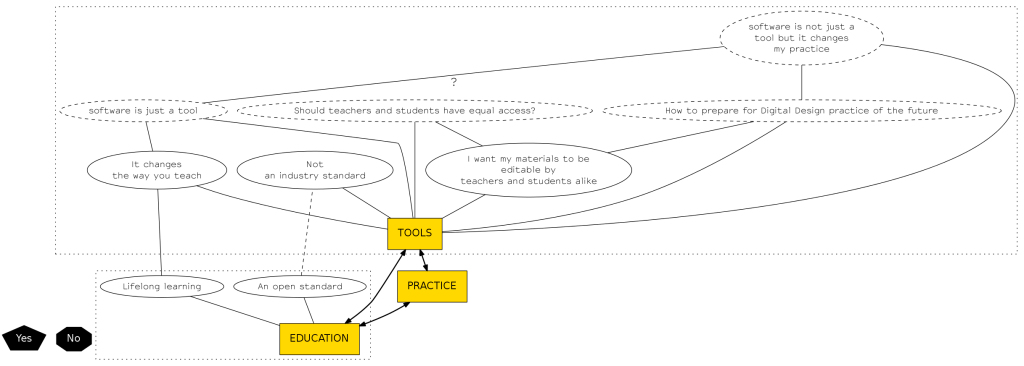
Collaborative mapping exercise using Graphviz and Etherpad (60mins)
The starting point for this exercise are notes from preparatory meetings. While brainstorming about relevant keywords and concepts, we generate a collaborative visualisation in real time.

Graphiz is a network visualization software software developed in the early nineties by AT&T labs and mainly used in bioinformatics, machine learning and other technical domains. Etherpad is an online real time editor originally developed by Google. After its release as Open Source software it has become immensely popular for many types of collaborative writing. The toolset is complemented by a small script that automatically imports etherpad content into a local installation of Graphviz, and updates the graph.

This exercise demonstrates a few tools and methods emblematic for the discussion: simultaneous editing of content, form and code; engaging with cultural paradigms of specific tools and mixing existing tools and platforms with additional DIY pieces. Please bring your laptop!


Productive tensions between institutional education and the practice of open design (60mins)

A discussion about experiences in design education that engage with the growing interest in ‘open design’, and the way Free, Libre and Open Source software could play in that.
  • What is the place of teaching tools in design education, at BAU and in what way could we imagine to make changes?
  • How to develop a consideraton for digital processes specific to the type of design taught at BAU? Free, Libre and Open Source software: motivations to introduce them, and possible challenges
  • Software and hardware as Tools of the Trade: shifting ‘professional skills’ beyond market requirements
  • The importance of self-education in hacking/free software contexts: alternating between teaching and learning
  • How to shift from learning about specific tools to understanding processes (ie ‘Photoshop’ or ‘GIMP’ vs learning about image processing).
  • Learning about FLOSS paradigms, engaging with Free Culture: institutions engaging with communities
  • The place of open standards and Free Licenses. Publishing and archiving of teaching materials and outcomes
  • Programming for designers: teaching skills and/or attitudes?
  • Platforms, tools that might support another understanding of learning and practice: etherpad, wiki, mailinglist, command-line, …
  • Every institution challenges the way FLOSS and design are brought together in a different way. Stories from La Cambre, erg, PZI, Merz … and BAU.
  • General discussion (30 mins)
Crossing open design-education vs practice: What does this mean when we think about future schools?

L i n k s :
R e g i s t r a t i o n :

Workshop for teachers from Bau, Design College of Barcelona.
Prior registration is required. The last date for registration is 31 October, 2014.
There are 20 places.

To register, send an e-mail to:
jara.rocha[@]baued.es

Indicating as the subject:
‘Registration for FCForum Lab Workshops’ and the name of the Workshop (Considering your tools).

+ i n f o :

http://lab.2014.fcforum.net/en/

17.7.14

let’s first get things done

: on division of labor and practices of delegation in times of mediated politics and politicized technologies

4th of August, 2014
Thinking together /  Osthang Project
Darmstadt, Germany

"How can we live together? This is the very simple and fun (if not challenging) question that the participants of the Osthang Architecture Summer School will be asking this Summer in Darmstadt, Germany. The program will come to a closure with a nine day(!) public forum titled “thinking together” curated by Berno Odo Polzer. As Berno writes:
“«Thinking Together» is focused on rethinking future modes of living together in a pluricentric world, so it is a transdisciplinary platform for political imagination: ‘political’ because it is concerned with the way in which we organize the spaces, practices and lives that we share, locally as well as globally – ‘imagination’ because it is aimed at forming new ideas and imaginaries about how to do so.”

Be it in getting out the call for the next demonstration on some “cloud service”, or developing a progressive tech project in the name of an imagined user community, scarcity of resources and distribution of expertise makes short cuts inevitable. But do they really?


The current distance between those who organise their activism to develop “technical infrastructures” and those who bring their struggles to these infrastructures is remarkable. The paradoxical consequences can be baffling: (radical) activists organize and sustain themselves using “free” technical services provided by Fortune 500 companies. At the same time, “alternative tech practices”, like the Free Software Community, are sustained by a select (visionary and male) few, proposing crypto with 9-lives as the minimum infrastructure for any political undertaking.

The naturalization of this division of labor may be recognized in statements about activists having better things to do than to tinker with code or hardware, or in technological projects that locate their politics solely in the technology and infrastructures as if they are outside of the social and political domain. What may seem like a pragmatic solution actually re-iterates faultlines of race, gender, age and class. Through the convenient delegation of “tech matters” to the techies or to commercial services, collectives may experience a shift in the collective’s priorities and a reframing of their activist culture through technological decisions. The latter, however, are typically not open to a broader political discussion and contestation. Such separation also gets in the way of actively considering the way in which changes in our political realities are entangled with shifts in technological infrastructures.

We want to use this day to resist the reflex of “first getting things done” in order to start a long term collaboration that intersects those of us with a background in politics of society and politics of technology." (Seda Gürses)

Together with Seda Gürses, Femke Snelting & Miriyam Aouragh

+ info on Thinking together here

4.7.14

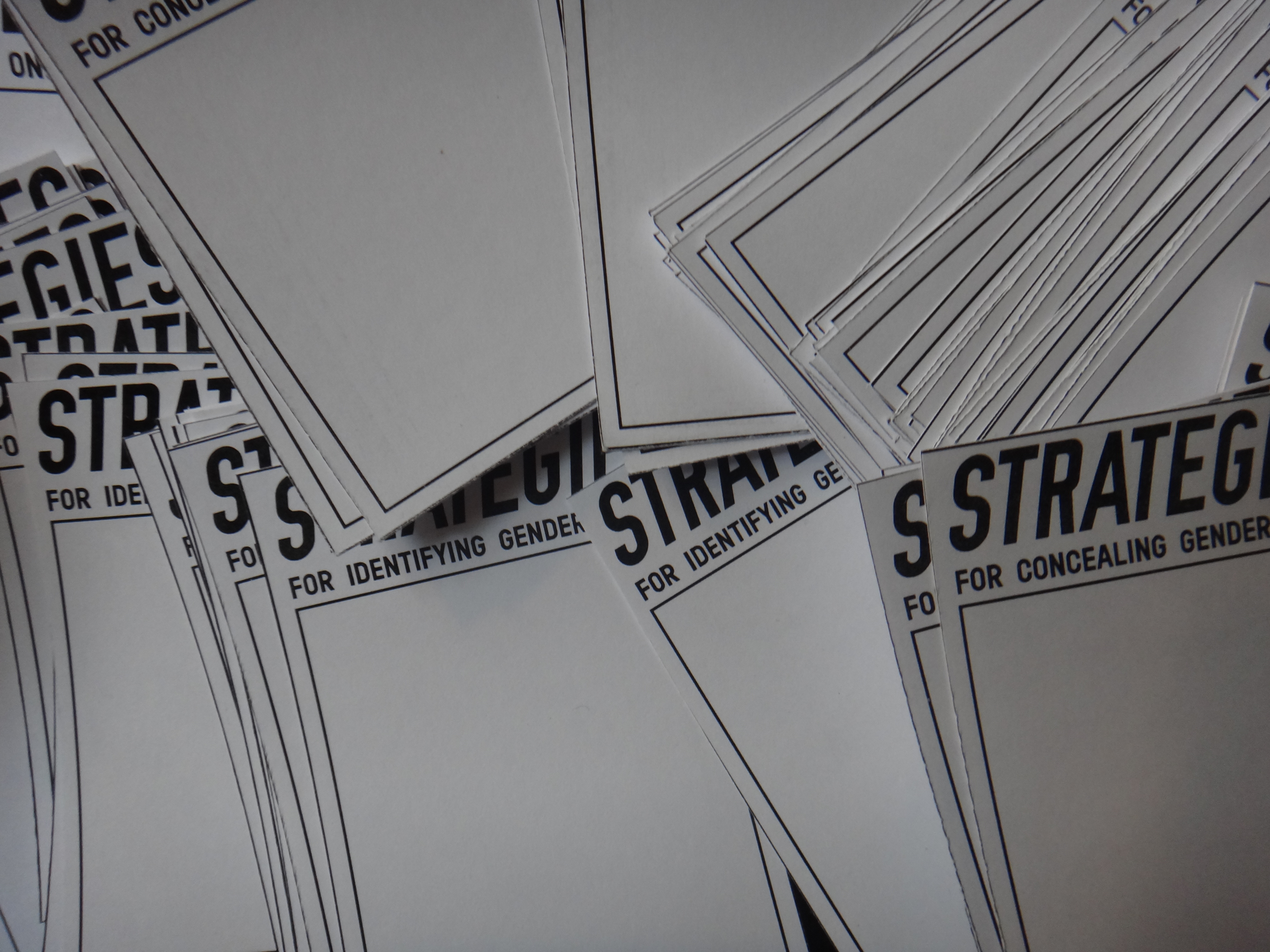
gendered Turing tests and strategies for concealing and identifying gender online


"In the prelude to How We Became Posthuman, N. Katherine Hayles describes two different variations on the Turing test. The most famous one, the one many of us may know, involves a person using some kind of computerized chat interface to talk to either a computer, or a human in another room. It is the task of the test subject to determine, from conversation, whether their interlocutor is human or machine. Passing the Turing test has long been seen as one of the holy grails of artificial intelligence. When computers are able to pass as human, the argument goes, one of the distinctions between humans and computers dissolves.

Hayles also describes another Turing test. This one starts in the same way as the previous, with a human participant talking to someone in another room through a computerized chat interface. But in this one, the discussion partner on the other side is definitely human. The goal of the participant is, instead, to determine whether their conversation partner is male or female. If this second Turing test has similar stakes to the first, Hayles asks, does an ability to fool the participant negate the gender of the human on the other side? (...)


There's a huge spectrum of ways that gender is represented, discussed, made an issue, or turned into infrastructure on the internet. Different platforms construct gender as an issue of varying importance. In some software development communities (on mailing lists, in IRC), it's generally considered impolite to ask people for personal details that they're not readily volunteering. A comment raised by this is the idea that many women don't get noticed or counted because they don't mention or make obvious their gender, because the default or un-gendered stated is considered to be male. If someone does not make it explicitly clear that she is a woman, she is assumed to be a man. If someone makes it explicitly clear that they are something other than simply a woman or man, it starts a discussion, which may or may not be welcome to the person who has accidentally instigated it. So on one side of this spectrum, there's communities where disclosing gender is not structurally necessary and speculation is entirely a private activity by individuals; on the other side of the spectrum, there are platforms like Facebook, where including a gender is a required activity in profile building, and where the default is man or woman, unless you choose to start writing in an answer, and then there's an authorized list of possibilities. Gender is built into the bedrock of Facebook. We take for granted that we can find out what gender someone is on Facebook. Moreso, we take for granted that we can find out what gender someone is, in general."


+info: http://www.constantvzw.org/site/Gendered-Turing-tests.html

28.6.14

REROAM worksessions

(at Relearn Summerschool - Variable - Schaerbeek - BXL - 6-11 june 2014 )


Chairs attached to a school fence, signifying the school is en toma [occupied] (Chile, 2011)


What would it mean to design a school in terms of a nomadic learning   situation? Probably we need to think differently about its physical   characteristics as well as its location and access to pedagogical resources. Then: what is a pedagogical resource? What is the meaning of   "learning infrastructure"? What would an itinerant educational object   look like, and how would it be produced and shared? Do educational   objects actually "learn"? How?

Reroam  proposes daily exercises, a collection of present models, experiences  and theories that examine the physical situations  where learning  happens. Thinking through conviviality and discomfort, we  look for  spaces that would facilitate disensus.Taking our bodies into  account,  we will take a moment every day to speculate together about  ways that  we could make re-learning situations physical.

Prepared by: Catherine Lenoble, Jara Rocha & Femke Snelting

+info: http://relearn.be/ 
(+ soon on schedule)

17.4.14

scanning party en Calafou

Del 17 al 22 de abril -en Calafou- unas cuantas personas apasionadas por la cultura libresca, las bibliotecas, y la preservación y difusión de la memoria colectiva de los movimientos sociales, así como del pensamiento critico en general, nos reuniremos para arrancar una biblioteca pública digital. Un arranque con pinta de scanning party. El encuentro se celebrará en Calafou, y contará con los siguientes colectivos: bookcamping.cc, el lokal, el ateno enciclopedic llibertari, xarxa de biblioteques socials y el proyecto memoryoftheworld.org.


Los objetivos detrás del encuentro son:
 
Fabricar y aprender a usar (y cuidar) correctamente un escáner de libros. 
>  Instalar, configurar y aprender a usar programas y aplicaciones libres para construir catálogos que compartir de manera eficiente en internet: colecciones de libros debidamente etiquetadas y documentadas. Tagging matters!
>  Instalar, configurar y aprender a usar los servidores donde se  guardarán los libros y demás masas textuales digitales, así como los catálogos.
> Documentar ese proceso y compartir todo lo anterior para permitir a otras replicar y/o traducir la experiencia ellas mismas.
> Hacer difusión de la biblioteca pública e idear mecanismos ágiles y robustos para conseguir su mantenimiento en el tiempo.
 
+ info aquí