
4.4.15
3.4.15


15.3.15
Let's first get things done! at LibrePlanet 2015
The Darmstadt Delegation, 2015
(present delegates: Seda Gürses & Jara Rocha;
distant -but close- delegates: Femke Snelting, Miriyam Aouragh)

MIT Stata Center
Cambridge MA
Room 32-155
Saturday, march 21
16.15h (Session Block 5A)
(for those not present, it will all be streamed from here: https://libreplanet.org/2015)
11.2.15
banda madriz emergencia editorial poesía silvestre emergencia silvestre banda editorial poesía madriz emergencia madriz banda silvestre editorial poesía
Dice V. Monroy que él no escribe, que a él le gustaría pensar que lo
que produce “tiene que ver con su tiempo y no con la literatura”. Una
premisa similar podría serle aplicada a Mariano Blatt. Y a ambos, con
ello, una posición señalada y consciente en el mapa de cambios de
contextos de la escritura; en el mapa de virus y vídeos y memes y
generaciones en tránsito de disociación de lo que había en lo que habría,
o en lo que de hecho hay pero vive fuera de las clasificaciones que en
ya otro mundo, con otras costumbres tiempo-espacio, sirvieron para
entender, recibir y generar el arte como Arte, la poesía como Poesía.
¿En qué podría consistir el costumbrismo poético de un mundo que podamos llamar nuestro? Igual en lo de las discos, los bailes, lxs chicxs guapxs/lindxs a lxs que quieres besar, o saludar por la calle, u oler por debajo de la remera/camiseta; un poco de md, un poco de…
todo lo que digo es porque pasó
o porque quise que pasara
Hechos de la realidad. Costumbres de época. Más que creencia, cuerpos y deseos. Y su retrato nítido, si ha de tomar texto; su registro más que su recuerdo; su construcción experiencial: en condensación y en vivo. Porque el presente continuo no existe salvo encapsulado en el flash de la droga, en el cruce de ojos en el baño, la estroboscópica, el olor un segundo, el viento en el flequillo de ése/ésa/ésx, y un verso afinado para nombrar lo que parece que existe. O acaso, si es que no, para hacer existir lo que pareció que no existía porque no había sido dicho.
Lo nombras, se va, se queda, se va. Y casi que nunca sale bien –cuidado con eso– casi que siempre roza la cursilería de una autorreferencialidad mate. Pero si triunfa y captura la sensación de ser joven en una acera, parado, desafiante del universo con su belleza lampiña-o-frondosa y dorada, consigue esta escritura del tiempo tan acertada como la que pueda detener-retener el preciso momento en que una experiencia se agarra del mundo, del famoso afuera y del famoso adentro. Es decir logra, en el panorama de ansiedad, consumo y desconexión epocal, un brillito de verdad física. De puro estar. Un brillo que puede decir que “la vida era entonces una cosa real / porque pasaba una parte adentro mío / y otra un poco más afuera / justo arriba de la cabeza / como un tubito de luz amarillo que a veces crecía / y a veces se achicaba / hasta casi casi desaparecer”.
Por esto es por lo que, de todxs lxs poetas posibles, el catálogo de la Banda Editorial Silvestre empieza con Blatt. La publicación de EMOTION, en nombre de la Silvestre, viene a luchar contra el NO NOS VAMOS, NOS ECHAN que opera desde hace décadas en la edición del trozo de arte textual/lingüístico que en el Estado de España ha tomado por nombre poesía. Algo así como entrar en una pista, mirar de frente y engarzar con los deseos verbales de al menos una generación, definida por filtraciones de mundos y no por años de nacimiento, es la operación propuesta. Una que viene a ganarse para la lectura el placer de lo que habita en la lengua & la toma de poder sobre las maneras en las que la lengua habita los libros, las páginas, las tipografías, las portadas y papeles.
Tan alto y tan fuerte y tan dentro de lugar – así nace una banda editorial silvestre.
y hacen un tumblr
y hacen un hotglue

¿En qué podría consistir el costumbrismo poético de un mundo que podamos llamar nuestro? Igual en lo de las discos, los bailes, lxs chicxs guapxs/lindxs a lxs que quieres besar, o saludar por la calle, u oler por debajo de la remera/camiseta; un poco de md, un poco de…
todo lo que digo es porque pasó
o porque quise que pasara
Hechos de la realidad. Costumbres de época. Más que creencia, cuerpos y deseos. Y su retrato nítido, si ha de tomar texto; su registro más que su recuerdo; su construcción experiencial: en condensación y en vivo. Porque el presente continuo no existe salvo encapsulado en el flash de la droga, en el cruce de ojos en el baño, la estroboscópica, el olor un segundo, el viento en el flequillo de ése/ésa/ésx, y un verso afinado para nombrar lo que parece que existe. O acaso, si es que no, para hacer existir lo que pareció que no existía porque no había sido dicho.
Lo nombras, se va, se queda, se va. Y casi que nunca sale bien –cuidado con eso– casi que siempre roza la cursilería de una autorreferencialidad mate. Pero si triunfa y captura la sensación de ser joven en una acera, parado, desafiante del universo con su belleza lampiña-o-frondosa y dorada, consigue esta escritura del tiempo tan acertada como la que pueda detener-retener el preciso momento en que una experiencia se agarra del mundo, del famoso afuera y del famoso adentro. Es decir logra, en el panorama de ansiedad, consumo y desconexión epocal, un brillito de verdad física. De puro estar. Un brillo que puede decir que “la vida era entonces una cosa real / porque pasaba una parte adentro mío / y otra un poco más afuera / justo arriba de la cabeza / como un tubito de luz amarillo que a veces crecía / y a veces se achicaba / hasta casi casi desaparecer”.
Por esto es por lo que, de todxs lxs poetas posibles, el catálogo de la Banda Editorial Silvestre empieza con Blatt. La publicación de EMOTION, en nombre de la Silvestre, viene a luchar contra el NO NOS VAMOS, NOS ECHAN que opera desde hace décadas en la edición del trozo de arte textual/lingüístico que en el Estado de España ha tomado por nombre poesía. Algo así como entrar en una pista, mirar de frente y engarzar con los deseos verbales de al menos una generación, definida por filtraciones de mundos y no por años de nacimiento, es la operación propuesta. Una que viene a ganarse para la lectura el placer de lo que habita en la lengua & la toma de poder sobre las maneras en las que la lengua habita los libros, las páginas, las tipografías, las portadas y papeles.
Tan alto y tan fuerte y tan dentro de lugar – así nace una banda editorial silvestre.
y hacen un tumblr
y hacen un hotglue

10.2.15
8.2.15
»Objetologías: a conversation with Femke Snelting«
*Sunday, 8.2., 4 pm, ABR-Library (2nd floor)*
AKADEMIE SCHLOSS SOLITUDE
(Stuttgart)
What is the attraction of an algorithm? Do servers have a gender? Can a book be a disobedient object? Is it possible to understand an infrastructure as a poetics? Jara Rocha presents Objetologías, a line of research she carries with Josianito Llorente, Jaron Rowan and Carla Boserman. Working on the aesthetics and politics of objects and technologies in their different material conditions, they speculate about the potentials and relatedness of humans and non-humans. Their attempt at a post-humanist approach brings together studies of culture, science and technology, actor-network theory, new materialisms, speculative realism, futurology and affects theory. Objetologías considers the ethic, erotic, aesthetic and political agency of objects, and studies their material conditions in a broad sense: scale, durability, weight, volume, attraction, dispersion. Instead of studying the social use of objects and technologies, they shift their attention to ontologies, understanding processes of individuation, co-production and articulation as basic gestures that act symmetrically in the complex web of materiality.
Tea and cake served!
*CROSS-READING*
Ahmed, S. (2006) Queer Phenomenology (Duke University Press)
Bennett, J.,(2010) Vibrant Matter. A political ecology of things (Duke University Press)
Bogost, I. (2012) Alien Phenomenology, or What it's like to be a thing (University of Minnesota Press)
Braidotti, R., (2002) Metamorphoses. Towards a Materialist Theory of Becoming (Oxford: Blackwell)
Butler, J. & Athanasiou, A., (2013) Dispossession. The Performative in the Political (Cambridge: Polity Press)
Haraway, D., (1992) "The Promises of Monsters", at Lawrence Grossberg, Cary Nelson, Paula A. Treichler, eds., Cultural
Studies (New York; Routledge) , pp. 295-337.
Harman, G.,(2012) The Third Table (dOCUMENTA(13))
Hayles, K., (1999) How we became Posthuman (University of Chicago Press)
Kittler, F., (1999) Gramophone, Film, Typewriter (writing science) (Stanford University Press)
Latour, B. (1993) We have never been Modern (Harvard University Press)
Meillassoux, Q., (2008) After Finitude. An essay on the necessity of contingency (NYC: Continuum Books)
Thrift, N., (2008) Non-Representational Theory. Space, Politics, Affects (NY: Routledge)
Lampland, M. & Star S.L., (Eds) (2009) Standards and Their Stories: How Quantifying, Classifying, and Formalizing Practices Shape Everyday Life (Ithaca, NY: Cornell University Press)5.2.15

28.1.15
xuxu de creim
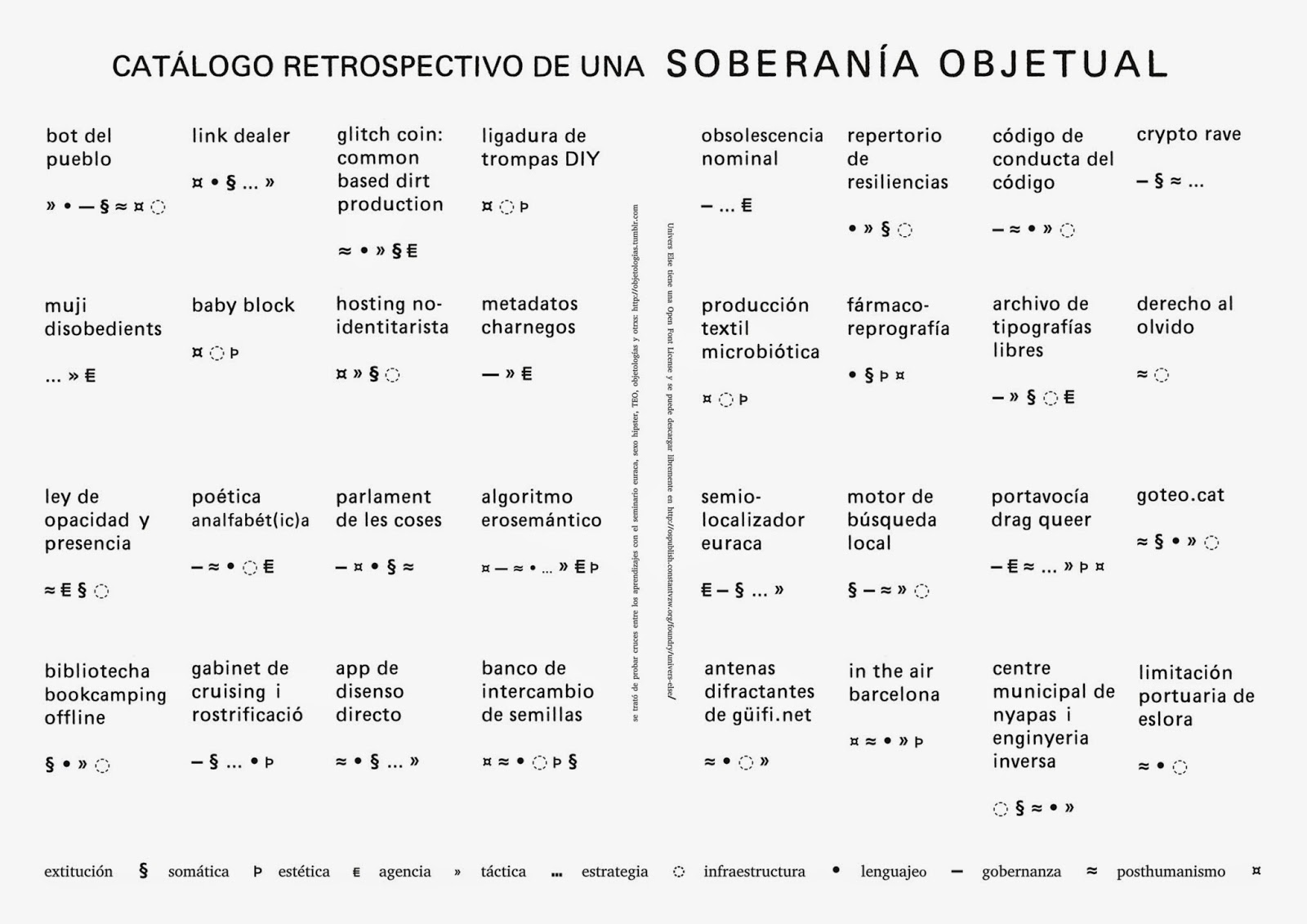
repoblamiento
 | ||
| imagen: James Dodd / texto: Amador Fernández-Savater |
se construye ahí donde uno está
desde lo que hace la vida relevante
desde las relaciones que hay
recombinando los saberes existentes
desde donde cada cual tenga puesto
cuerpo
deseo
y
atención
12.1.15
HACÍA UN RUIDO sábado 17 en Hangar >> María Salgado & Fran MM Cabeza de Vaca + pinchada de Casi Baile y Jules Rules
¡VENGAN, NO SE LO PIERDAN!
HACÍA UN RUIDO
*
¡segundas veces del famoso rap invertido
ACAB!
*
¡nuevos textos & sonidos respecto
de las anteriores veces
del recital!
*
¡y el estreno en naves de la versión analógica del audiotexto
Hacía un ruido!
Sábado, 17 de enero de 2015, de 18h a 24h, en Hangar
Hacía un ruido no
es el nombre de una obra cerrada, sino de una zona de investigación que
iniciamos en enero de 2014. Va mutando, pues, según pasan el tiempo y
la exploración; de modo que lo que en Hangar presentaremos no es
idéntico a los recitales del mismo nombre que presentamos en Naranjo, CA2M,
Fordham University y 16 Beaver la pasada primavera. Hacía un ruido es
el nombre de un recital heterogéneo. Hay lectura de memoria y lectura de
papel. Hay lectura procesada por la electrónica de Cabeza de Vaca. Unos
cuantos poemas hay. Los poemas proceden de la mirada y de la
experiencia lingüística rica y salvaje que cualquiera puede tener en una
ciudad a, en una ciudad b, en una ciudad ce… Hay esta poesía sin poetas
que se encuentra en el oído del habla de cualquiera, la joyería
gramatical de las revistas, la irradiación de frases buenas, la
verbosidad: bisuteria casual de verborrea de la ciudad. Fotografía
verbal. Hay poemas de otros poetas de quien deliberadamente se aprende
en los poemas de una. Hay un rap invertido: bases que buscan voz en vez
de al revés. Hay esta pieza sonora al final. Que intenta verbalizar. La
experiencia de no caber. Ese desborde. El exceso. Hacía un ruido. Como
si. Fuera. Un mundo entero.
María Salgado es poeta low-tech. Ha publicado ferias (2007), 31 poemas (2010) y ready (Arrebato,
2012). Investiga en formas contemporáneas de escritura y recital. Hace
zines y bandas y forma parte de planes como el Seminario Euraca. Escribe globorapido.blogspot.
Fran MM Cabeza de Vaca es
músico y compositor. Ha estrenado música instrumental y electroacústica
en diversos festivales nacionales e internacionales. Ha participado
como compositor e intérprete en diversos espectáculos escénicos,
colaborando con coreógrafos como Michelle Man, Guillermo Weickert,
Fernando Lima o María Cabeza de Vaca. Entre otros trabajos audiovisuales
cabe destacar tres largometrajes documentales junto a José Luis Tirado y
la BSO del largometraje Carmina y Amén de Paco León. Participa activamanente con en el colectivo ZEMOS98. Ha creado y dirigido el espectáculo escénico Veo una Voz junto a la actriz Ana Barcia; y la ópera experimental Todos Caníbales junto al Nou Ensemble y los artistas Christian Fernández Mirón y Roberto Martínez.
Y
+

CASI BAILE (Del lat. Quasi ballāre).
1. m.
Las pocas informaciones de las que disponemos hoy en día sobre el
término “casi baile” nos hacen referencia a lo que, parece ser, una
forma ancestral de lucha, la cual se caracteriza por la ausencia
absoluta de reglas o normas. No hay ningún estudio que logre situar su
procedencia geográfica y/o cultural.
2. m.
coloq. Determinada actitud y/o estado de ánimo, bajo el cual se
mantiene un leve balanceo corporal a medio camino entre la euforia y la
contención. Mejor no contamos con ella, se quedó en “casi baile”
3. m.
coloq. Figura que se aplica a aquellas artes o disciplinas que se
sitúan en los márgenes y no se decantan por ninguna actividad conocida,
resultando imposible su definición y clasificación. Define bien tu proyecto, o parecerá un “casi baile”
Y
+
+
PINCHADA
¡VENGAN & OIGAN!
(y/o agiten)
9.12.14

28.11.14

27.11.14

25.11.14
1er prototypage d'une boîte à outils pour lx dragqueer

développé avec María, Xavier et Anne dans la session de travail #genderblending, organisé par Constant - BXL , 17 au 22 novembre, 2014
the limits of
"Queering can only be thought today from its position in a dynamic
relationally that blurs the distinction between subject and object,
difference and repetition, separations and connection, identity and
collectivity."
Magnus Eriksson
20.11.14


15.11.14


4.11.14
considering your t o o l s
f r e e c u l t u r e f o r u m 2 0 1 4
Wednesday, 5 November
from 14:00 until 18:00
In Bau, Design College of Barcelona (see the map)
Building A – Classroom A.0.6
I m p a r t e d b y :
Femke Snelting & OSP (Open Source Publishing)
D e s c r i p t i o n :
This workshop starts from our experience with using Free and Open Source software in our (graphic) design practice. We would like to share what this means for our own work, and more particularly how it has an effect on our ideas about design education. Free culture challenges traditional art-education paradigms because it invites participants to move between roles (teacher, student, developer, user) and because it necessitates a fundamental questioning of the political and cultural heritage embedded in the technologies that we employ.
Art- and design students are typically expected to create
their work using proprietary tools for research, prototypes,
(re)presentation and production. Sometimes, they are taught particular
packages but more often the impact of software and hardware choices will
be ignored. How to engage with the growing importance of digital
processes in a way that relates to the intellectual and aesthetic
paradigms of design-education? How to consider soft- and hardware as an
integral part of design practice, and develop more intimate and
experimental relations with digital tools? And what is the importance of
using Free, Libre and Open Source software for all this?
P r o g r a m m e :
A tour through the current practice of OSP, a Brussels’ based design caravan that decided in 2006 to use Free, Libre and Open Source software only. Changing from proprietary (ie OSX and Adobe) to Free Software means not just replacing one tool by another. It means engaging in the design of those tools, rethinking the collaboration processes, and the way one distributes their work. How has Free Software changed the practice of OSP? How do they work together now? And in what way have their aesthetics changed?
T a l k i n g p o i n t s :
- Free Software tools might be designed for a different public than graphic deisgners. For scientists, activists, programmers or amateurs, for example. Using these tools means confronting paradigms different from the Graphic Design mainstream.
- The Free Software community puts a lot of emphasis and archiving and sharing their sources, choosing to release ‘source files’ early in the development process: ‘Release early, release often’. OSP follows this approach by sharing their design files online, right from the start of a project. How does this change the relation with the client/collaborator and the public?
- Within existing proprietary design tools there are not many infrastructures for collaboration. The world of Free and Open Source Software has great tools for collaboration, but they are meant for programming code. OSP tries to imagine other infrastructures that allow to design together: open ended, fluid, Read-Write exchange…
- Using non-mainstream tools often requires new expertise. Every new OSP projects mixes designing and learning. We may find ourselves programming too, even if we’re not educated programmers and may be less confident about it. How do we live this constant ‘relearn’? And how do we find the time to do so in the market of Graphic Design, where time is always in short supply?
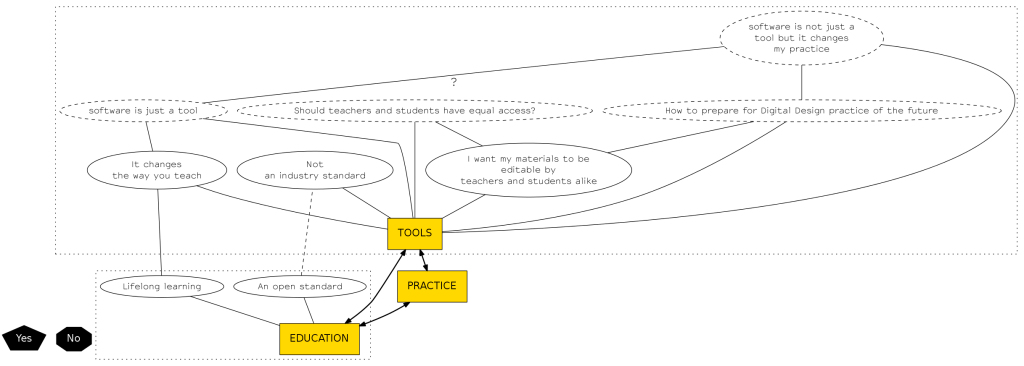
Collaborative mapping exercise using Graphviz and Etherpad (60mins)
The starting point for this exercise are notes from
preparatory meetings. While brainstorming about relevant keywords and
concepts, we generate a collaborative visualisation in real time.
Graphiz is a network visualization software software
developed in the early nineties by AT&T labs and mainly used in
bioinformatics, machine learning and other technical domains. Etherpad
is an online real time editor originally developed by Google. After its
release as Open Source software it has become immensely popular for many
types of collaborative writing. The toolset is complemented by a small
script that automatically imports etherpad content into a local
installation of Graphviz, and updates the graph.
This exercise demonstrates a few tools and methods
emblematic for the discussion: simultaneous editing of content, form and
code; engaging with cultural paradigms of specific tools and mixing
existing tools and platforms with additional DIY pieces. Please bring
your laptop!
Productive tensions between institutional education and the practice of open design (60mins)
A discussion about experiences in design education that
engage with the growing interest in ‘open design’, and the way Free,
Libre and Open Source software could play in that.
- What is the place of teaching tools in design education, at BAU and in what way could we imagine to make changes?
- How to develop a consideraton for digital processes specific to the type of design taught at BAU? Free, Libre and Open Source software: motivations to introduce them, and possible challenges
- Software and hardware as Tools of the Trade: shifting ‘professional skills’ beyond market requirements
- The importance of self-education in hacking/free software contexts: alternating between teaching and learning
- How to shift from learning about specific tools to understanding processes (ie ‘Photoshop’ or ‘GIMP’ vs learning about image processing).
- Learning about FLOSS paradigms, engaging with Free Culture: institutions engaging with communities
- The place of open standards and Free Licenses. Publishing and archiving of teaching materials and outcomes
- Programming for designers: teaching skills and/or attitudes?
- Platforms, tools that might support another understanding of learning and practice: etherpad, wiki, mailinglist, command-line, …
- Every institution challenges the way FLOSS and design are brought together in a different way. Stories from La Cambre, erg, PZI, Merz … and BAU.
- General discussion (30 mins)
Crossing open design-education vs practice: What does this mean when we think about future schools?
L i n k s :
- Considering your tools – a reader for designers and developers http://reader.lgru.net
- Wiki gathering materials for courses around digital culture at Ecole de Recherche Graphique, Brussels (FR) http://ustensile.be
- Relearn Summerschool 2014: http://relearn.be/r/about.html
- Relearn Summerschool 2013: http://relearn.be/2013/r/2013::introduction-script.html + publication: http://relearn.be/media/relearn-2013.pdf
- A network of free culture aware educators in art, music and design education: http://eightycolumn.net
- Interview with Open Source Publishing (FR) http://silo.schr.fr/osp_etapes_red.pdf + http://etapes.com/etapes-221
- Various workshops developed by OSP http://osp.constantvzw.org/workshop/
- I like tight pants and unix for art students (Eric Schrijver) http://i.liketightpants.net/and/absolute-beginners-unix-for-art-students-part-1 + http://i.liketightpants.net/and/absolute-beginners-unix-for-art-students-part-2 + http://i.liketightpants.net/and/absolute-beginners-unix-for-art-students-part-3
Workshop for teachers from Bau, Design College of Barcelona.
Prior registration is required. The last date for registration is 31 October, 2014.
There are 20 places.
To register, send an e-mail to:
jara.rocha[@]baued.es
Indicating as the subject:
‘Registration for FCForum Lab Workshops’ and the name of the Workshop (Considering your tools).
+ i n f o :
http://lab.2014.fcforum.net/en/
2.11.14

1.11.14

31.10.14

29.10.14


26.10.14

19.10.14

18.10.14


17.10.14
laberinto de pasiones (28O-02D)
Rubén y Jaron coordinan esta cosa tan chula que se cuenta así:
"De forma reciente hemos experimentado el resurgir de una multiplicidad de materialismos. De ciertas miradas del mundo posthumanistas que pretenden llevar el materialismo hasta sus últimas consecuencias. El interés por entender las agencias y potencias de la materia hace que nos interroguemos sobre las condiciones materiales de existencia más allá de la voluntad de los hombres y mujeres que producen su acontecer histórico. Densidades, viscosidades, resistencias, distancias y humedades se entrelazan con infraestructuras, artefactos, herramientas y tecnologías, cruzados por serotoninas, dopaminas, testosterona y feromonas, creando redes complejas que afectan y se dejan afectar. La agencia ya no reside en la voluntad sino en la densidad de las redes que integran humanos y no humanos, discursos, máquinas y animales. Esta complejización del materialismo, aceptar que no vivimos en un mundo lineal ni determista nos obliga a repensar nuestro análisis de las cosas, sobre cómo se relacionan eventos, sujetos y tecnologías, y sobre todo, sobre cómo acontecen las realidades materiales de la cultura."
+ info en la web de nociones comunes bcn
"De forma reciente hemos experimentado el resurgir de una multiplicidad de materialismos. De ciertas miradas del mundo posthumanistas que pretenden llevar el materialismo hasta sus últimas consecuencias. El interés por entender las agencias y potencias de la materia hace que nos interroguemos sobre las condiciones materiales de existencia más allá de la voluntad de los hombres y mujeres que producen su acontecer histórico. Densidades, viscosidades, resistencias, distancias y humedades se entrelazan con infraestructuras, artefactos, herramientas y tecnologías, cruzados por serotoninas, dopaminas, testosterona y feromonas, creando redes complejas que afectan y se dejan afectar. La agencia ya no reside en la voluntad sino en la densidad de las redes que integran humanos y no humanos, discursos, máquinas y animales. Esta complejización del materialismo, aceptar que no vivimos en un mundo lineal ni determista nos obliga a repensar nuestro análisis de las cosas, sobre cómo se relacionan eventos, sujetos y tecnologías, y sobre todo, sobre cómo acontecen las realidades materiales de la cultura."
+ info en la web de nociones comunes bcn


29.9.14
The Darmstadt Delegation / DL14
The darmstadt delegation came together on the basis of a shared
experience of troubling differences in the politics, values and
practices of “activists" heavily using networked technology for their
struggles, and of "techno-activists" who struggle to develop progressive
and alternative technologies. We observe that, loyal to a utopia of a
globally functioning interwebs, techno-activists usually organize around
universal values: information must be “free”, secure,
“privacy-preserving”, accessible, etc. In comparison, those who bring
their political struggles to the interwebs may express political
differences across a broader spectrum, situated in local and/or global
contexts. However, pragmatic decisions due to time pressure and lack of
resources often mean that these struggles may integrate themselves into
proprietary and conservative technical infrastructures. As a
consequence, during “sneaky moments of first getting things done", many
organizational matters are delegated to "techies" or to technological
platforms.
If we believe the mantra that our tools inform our practices and our practices inform our tools, we may want to radically reconfigure these divisions of labor between “activists” and “progressive techies". But how? Where do we start? What are ways to resist those sneaky moments in which we pragmatically submit ourselves to "specialization of work" that reproduce hegemonic divisions of gender, race, class and age, and that reinforce ideological differences between activists for social justice and activists for just technologies?
The darmstadt delegation follows in the steps of numerous initiatives which are working on crossing divides while developing technical alternatives for current day struggles. Most recently, we see ourselves in conversation with the numerous initiatives that have aligned around backbone409 [1], interference [2], transhackfeminist camp [3] and the internet ungovernance forum [4]. We are excited to have the opportunity to continue some of these conversations with you in the context of DL14 [5]. Due to unforeseen constraints, only Seda Gurses will be physically present at the conference. For those who would like to discuss more, I encourage you to get in touch with all of our delegates [0]

[0] Currently active delegates are Femke Snelting (ConstantVZW, Belgium), Jara Rocha(Objetologias, Bau School of Design, Spain), Miriyam Aouragh (University of Westminister, UK) and Seda Gurses (New York University, USA).
[1] http://backbone409.calafou.org
[2] http://interference.io
[3] http://transhackfeminist.
[4] https://iuf.alternatifbilisim.
[5] http://digitallabor.org/
If we believe the mantra that our tools inform our practices and our practices inform our tools, we may want to radically reconfigure these divisions of labor between “activists” and “progressive techies". But how? Where do we start? What are ways to resist those sneaky moments in which we pragmatically submit ourselves to "specialization of work" that reproduce hegemonic divisions of gender, race, class and age, and that reinforce ideological differences between activists for social justice and activists for just technologies?
The darmstadt delegation follows in the steps of numerous initiatives which are working on crossing divides while developing technical alternatives for current day struggles. Most recently, we see ourselves in conversation with the numerous initiatives that have aligned around backbone409 [1], interference [2], transhackfeminist camp [3] and the internet ungovernance forum [4]. We are excited to have the opportunity to continue some of these conversations with you in the context of DL14 [5]. Due to unforeseen constraints, only Seda Gurses will be physically present at the conference. For those who would like to discuss more, I encourage you to get in touch with all of our delegates [0]
[0] Currently active delegates are Femke Snelting (ConstantVZW, Belgium), Jara Rocha(Objetologias, Bau School of Design, Spain), Miriyam Aouragh (University of Westminister, UK) and Seda Gurses (New York University, USA).
[1] http://backbone409.calafou.org
[2] http://interference.io
[3] http://transhackfeminist.
[4] https://iuf.alternatifbilisim.
[5] http://digitallabor.org/
28.9.14


26.9.14


Suscribirse a:
Entradas (Atom)
![[proyecto] Altas latencias](https://blogger.googleusercontent.com/img/a/AVvXsEiBpD8AFlYRdLzeJ2Hsn_CW_e5gS2aqI95InyU5RVD32AgQq1pu7RkVfqaIVCx8HGOvz6-KsASWhMiTRiAOeMFuq_5CdJ4oBpbugFCz27q4naB5GwKSI6367EAzmdV7gwMJ3bsY49giAjtGaszVwN6XK8Jt9TGRgsuh4UAGYJiG6-BT5M8TUcuqDBvoOME=s220)

![[txt] A breeding ground for uncertainties](https://blogger.googleusercontent.com/img/a/AVvXsEj8Ul_82KszibGV8b6jg9LFyWXEGE4qp6ecSy5BMMylXRoJD3M9p69kVu-AzxnSX2giXA1KXDQK0N-9PgDXC3iiwOb8gbekKC9_uczQKXOnaWH8az3En1ZSVefP22hPQWRvsUBccZEqf9CI15VXUsq8xboFMelx4l9oFikZJpvUX3xTe4mnAAeXwpDzIg0=s330)
![[Bugreport] to Frontier Climate](https://post.lurk.org/system/media_attachments/files/111/901/018/803/503/560/original/1075209e931cabe8.png)
![[zine] Ancho](https://blogger.googleusercontent.com/img/a/AVvXsEgxhMNpFpNTQs8-WPjqQ4xMJ3_BZJbszhAfiHl63dmkzEof-nuHBGdzLZzpneNz9vTWNnw4k1RBBRlY8Lku7gu3bPCmoB58oyB8p0m85z8G4vsPwQWrNDmDhPrcLyvW0SP8AVn6WTAkKi6967tUChbVAl73hP9Umq097rixVNbci22Ua_iZFxOiunVkTjE=s312)
![[radio] naturoculturas son disturbios](https://blogger.googleusercontent.com/img/b/R29vZ2xl/AVvXsEh1vf5WGEHGsX7aYwBLxMSY5_yPI3DzKWwCdqAOOIDKz0yFkISa81hx2ljEMCPPb6bRtYCCtoOb89SdCQET4P_BJoQeYy5990dZ2FmiqJL_Sb_ROngQphHGA9wnu3rIZyUkI7LPLNDqRXE/s220/tapiz.jpg)
![[Journal] La composición activa de la presencia](https://blogger.googleusercontent.com/img/a/AVvXsEgWJBnXgfCm300uKPAr-n4sEqPCBHxy2Hxheu2bFuYCl0IgeJCmJ_7U6SwP01cDamYTfgGpbMtgeSS6KtRm5j85_bclhQ4wn7f8DfSKu7C3_AM87wNHhELUwQ_VXIemDotxFy_h2kiZuqa1h2vLKHeMUALEg63BeR_dbpHh4Y7DEfZgKekOA0eCxPT_lJk=s320)
![[fellowship] LaaS (Life as a Service)](https://blogger.googleusercontent.com/img/a/AVvXsEijogwX9jgADqQ9A00tu8fCFaF8ARU8Sq0EXI0Z_PBE8M-SVpgMWAUiHJjw4-QwLjz-KCQlOgyvJNwpvBLe41Gr7xN0xlWzvyrGxZg9mUIH9-q3xEF51MSk6UnyUkD--ZptqoMcp7XSlgD8wV5MVeUaN8o7X34SnScuLZ4C76XyW6U8JDneHWrSw8vZ=s220)

![[associate membership] TITiPI](https://blogger.googleusercontent.com/img/a/AVvXsEjcMlj6-I_3r2L84w6kGyECKoYCgG_clIbPgkJU643pGFonPn9P-UV_qnNI3V-pjgEVFigNgse4IABpsD7WRie8evGe1jdLZOV92rg_McRtrbSIJOTVzyUW5Xx4ITTYM3JL-d90tF-XGKpKscmUYcnrts654lnj1hVbrHZUBvKA8X5pZPXL6DIoILz9=s341)
![[escuela] Elefantes en la habitación](https://blogger.googleusercontent.com/img/a/AVvXsEgg8WMXXVVHA5uHIAlHGUstKTSRhzQEhEORdROKz8QBgLMPCtYxyNIyCnuFkFwDAoixgS1XMLDeGEtm5P0cXW3AUi6AB179S0Ei6BueXW8NXbREYnik1VICivjPvl7G2Ti597fcw2OQ38cWzV0BpfG3MijQiSAzCdVmj67HS4VIiCsQV5dLgdOubMvIGiM=s220)
![[book] Volumetric regimes: material cultures of quantified presence](https://blogger.googleusercontent.com/img/a/AVvXsEgmU-TcPBoSAK-bYjc2IS1c3j6YaoY0bAmoWeJphwdAVgJ1vRcZP_dg5Ki_GWBYPakurYUpM6XIlUGJKAKALaYhdx-sLtC-KlL3NocFIq5S3RzmuefQP1pCwpUTjJ4it_itZKmY1FLZ-GuvAE1PHWP90G9nxsDRdyPVaoyQxl6s3A0SQEeRxP5fNlcI=s332)
![[manual] Queering Damage. Methodologies for partial reparation... or not.](https://blogger.googleusercontent.com/img/b/R29vZ2xl/AVvXsEj8Q0pcpgV4ta3XRYXd7_TLrE-e8iIRW9gtbF-tRh5pKQClpqaw6qbr0dUadU7sASJ9ElOlYJwy4mPROA46dn7bGeTFwAb09LCR2yMuQOkeJUCeRUrAGKai3pPb9x7nvSaISuDx8FZlppg/s1600/QD.png)

![[project] the underground division, with Helen Pritchard & Femke Snelting](https://blogger.googleusercontent.com/img/b/R29vZ2xl/AVvXsEiP7ySE_-Ag-61vgRhsOgPJOVlvsnsupcriKB9x-nxLA_XjAYdkeYSOajqqqBnnGI82iX4wCbaDfnYfAc9lSHl0ny7ES0V1xTeJl3zW0sfLto6Ardt6AiZmYZlqizeDw98sijpGLY_K1p8/s1600/unthoughtinfrastructure.gif)

![[expo] Dorm en l'accident que provoca](https://blogger.googleusercontent.com/img/a/AVvXsEgjj7ASH7edRFh6yretcviCckrs19chm_iyuaa0PyNeRqKj6EWr5C8wRAUQXNsR0rSxSIY0-j_a0z1PfmEjabITfUBWfMwqCNKLo9Fvb65P31PtSbEiBBJ_HhiNrs1iVFZsD4LWicCfvZXM20ivsPoG2XfLBZYGBhv7Iavs2VPb0uGV2mYehjf7mzdm=s220)
![[exposición] La Irrupción](https://blogger.googleusercontent.com/img/a/AVvXsEiJnQT68iCPb08I1Bq9Cq8cGWfRLxF_cwD3tqfqovDvh1oy1L-Mj5DVkBsyBEezs9ydH0kVterKMClhihz3EkJgySfauazM8-YsPZRI2qUOQKSWKE8phvjFy5lPNqE5r60m0bbgm4eyMXVA4xktKU5hrJoQ6gBv22a7QRAhFlmFDxYQVATl6orDZ-oK=s311)
![[Fellowship] Spectral Infrastructure | Cell for digital Discomfort](https://www.bakonline.org/wp-content/uploads/2021/07/Spirit-Labour-1-web-2000x1335.jpg)

![[paper] Figurations of Timely Extraction](https://blogger.googleusercontent.com/img/b/R29vZ2xl/AVvXsEheNeBTv2n__LM26gVP5_NJsH4-vssVsRn3CspeiFnoCsUY4RmKBE1dTzYurmx73Nt5hceLv_zcORBxLnGV5AR3tJnb579NJ5194ThAdnH5itHI-e9W79rOLD5_sPpkmjjGb1RT1RVnmN0/s1600/hueco.png)
![[weft] The Relearning Series (with Martino Morandi)](https://constantvzw.org/site/local/cache-vignettes/L650xH614/arton3397-dd459.png?1609926532)

![[text] The Courier Bag Praxis of Friction](https://blogger.googleusercontent.com/img/b/R29vZ2xl/AVvXsEgBtBXr6VHozr_KsHsqSJ7_sMDHSSc0l0pD4wcrZJZzqX6IUeTjQEED64R-hg4QG0lK8RHN6J6j-BtRbsTDwI-R-5OlzwcCDYPHX_q7_yTCbgnJEqPic7LsADeclTIpqgX8SWZpdXdncKs/s1600/amz.png)
![[text] We Have Always Been Geohackers](https://blogger.googleusercontent.com/img/b/R29vZ2xl/AVvXsEg3_-X1JXUAU7D1PqsbnkyLFi1PAvVb4P9ZPszvgZkaI5q5lY4JDDPsjeBScyoev-cxl3DD9ocyeaj4ROLezLzA1RM00Ib3SGeaMUiNvnhsSOtRHVy9pK2WQ4p8gXBbDqEABMiaM6uhjzk/s1600/600px-Image04.png)
![[entrevista con Nerea Ubieto] unos corpus a través de otros](https://blogger.googleusercontent.com/img/b/R29vZ2xl/AVvXsEiUAX_3sRJEwxPRY1X9jmG1DxmZBTqhXRVHN3wcA4h_oO6HNIGt9uroK9oP9ktNm79nbj0z6Kt02SNIBynmRmAbxHJa3bWPttwiF1Iffm8azfPumTmr32-pC8bQJ1cRwFvUm5QRfYjiWrs/s1600/yaaun.hotglue.me.jpeg)
![[book] Iterations](https://blogger.googleusercontent.com/img/b/R29vZ2xl/AVvXsEg6AIPpC3jitHSZRTZUAUrI-C01YGIeyM7C7ZPDO0HQhUx0nqTOyVUdpOOJBVh66ZwBJk-Z_NLtlDZtIhB5zyj7lzi1psorzemK2pJKiRk75Z8_8K60nJcdJEz1nmUZqmTm-BId_XYjINo/s1600/iterations_img.png)
![[text] Depths and Densities: a bugged report](https://blogger.googleusercontent.com/img/b/R29vZ2xl/AVvXsEj2kAiZhHGbiApkAnVW086MP8Auew-PJjqA5m1dP0C0PQTv99laH46OO1-5K5YOzYQIYBpgG4SsC8ibvqLz2fkIBoUPi3_dL6dfOir_DosCim4oY2Tq9877vFU-6SSWLfps0rLs_v3wBCM/s1600/2.gif)
![[expo] ROCK REPO](https://blogger.googleusercontent.com/img/b/R29vZ2xl/AVvXsEjMCpx4QnmsTfWUtRNlzUOhGnEWqZozBYCPkzKG3cs29OniGUqAzXFMDp4EggGvEM1B3xDC-Kf9QFHKe2EqKL6QGLhttL6FzalmkJYo8f9_aKdnmiUf61_QMaoa7F228d5farlhzSeV1Ok/s1600/ROCKREPO.png)
![[ciclo] unsupervised imaginations](https://blogger.googleusercontent.com/img/b/R29vZ2xl/AVvXsEhjO8oPteLww8zP6OPAvLXOm4uiwvBIFJ0k9DWqK7YEfSau1A9E0RdvY0-qokscG-y_a9sgou1xkCNBSw_VvBOlsFqLbcR_HSDg7K3hRB5LqkOjTdwfaCWLsemvyyt1lttyqz3zgyuzGZY/s1600/done.png)
![[texto] O o no O](https://blogger.googleusercontent.com/img/b/R29vZ2xl/AVvXsEjW0TtZQPjFHfhxlODgGdVzgg68Ac0-ARhty2p_GLpS376bYEQzPCLV3rcfveLPHTKa5NayqjcU5tkEHR1XravZ0ELvayh3Llh-dTbLDoTzqCu2-o4_XL-x7BOorECQVHzvrAbPgArKd5I/s1600/OOO.png)

![[text] testing texting South: a political fiction](https://s-media-cache-ak0.pinimg.com/236x/ee/bb/77/eebb777b79c372e431f8f01a9f8c417e.jpg)

![[texto] connivencia km 0](https://a-desk.org/wp-content/uploads/2019/02/yCNQVn7-595x356.jpg)
![[texto] tendido topológico de opacidad](https://lh3.googleusercontent.com/blogger_img_proxy/AEn0k_uRVH7ziXnIU0WFkiWa7pQojvzCchUF9Dbse-C4DOh4aS54d_0sk9bu4T2RG169i8ZwCgdhbohVeUCJgWeRulGzcrG7j65tVQ5CTJtL9jViWG2FHBMkZuy6Fa5OvZguS3MsO5k08Wb0SkibHnfHTBpllxgZa0NyPJbR1z8GvL-lFg=s0-d)

![[workshop] queering damage: methodologies for partial reparations... or not](https://hangar.org/webnou/wp-content/uploads/2018/09/fotoactivitat-448x197.jpeg)
![[text] ultrasonic dreams of aclinical renderings](https://blogger.googleusercontent.com/img/b/R29vZ2xl/AVvXsEgQ0Hyf8egbRwVzEbocuGIrXelXCAPHtrkb_7qMB6MbJQpI-ImX-BnGi1Gz6BBmBUJ6ikF14F0XEdxaRvoPF8fpfA_zK2nzYx3o4fhQ_6AxTaJvn_ONeJ7kO54Ht23J4coCzwb9VNhJ7lo/s1600/ada.png)
![[text] la Caníbal Mondothèque](https://blogger.googleusercontent.com/img/b/R29vZ2xl/AVvXsEgSPEAotBhGULLOoGt7ah32WUd5Uhq7OFyBOu0HMmhi_vXY1YhVzPzfhS6z-Q9xoAUayFSZ1T875S6PzU7hLfQuqpFSffkWSElVxere3sOffMK6uJVCu6rtwjcMF7VSL8IHMqewLUaRARw/s1600/sss.png)
![[taller] Signos de desorden clandestino en la multitud uniformada y codificada](https://blogger.googleusercontent.com/img/b/R29vZ2xl/AVvXsEh2NuAewDFzlY_WN91ef8C-irr-DsGHBdEOhztzIwEqDxv-BFgccpIu7wCcZQXrhqhc6eQJBaYLJwEWSxCpoDu4WSGYO6RP2oJDte-QD2B6xGpWy5_HHAj_na47Qr4JM2x99u_CErHbcgY/s1600/signos+de+desorden.png)
![[book scanner] hackthebiblio](https://blogger.googleusercontent.com/img/b/R29vZ2xl/AVvXsEhWvEJ8bLbWXegmJmJjy0IvTFE4zHz-PQXgbVtK3YexrUu0dGq1dvhuzekD6YgOcBDJqjJiZveoMSo9EwTJAZvNK1BZXwEvnSmzPk3v-8xuJyUxgTdyjFnLSQe-AZSS7kxnFzCsoM6my74/s1600/marron.png)


![[installation] somatopologies](https://lh3.googleusercontent.com/blogger_img_proxy/AEn0k_uFJ663P3bgBC_QHASkYqre_0bF-NN0swFsszLnDMHhy923zhM9ezrmil6hlKvqzDZFEB2J3PNHTHdgwTuU3rtN7qi3biTpkpCJru4KSD5ryIXRRNDqJ8sjEDWLLGdeYEPLHa6rbC4wvLd3w3aR_Lakili6OW2sNkSOQE292cI0ZjY=s0-d)
![[workshop] ageing companions](https://blogger.googleusercontent.com/img/b/R29vZ2xl/AVvXsEgLEng19oM7Z1ABKaMNTvuNjr70o1HJvJtwCcBNQw-mN2p-j6LmAqGufemrhR2Bo_vca7ps4MYHDxpVfpbMpy3kH2pgjyrN-qal4iSVOMZBquhe2Yr3c0Qj_mWNiCAPBtceZwOQqLjwGSM/s1600/ageing+companions.png)
![[curso] ya aún (con Laura Benítez)](https://blogger.googleusercontent.com/img/b/R29vZ2xl/AVvXsEj5BUUemTv0dcKlSWxoe-95jPAn8EwoM_w0sxSEqGr2sxMN1WWY61oAFm3rkmZj-PynKmvxFGr0mu7IKZpa_mYb1AdlQoaKLXUhkTYlNXrNy-A2Zbf274hmC4iCs9pzCYl8D80VyIxTgD8/s1600/yaaun.png)
![[text] MakeHuman @ posthuman glossary](https://blogger.googleusercontent.com/img/b/R29vZ2xl/AVvXsEjAxY9qjS-hUJzSbUY4EvX-FZ6gRgbrXq0ehjWtRXZnjJvN8HEfQq1-RG8Fi-5-9JCK9DG6SNi_iod-ARLMAHWpgL9XdQFISHjvahpFJhn6dxFKMuVovjuMICweTAJV0tApChjht-ZXCVE/s1600/posthuman+gloss.jpg)
![[taller] Las promesas de los algos: una visión inapropiada/ble (con Nicolas Malevé)](https://hangar.org/webnou/wp-content/uploads/2018/01/tensorflow-448x298.jpg)
![[text] dis-orientation and its aftermath](https://media.giphy.com/media/L35lnVzYLgHFS/giphy.gif)
![[artwork] UKI, a viral game (with Shu Lea Cheang)](https://lh3.googleusercontent.com/blogger_img_proxy/AEn0k_uU657T30y9MnXT6NZF0G2OyYfujiySzEmKLT7tGNTgQ6IUZsNAs1z_uGDUo8WURPmJVyte-0dylfMMTZVay0pItyME-AIQVyIsXWv1y9dQE6doTwMI6exCPB1kD7ACdGPh9FM9-Doe_wLh9wWwr3v6Q8vdj3wF=s0-d)
![[curso] fonaments del disseny](https://blogger.googleusercontent.com/img/b/R29vZ2xl/AVvXsEgD02few_onlQayFaMENECRZYVjbfJ-1BivdgWn_PntkkwCCG8jUGdswJyugFctCcFRBB3lwSXUZotFCc5EnxqfxSKywMrdfAVfBXvPsb7vcdIdr2RUowODsgri4EReXMudK_3IAStF_3w/s1600/fonaments3.jpg)
![[revista] L/EN/G/U/A/J/E/o](https://blogger.googleusercontent.com/img/b/R29vZ2xl/AVvXsEgdBBru_p5K4zK77CmgtRcK2hLubFw46lHgQqqXqJoMuEeIDJr1933trw0vcve7q3b9Mhjy96nYQDPxWYddDZ60RbtwCZcUoIYJq_F7WWd9xsnfoqhXgyZNquQLkFNbsbz7dDJoaXRZZWc/s320/Captura+de+pantalla+2017-09-10+a+la%2528s%2529+21.46.40.png)
![[methodology] workshop à la carte](https://blogger.googleusercontent.com/img/b/R29vZ2xl/AVvXsEirP91N_kdgle-XhzJxTu9qeU4rnpcG-tl-z6em-_ecKjZpIsTgRgOQn19a5SLVkW3SJ6rbkWNg7gCHdRFtXMkc4gE4OpWRGHcch_ylyVaNDjSXLkXPrRD8wf02542DxRh07xWwc54Hbxw/s1600/teo.png)
![[text] tongues in the making](https://blogger.googleusercontent.com/img/b/R29vZ2xl/AVvXsEgXl-8Ave1Yx3VqxhcrI24uG_fzX8Ohc8LNjgv8KkTq4s1W9J0LH_iVG22E22ojnNFUauSMGvN9M_JMRod7iHqahzkJMHjWvHPV0B4v1i14iRtGWNga8NmZ-LdXXlOPqAtdISnR2MQFd1Q/s1600-r/Captura+de+pantalla+2016-02-04+a+las+13.53.52.png)

![[texto] altas tensiones, saberes menores](https://lh3.googleusercontent.com/blogger_img_proxy/AEn0k_suCK5jE6RxvIhfhxdl6kgZKD8IKhDvvTyunJJr0mHpQQDyyM0y4YNgA_56J6BeZh87bNIKjaItIvg2bvURchm_-5-A3OL-c8hT11In-fBO6IsztfodJJNHiczTxjQhLqgQHx2rjiSw5cTIEEQZ-RlgqJBNOMjBcioe9iMq-HhE=s0-d)
![[text] new criticals: cadavre exquis](https://lh3.googleusercontent.com/blogger_img_proxy/AEn0k_tRHdAG1DAy66G_NQgLvuv0jy7topWPEMlehRK3tEqATyk5mckeSRCKncBUjxi8OmIptxFXF9q4RxCWv85efq2kQ61NTLj2miRMZV_Vh4Ht6UPutLUkQlMHJ8CGZqkM-Ec1lj9SUhirTkyvUVoGHHLGVGMSi_EMD54=s0-d)

![[article] Let's first get things done! / Fiberculture Journal #26](https://blogger.googleusercontent.com/img/b/R29vZ2xl/AVvXsEhaDyKgtq30kos1sAGxvccGpJru0lFDJpNdr2Znui0GZq-uBP4rv7qq4wxZIHlAqGloQcjpEfhYlftguJHCfQakT3_ddO8Rs5opBTGClnrALMsSpNtDyR2ljW37LPnBtUfJ1gEO_aZqvt0/s1600-r/graph.png)
![[post] chismes del aprender](https://lh3.googleusercontent.com/-ECXXUPo6Pyyh40LLcwXtRvV95OpS-w6misVn0DL7n1jkl7tYKBDhyPVtRayTBEARSvAIFlvR0Ajv1PdHLgBIs8un7fymWjqZRhedhJiizk6HodrTJYwICBn2w)

![[paper] "La materia contraataca: una tentativa objetológica"](https://blogger.googleusercontent.com/img/b/R29vZ2xl/AVvXsEhqled-DehDpXZnTMEkO0WSjozmkdTcjnEaTT27rrnu1q69whrT275w3Hs7zzeUtLfNJXs73mXB1Q0lwJjR2AGzInb6WpEUfRFWRui5s-YhE7CAf89z1j3TDKQMAmIyDr_XF22DcA9506I/s1600-r/m%25C3%25A1quina_cuadruple+haz.jpg)
![[expo] not yet know: ontologías sorpresa y agencia-ficción](https://lh3.googleusercontent.com/blogger_img_proxy/AEn0k_vAYF_31e3VGpd-rTasDBVeikaddMc9sw9VL4EQyNdnQjQ0O7Ou9788tBqLQebhh0e0vCz9HtfE2poh_WkbzCwtU5k6ZYvXS11uW9i3utJ2MYXjp8luNZblgFPYdtvQuqzxe8gYm7ho_1bVCgMXzDZzIyn_QQ-W-HkjMa4Qm74SvFCq=s0-d)

![[libro] "El futuro de los centros culturales en la europa creativa"](https://blogger.googleusercontent.com/img/b/R29vZ2xl/AVvXsEjkwzqzUznKska3wNFn9G6GyFhyphenhyphen6v2ptsM6suKRqoeq6FUzv7Rs8mx3YQABu9QFWpj0XPZs32NhE2DNCgRSMEnnhPw4SQjSKsm1MuMrEvBDnO7z__-iWxNqt1Mn61h00R-4Co76tF7EdXY/s1600/euroz.jpg)
![[zine] catálogo restrospectivo de una soberanía objetual](http://40.media.tumblr.com/474e97cd6589b57032fbb079230ae643/tumblr_nkr05twfSL1tu5ph3o1_1280.jpg)
![[wiki] protocol for interdisciplinary research / Hangar / Grid_Spinoza](https://blogger.googleusercontent.com/img/b/R29vZ2xl/AVvXsEjmi8Df_v7kPAefpI6pLe-Xl-NhQx3VsKNEiZGO_tB1E2HCbKmQY69oI6SkN36aCFzzlI0ihwKUevFeZbmEAT-YBIGGCTfE_XlHvVbRHrnAAJS7_aCsOZW9bmeIzv1U06IVz_ik6btFPfM/s1600-r/Pantallazo.png)


![[monográfico] Laboratorios de Procomún](https://blogger.googleusercontent.com/img/b/R29vZ2xl/AVvXsEjjbDSQa0RdXhfgnejeyUgQL7ae7l7d3rC5-NoyRkrNiLiMGdo27hBA2NIiJTGDVDwkJ1JZuVh9rnQYhvbdZf8ru5Ou1W-trOX7QfMPS0h3t57HEiY3wu4CeXrWW9TfDk7VpKP6rvb17HU/s1600-r/teknokultura.png)
![[libro] Teknokultura: tecnociencia, arte y cultura](https://lh3.googleusercontent.com/blogger_img_proxy/AEn0k_vmuPbz589SXyRCJNdW5sy4TJs0uwScYNF-_6IHSbyRSxqSgoGBHwAdK1PNboZ5EeIzXGFhocCf7x1AMlyw3BuNS3tkqLDwbu_GopjcY3Ms0mduL4sGgmjw9H4Eif4_rcJrQ3iHGYLkIDOSToy_kO23xZQ7Zh605HZkFbyY3Cvk=s0-d)


