4.10.22

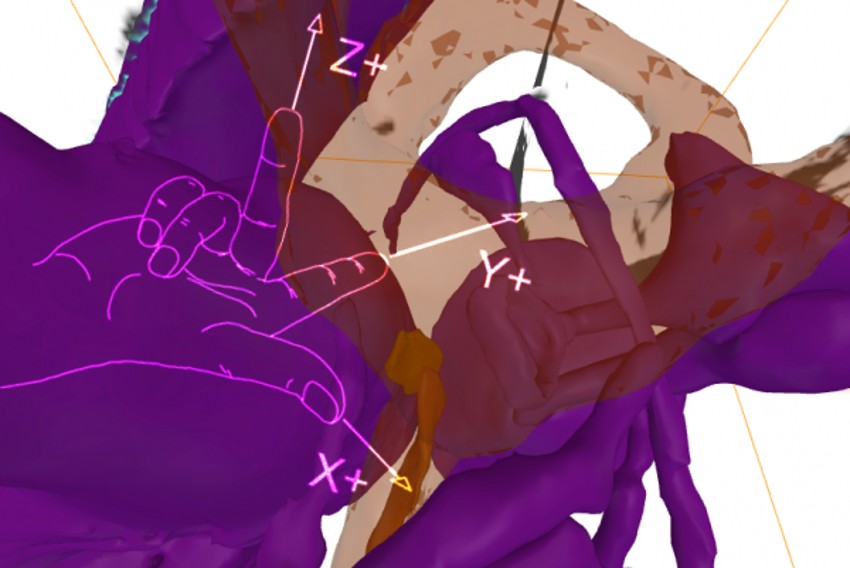
Booklaunch | Volumetric Regimes: Material Cultures of Quantified Presence

"Volumetric Regimes makes an essential contribution to the ways in which we must rethink matter politically and ecologically. As the book unfolds, ontological questions of intensities, dimensions, and substance are denaturalised as mere properties of matter that can be measured, modified, and thus computed, which today are exemplified by 3D modelling and parametric design, but are shown to be part of processional life-worlds that relational and mutually informed and informing. Not the partitioning of bodies, particles, datapoints, and spaces as techno-capital and techno-science would have it but a material enmeshment that brings the volumetric into presence otherwise." Susan Schuppli

This radical multi-form collective investigation traces the cutting edge of how bodies and subjects are rendered technologically. It proposes multi-dimensional forms of intervention, and claims an experimental horizon of the possible, shattering the mantra of unavoidability.” — Olga Goriunova


To download the pdf and/or order a paper copy on-line: 

http://data-browser.net/db08.html

http://www.openhumanitiespress.org/books/titles/volumetric-regimes/ 

Six years of trans*feminist disobedient action-research on 3D technologies, paradigms and procedures culminated in Volumetric Regimes: Material Cultures of Quantified Presence (Open Humanities Press 2022, DATA-browser series, eds. Geoff Cox and Joasia Krysa). Compiled by Possible Bodies (Femke Snelting and Jara Rocha), the publication brings together diverse materials on the political, aesthetic, computational and relational regimes in which volumes are calculated. The book foregrounds technological practices that invite widenings of what is possible. With contributions by Sophie Boiron, Maria Dada, Pierre Huyghebaert, Phil Langley, Nicolas Malevé, Romi Ron Morrison, Simone C. Niquille, Helen V. Pritchard, Jara Rocha, Sina Seifee, Femke Snelting and Kym Ward.

Tuesday 4 October 20:00 – 22:00 @ Varia, Rotterdam (NL)
https://varia.zone/booklaunch-volumetric-regimes.html

The event at Varia celebrates the wiki-to-print paper edition designed and developed by Manetta Berends. It is a special moment in an ongoing multi-local launch, made up of playful contributions, informal responses and interactive formats proposed by comrades in the making of technosciences otherwise.

The evening starts with a performative introduction by the editors, followed by an intervention by designer, artist and researcher Alex Zakkas in conversation with Manetta Berends.


Books will be sold at the event at a reduced price.
All materials have also been published on a dedicated wiki: https://volumetricregimes.xyz/

Volumetric Regimes is produced with support from London South Bank University and Liverpool John Moores University.
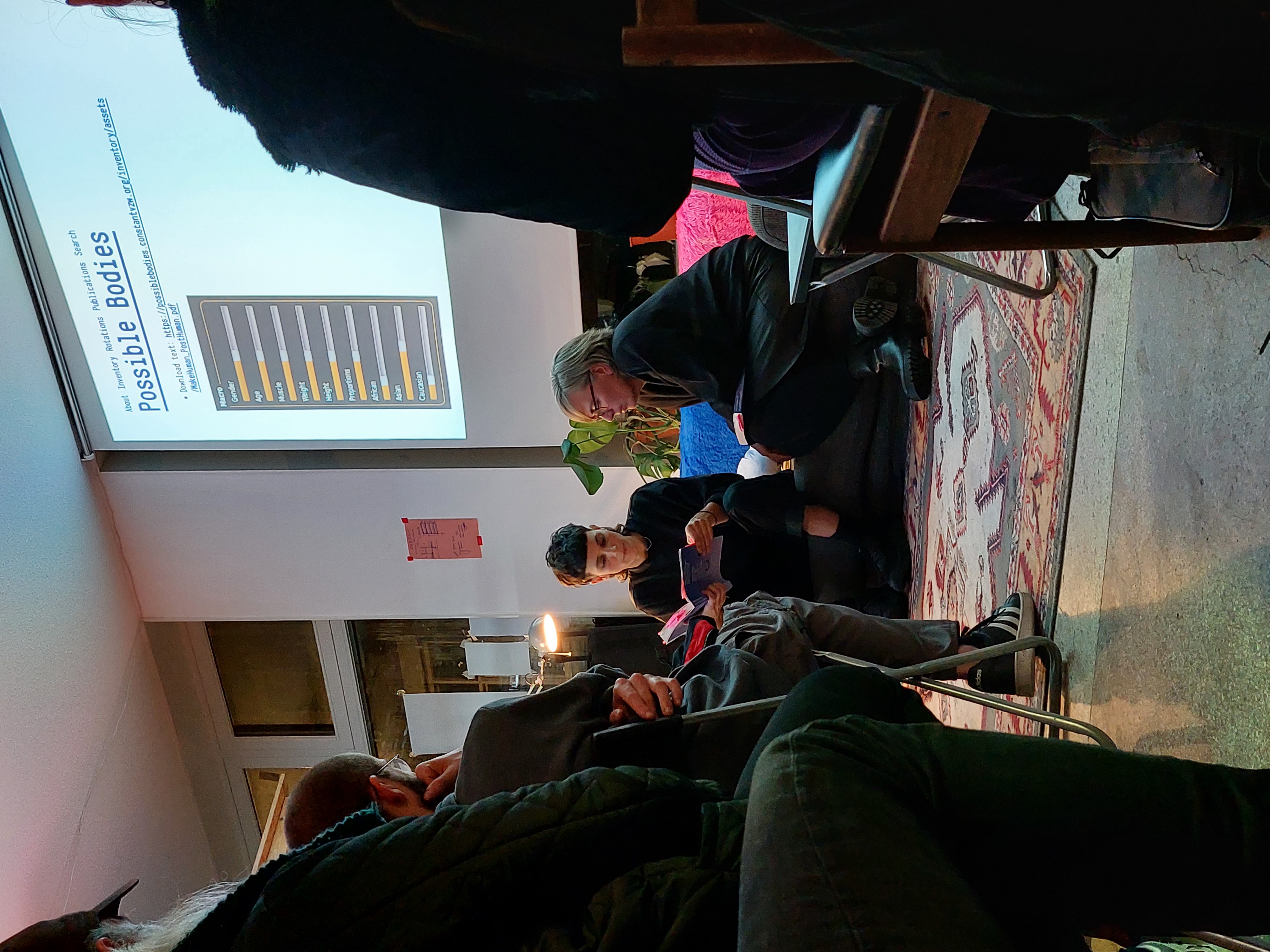

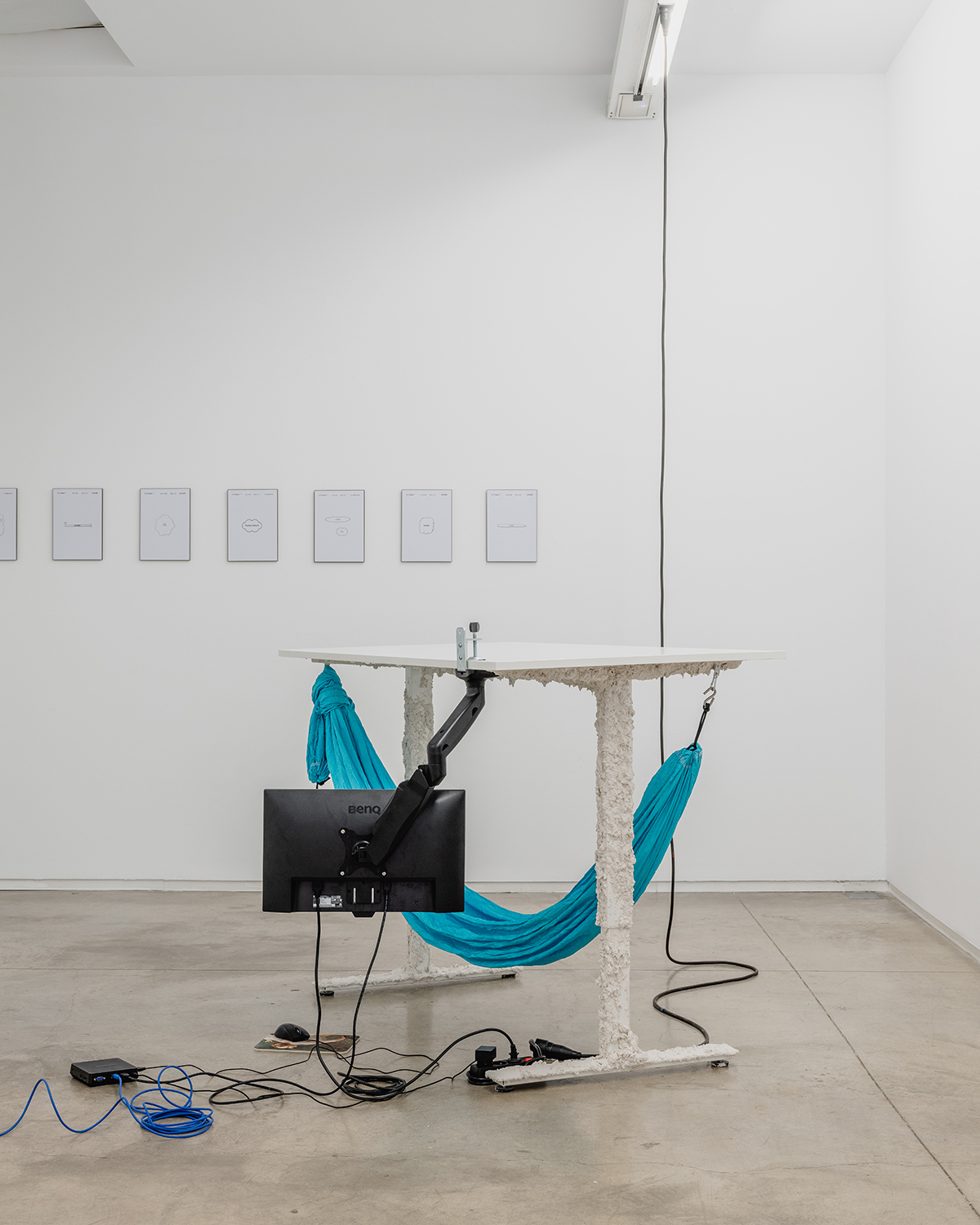
(pic by Varia https://varia.zone/archive/2022-10-04-Volumetric-Regimes-booklaunch/)


1.10.22

Elefants dins l'habitació | Ecoles de Context | La Capella

Escoles de context és un programa d’estudis que posa l’èmfasi en facilitar recursos formatius, línies d’investigació i espais de trobada a disposició de la comunitat artística de la ciutat. Així, l’objectiu de “fer context” mitjançant la pràctica es reformula com un dels eixos vertebradors de La Capella, donant peu a una sèrie de subprogrames estables dedicats a la performativitat de la veu, la textualitat, la cultura LGTBIQ+, la noció de llibreria i el mateix autoaprenentatge institucional.

Com a prova-pilot, Escoles de context inicia les seves dinàmiques el pròxim mes d’octubre, assajant temporalitats, ritmes i intensitats diverses que, a la vegada que posen sobre la taula certs atributs contextuals inherents a la pràctica artística emergent a Barcelona, possibiliten també una revisió i posada en crisi constant del model institucional, tant a escala d’infraestructura com humà, que defineix La Capella. Els grups d’estudi de les Escoles de context s’adrecen a la mateixa escena artística, establint dinàmiques de proximitat amb grups petits i regulars que només s’obriran al públic quan la situació ho requereixi.

El grup de persones que conformen Escoles de context són Enric Farrés Duran, Alexandra Laudo, Daniel Gasol, Marc Vives, Laia Estruch, Jara Rocha, i amb les següents línies d’investigació:

PUBLICACIONS - La llibreria de La Capella

A cura d’Enric Farrés Duran

TEXTUALITAT - Branca, arrel, brot, tija

A cura d’Alexandra Laudo

VEU - Escola de veu

A cura de Laia Estruch i Marc Vives

CULTURA LGTBIQ+ - Transmaricabollo

A cura de Daniel Gasol

INFRA-INTRA-APRENENTATGES INSTITUCIONALS - Elefants dins l'habitació

A cura de Jara Rocha:

La xarxa de dependències infraestructurals on succeeix el dia a dia de les estructures institucionals també és cultura, i defineix pràctiques artístiques. Aquesta escola es planteja com un espaitemps en què atendre les continuïtats i discontinuïtats, herències i prospeccions, latències i potències que configuren el context tècnic, burocràtic i semiòtico-material, i amb què els centres d'art es constitueixen. En sessions d'estudi intrainstitucional, conversant i documentant a partir de close-readings d'infraestructures, eines, protocols i literatura grisa, La Capella s'exposa a un procés de coneixement del medi en què existeix el centre d'art.


+ info e inscripciones: https://www.lacapella.barcelona/ca/escoles-de-context-1


15.9.22

Expo | Duerme en el accidente que provoca

Sobre las numerosas y contradictorias experiencias del hogar


Exposición, 15.09.2022 - 08.01.2023 (Barcelona)

Las numerosas y a menudo contradictorias experiencias que provocan las nociones de hogar laten bajo una gruesa capa de asunciones, imposiciones, inercias y familiarizaciones. ¿Qué ocurre cuando estas latencias de vivencias dispares se agitan, se exponen y se cruzan provocando accidentes, señalando violencias y abriendo posibilidades?

Duerme en el accidente que provoca es un tejido de preguntas y propuestas artísticas acerca de significados y dudas, vivencias y extrañamientos, genealogías e historias, políticas y Políticas, representaciones o difuminaciones, explotaciones y exploraciones, espacios y tiempos, nosotres incluyentes o excluyentes, violencias y revictimizaciones, o las matrices de racismo, clasismo, capacitismo, androcentrismo, antropocentrismo.

Una exposición formada por las propuestas individuales y colectivas del grupo de artistas seleccionades, por las actividades paralelas con las voces y participaciones de otros agentes convocados y por una mesa situacional que se ha ocupado colaborativamente de provocar y acompañar los procesos y subprocesos de creación y reflexión.

Mesa situacional+

Hannah Adib 
Asunción + Guasch 
Gael del Río + Luca Bani 
Daniel Cid + Francesc Pla + Eva Serrats 
Gema Darbo 
Agnes Essonti 
Rafael Frazão 
Hogar Diska 
Hogueras/hogares 
Lucía Lijtmaer 
Julio Linares 
Eva & Franco Mattes 
Noha Mokhtar + Júlia Nueno + Xavier Nueno 
Recetas Urbanas (Santiago Cirugeda + Alice Attout + Yaiza Ares) 
Río Paraná (Duen Sacchi + Mag De Santo) 
TAKK (Mireia Luzárraga + Alejandro Muiño)
Génesis Valenzuela 

+ info y programa: https://artssantamonica.gencat.cat/es/detall/Dorm-en-laccident-que-provoca

10.9.22

the Cell for Digital Discomfort @ The Hauntologists | BAK (Utrecht)


10 September–13 November 2022
BAK, basis voor actuele kunst, Utrecht

18–20 November 2022
İKSV, Istanbul

2–4 December 2022
GUDSKUL, Jakarta

Participants include: Özge Açıkkol, Merve Bedir, Kerem Ozan Bayraktar, Cell for Digital Discomfort (Cristina Cochior, Karl Moubarak, and Jara Rocha), Dika+Lija, Philippa Driest, freethought collective, Ilgın Hancıoğlu, Alexandra Karyn, Gayatri Kodikal, Gatari Kusuma, Yen Noh, Rifandi Nugroho, İlyas Odman, Marina Papazyan, Anitha Silvia, and Zone Collective (Megan Hoetger and Kirila Cvetkovska), among others. 

The Hauntologists is a project emerging through experimentation and collective research within the 2021/2022 BAK Fellowship for Situated Practice. Engaging spectrality as a tactic to investigate and redress the conditions of brokenness of the world, it takes place in Istanbul, Jakarta, and Utrecht from 10 September until 10 December 2022 as a continuously evolving and geographically distributed discursive, performative, publishing, and exhibitionary composition.   

At present, many find themselves haunted by the persisting brokenness of the world—inequality, war, racial and gendered violence, precarity, techno-colonialism, and other perpetual crises. Can one haunt back to intervene and redress this ongoing sense of dread? Could spectrality be embraced as an embodied cultural and political sensibility to experiment with? Can research be practiced as a haunting to overcome the limits of traditional categories of knowledge, knowledge production, and so-called artistic research? 

+info: https://www.bakonline.org/program-item/the-hauntologists/

13.7.22

Vibes & Leaks goes Elastic II, Berlin Fieldtrip

2nd FIELDTRIP of the Vibes & Leaks Goes Elastic process.

Berlin, 14-24 July, 2022.

In collaboration with: Kollektiv Bibliotheck New Yorck Bethanien, Ren Britton and Maeve Devine

Vibes & Leaks elasticizes towards Berlin in July to organize our attentions around a self-managed and assembly-based archive of social movements' banners of several decades, and the implications towards non/normative bodies and collectivities due to somatic difference as well as semiotic-material complexities of the genealogies of struggle.

The plan is to visit (staying there over night or not, this is to be discussed/defined!) the amazing archive of the formerly squatted space of Bethanien, which now is a house project called "New Yorck". Along the years, for decades, this archive became a key backbone for the memories of social movements, local and international, and hosts a massive amount of books, fanzines, posters and other printed materials. There is a small group (of circa 5 people?) caretaking for the archive, which contains contents of a super wide array of socio-political struggles, from kurdish and zapatista fights to transfeminisms, squatting legacies, anti-gentrification, anti-colonialism, ecologism, etc. Really, really a jewel of paper and cardboard in the middle of Kreuzberg neighborhood. But what interested us more is that they also host an archive of demonstration banners: they keep the memories of voices which once occupied public space with reclaims, affirmations and rejections of many sorts and sensibilities, but clearly intersected. Huge banners, medium banners, small banners. Banners in german and english and spanish and arabic and greek and... banners of textile and of recycled plastic, banners so big that needed to be folded and kept somewhere, together. Apparently the Kollektivbibliothek only hosts the banners, but they belong to a different collective. We love the idea of these banners and posters --along with zines, books and stickers, for sure-- being our axis for a research on what voices get to be heard, where and by whom. What claims circulate and can be read, or not. What urgencies get passed along from bodies to collectives to cityscapes. And which ones get lost in time while others still pervail on our contemporaneity, in our politicized to-do lists.

This is why we also approached Ren Britton: because their sensibility regarding what gets heard or seen, in a queer and trans*feminist fight against ableism, is super important to us and we want to learn and invent things together with Ren as well. And of course the device of the archive itself comes with its big problematics, which we need to look at together, with a queer technosciences approach.

small outcome of the session: some Prototypes for Archival Redundance

+ info on the project: http://ttttoolbox.net/VibesnLeaks::index.xhtml 

15.6.22

[Investigación-arte] Infras Antifas

Damos comienzo en colaboración con Higo Mental al proceso de investigación-arte Infras Antifas, gracias a una Beca Barcelona Crea.

Img: David Benqué

¿Sabemos reconocer las estructuras microfascistas en los ámbitos cotidianos? ¿Qué define a una infraestructura, y en qué medida su uso o asimilación participa de lógicas fascistas? ¿Qué impacto tienen la operaciones corporativas en la llamada innovación totalitaria que nos viene impuesta en los detalles más mundanos? Infras antifas es un proceso de investigación en marcha alrededor de estas preguntas con el fin de elaborar una serie de herramientas que nos permitan, por un lado, identificar las derivas microfascistas en nuestros hábitos tecnológicos y, por otro, ofrecer una respuesta a las mismas. Consideramos que el proyecto puede encajarse en las artes visuales, en tanto que son estrategias del campo artístico y visual las que se utilizarán tanto para el proceso de investigación como para imaginar y prototipar el conjunto de herramientas.

Este proyecto pretende arrojar luz —con una sensibilidad trans*feminista— sobre cuestiones a menudo invisibilizadas en los debates en torno al auge de los fascismos. Si bien en los últimos años se ha dedicado mucho esfuerzo desde el ámbito cultural y de la comunicación a entender cuáles eran las estrategias comunicativas de la extrema derecha, es innegable que el fenómeno en auge es demasiado complejo como para explicarlo únicamente desde esta dimensión. Los fascismos no solo se apoyan en una estrategia comunicativa concreta, sino que fundamentan su aceptación social y construcción o limitación de deseo en el campo de lo material. En este campo se encrudece la ideología de la escasez en la que nos encontramos desde hace más de una década y que refuerza tanto los discursos, mensajes e imaginarios fascistas y microfascistas como su materialización en la práctica. Uno de los ejes invisibilizados del ámbito material es el de la articulación tecnoecológica/infraestructural. 

La articulación tecnoecológica/infraestructural contemporánea arroja una complejidad relacional para cuyo análisis probablemente no sean suficientes las perspectivas y análisis sociopolíticos más habituales (Mackenzie Wark), incluidas aquellas más sofisticadas en los ámbitos de la crítica institucional, económica, medioambiental o representacional. Aprendiendo de las tecnociencias transfeministas, urge una inventiva analítica y una imaginación tecnopolítica que provea con métodos más oportunos a esa articulación. Las condiciones semióticas y materiales de posibilidad en un entorno de daño acelerado y precariedad relacional altamente mediada computacionalmente, requieren primero nombrar el régimen patriarco-colonial del tecnocapitalismo como un régimen de resonancias y maneras evidentemente fascistas (limitación de la soberanía de individuos y comunidades, deterioro de canales públicos o autónomos de intervención democrática, universalización por vías de innovación centralizante de grandes poderes tecnológicos, fabricación sintética de escasez y opacitación de los procesos de introducción de dependencias y necesidades de impacto socialmente desigual que intensifican vínculos de exclusión/explotación/extracción basados en el racismo, el sexismo, el capacitismo, el clasismo, el especismo o el edadismo). Pero después de nombrar los fascismos y microfascismos, cabe preguntarse por qué modos de diversificación, ensanchamiento de posibles y florecimiento de tecnodiversidades (Yuk Hui) pueden contribuir a lo que cabría llamar "tácticas infraestructurales antifascistas".

+ info: https://higomental.com/


10.6.22

(Un)wanted Spacetimes | Espaciotiempos (in)deseados


[ESP abajo]

What does it mean to live in the midst of devastation and to find ways to exist through the cracks? Which questions, not new for several modes of existence and lands, are rised by the current planetary crisis? How many worlds have already ended? How many others keep becoming in absolute abandonment? How to give account of the ways in which colonialism, extractivism, patriarchy and different forms of violence have been oppressing, segmenting, excluding and disableing bodies, populations, epistemes and lands for a long time now? This itinerary focuses on (un)wanted zones as spacetimes of sacrifice, and wishes to examine areas that are (administratively, representationally) abandoned, unfairly exposed to damage or strongly wounded. In such places, human or nonhuman existence is disinvested in relation to the deep time of earth as well as the flowing times of day-to-day-turbocapitalism. What is yet to be (un)learned in relation to these areas, and what can the role of technology be? Which tools, discourses, aesthetics and practices can contribute to building forms of transversal resistance and action, while underlining the need for participated, intergenerational and interterritorial environmental justice?

by Daphne Dragona & Jara Rocha


Visit the itinerary on-spot at the show, 09.06-21.08.2022

+ info about The Irruption: https://artssantamonica.gencat.cat/ca/detall/La-irrupcio

Read the itinerary texts here: https://artssantamonica.gencat.cat/en/detall/Espaitemps-desestimats


---


¿Qué implica vivir en medio de la devastación y encontrar formas para existir a través de las grietas? ¿Qué preguntas, ya conocidas para numerosos modos de existencia y territorios, son planteadas por la crisis planetaria en curso? ¿Cuántos mundos ya se han acabado? ¿Cuántos otros siguen sucediendo en absoluto abandono? ¿Cómo dar cuenta de los modos en que el colonialismo, el extractivismo, el patriarcado y las diferentes formas de violencia han estado oprimiendo, segmentando, excluyendo y discapacitando cuerpos, poblaciones, epistemes y tierras durante demasiado tiempo? Este itinerario se fija en las zonas (no) queridas como espaciotiempos de sacrificio, y busca examinar áreas que están (administrativa y representacionalmente) abandonadas, injustamente expuestas a daños o fuertemente heridas. En esos espacios, la existencia humana o no-humana sucede en condiciones de desinversión en relación con el tiempo profundo de la tierra y de los tiempos fluidos del turbocapitalismo cotidiano. ¿Qué queda por ser (des)aprendido en relación a estas áreas, y cuál puede ser el rol de la tecnología? ¿Qué herramientas, discursos, estéticas y prácticas pueden contribuir a construir formas de resistencia y acción transversales, mientras se señala la necesidad de una justicia medioambiental participada, intergeneracional e interterritorial?

por Daphne Dragona y Jara Rocha

Visita el itinerario presencialmente en la exposición, 09.06-21.08.2022

+ info sobre La Irrupción: https://artssantamonica.gencat.cat/ca/detall/La-irrupcio

Lee los textos del itinerario aquí: https://artssantamonica.gencat.cat/es/detall/Espaitemps-desestimats


9.6.22

La Irrupción (ISEA BCN, 2022)

09.06-21.08.2022

ISEA 2022 (Barcelona)

Arts Santa Mònica (La Rambla)

https://artssantamonica.gencat.cat/es/detall/La-irrupcio


La crisis ecológica, climática y social que nos atraviesa provee con agitaciones ecosistémicas múltiples, como por ejemplo el momento pandémico que todavía estamos viviendo. No obstante, aunque los desajustes se narren como irrupciones aisladas, pertenecen a un continuum de fenómenos acumulados. La pandemia COVID-19 es uno de los numerosos síntomas del profundo agotamiento y de una violencia lenta desigualmente distribuida, derivados de esquilmos y macrooperaciones industriales e institucionales extractivas que han sido llevadas a cabo en nombre del desarrollismo y el progreso, en el marco de la modernidad colonial capitalista. Esta exposición propone un conjunto de piezas y proyectos que, desde diferentes posiciones, indagan en esta situación y las posibilidades del arte (siempre limitadas y parciales) para repolitizar las imaginaciones, los traumas, los miedos y las urgencias que nos interpelen e instiguen a irrumpir diferentemente, respons(h)ablemente desde dentro del colapso medioambiental y socioeconómico al que se ha precipitado el planeta Tierra. 

La selección de obras se ha llevado a cabo en el marco de una convocatoria pública elaborada conjuntamente entre el Simposio Internacional de Arte Electrónico 2022 (ISEA 2022) y el centro de artes Santa Mònica. Su despliegue en el espacio expositivo ha sido concebido como una invitación a que quien lo visite recorra la exposición trazando su propia narrativa o siguiendo algunos de los itinerarios específicos propuestos por les comisaries y les colaboradores invitades.

Artistas:
Erich Berger
Uwe Brunner + Bettina Katja Lange + Joan Soler-Adillon

Joana Chicau + Jonathan Chaim Reus
Chanee Choi

Erik Contreras
Roderick Luis Coover + Adam Vidiksis + Nick Montfort
Derek Curry + Jennifer Gradecki
Sara Dean + Beth Ferguson + Marina Monsonís
Joelle Dietrick + Owen Mundy
Nikolas Gomes
Andy Gracie
Xuanyang Huang
Colin Ives
Shona Kitchen
Irma Marco
Lauren Lee McCarthy
Rosell Meseguer
Jane Chang Mi
Kasia Molga
Marina Núñez
S4RA
Robertina Šebjanič  + Sofia Crespo + Feileacan McCormick
Laura Splan
Nooroa Tapuni
Weidi Zhang

Itineraris narratius per:
Paula Bruna y Marta Gracia
Daphne Dragona y Jara Rocha
Joan Yago y Enric Puig
Paz Peña O. 
Israel Rodríguez Giralt
Ian Alan Paul
Grupo Contraimaginarios Postpandémicos

Diseño expositivo:
Francesc Isern
Paula Font

Un proyecto curado por:
Marta Gracia
Jara Rocha
Enric Puig Punyet


1.6.22

Biomitomecánica de la presencia | A propósito de La Voltereta (Mar Reykjavik, 2022)

Biomitomecánica de la presencia

Una película a base de incorporaciones del presente. Su posibilidad. Su inexportabilidad. Y una escultura cilíndrica, de maestría fallera. Mar Reykjavik se expone al estudio, manipulación y manufactura de mecanismos y metodologías que expliciten una traducción a lo real. No es, por tanto, un estudio del presente sino de la biomitomecánica que hace, técnicamente, emerger presencias.

Para Sylvia Wynter, las categorías de lo biológico o fisiológico se constituyen en mutuidad con aquellas de lo narrativo, lo relatado, lo representado culturalmente. Por eso, desde su rotunda crítica al humanismo moderno-colonial, propone una revisión constante desde la complejidad biomítica con que se es. Es una praxis biomítica, la humaneza. La Voltereta atiende a la mecánica de esta praxis, en su defensa.

La humaneza emergiendo a través de operaciones de recursión, no tanto en cambio universal. La humaneza defendiendo el ensanchamiento de las formas del presente, que no la linealidad del tiempo ni la geometría euclidiana de la que no hay afuera. Una zona ancha espaciotemporal, un volumen a la vista que cambiará por combustión en iteración. Se quema hasta por dentro, una y otra vez y así apuntala la presencia fuera de quicio, en el espacio-tiempo ritual.

La Voltereta moviliza procesos auto-instituyentes que tienen la potencia de reinscribir o re-escribir las operaciones de humaneza en el hacer. En el auto-manufacturarse: versionar, crecer, cantar, inventar. En la auto-institución hay siempre giro, la cosa es desde dónde operarlo: ¿impresión <> inercia? ¿transformación <> dolencia? ¿invocación <> ficción? ¿intuición <> abrazo? ¿nutación <> reparación?

Primero está la fase de impulso, con la semiosomática de lo rígido, lo controlado, la ordenación de posiciones. Para hacerla aquí-ahora, cuatro actos en digital. Luego está el fuego, ritual para oscilar el eje en movimiento, la nutación de las formas. Y luego viene la caída en actos analógicos, una redistribución de lo factible y de lo sensible cuya salida será parecida al presente, pero habiendo encarnado la energía rotacional, una inercia, una memoria, una imaginación, unas formas de hacer. Después de la caída el presente es impresentable y urge seguir intentando su biomitomecánica. En la maestría del fallo, while mastering the fall. Somos la humaneza defendiéndose.

Jara Rocha, Junio 2022


 + info exposición "La voltereta" en Galería Àngels Barcelona http://angelsbarcelona.com/en/artists/mar-reykjavik/exhibitions/la-voltereta/287

+ info trabajo Mar Reykjavik https://www.mataderomadrid.org/en/residence/mar-reykjavik

27.5.22

Son[i]a #350. Deleted scenes

We dig up some unreleased fragments of our conversation. We talk about research as an interdependent practice and we call for complexity. Along the way, we speculate on non-coercive forms of computation and consider some case studies from the collaborate project Possible Bodies and The Underground Division.

Listen: https://rwm.macba.cat/en/extra/sonia-350-jara-rocha-deleted-scenes

Conversation: Anna Irina Russell, Albert Tarrats, Ricardo Cárdenas and Anna Ramos. Script: Anna Irina Russell. Production: Anna Ramos. 


  • 00:01 Interdependent research
  • 03:35 Conversational crossroads as a starting point for generating amalgams
  • 05:30 Mapping and DIWO/DIY
  • 08:46 Bitflipping, non-coercive computing, and a hunch about 3D to be explored
  • 13:02 Possible Bodies
  • 15:23 The three axes of Possible Bodies: (X) so-called bodies, (Y) the legacy of volumetric technologies, (Z) the probable and the possible
  • 21:25 Inventory as methodology
  • 26:46 Research and disobedient action
  • 30:36 Languaging
  • 34:29 Item #89: The truthful hairy hominid and the cracks of parametric truth
  • 43:25 The case of Make Human
  • 47:28 Item #117: Fold Out. Detection of “fugitive bodies” in lush borderlands
  • 49:00 G-plates: visualization of plate-tectonic processes and movements. A change of scale
  • 51:27 Texts on the table: Sylvia Wynter, Cassandra Troyan, Sophie Lewis, Helen Prichard, Martino Morandi...

22.5.22

[workshop] Installing Ourselves into Libreplanet

RESCHEDULED: May 23

A workshop session to map out each of our current conditions of connecting and being together, the physical-political, and technological conditions using a diagrammatic methodology.

The workshop is geared towards installing ourselves into the conference's infrastructural spectralities by sharing, learning from and attuning to each others' conditions for connectivity, online participation and basic computer-mediated mundane day-to-day life. We want to pose this affirmation as an initial trigger: installing is about situating — attuning to our network of (inter)dependencies and attuning to the dependencies with our local and vernacular but also standardized and planetary networks.

This workshop was created in the context of the Fellowship for Situated Practice organized by BAK.

  + info: https://www.fsf.org/events/libreplanet-workshop-april-25-installing-ourselves-into-libreplanet


17.5.22

Tilt the Scroll to Repair: Efficient Inhuman Workforce at Global Chains of Care

it is fundamental to challenge the GAFAM regime from a perspective of anticolonial and transfeminist intersectional analytics. The crisis of presence at the global chains of exploitation is already mundane: by user power wasted—­or washed away—­by a capitalist patriarchal-­colonial matrix of woven and wefted infrastructures; by an infrastructure of damage arranged around supply chain events such as the domesticated labor

production of microtaskers (or “Turkers”), the offshore labor production of hardware assemblers; by the shipping routes that routinely trace the colonial scheme; by the waste around smelters and refiners erasing life all around; by the care workforce that shoulders all this productive weight. In sum, by a convergence of powers entwined in the project of massive extraction, growth, and control.

To continue with the urge for a denser and more complex technopolitical imagination, those global chains of care need to be scrolled up and down, sideways, and underneath. Scroll the chains away from the userized nonlife flows hidden by Amazon. Scroll the chains through to show their damage. Scroll the chains along to tilt forces and erase GAFAM & Co.’s efficient machinery. Scroll off the chains, and partially repair them through other computational geometries of relation.

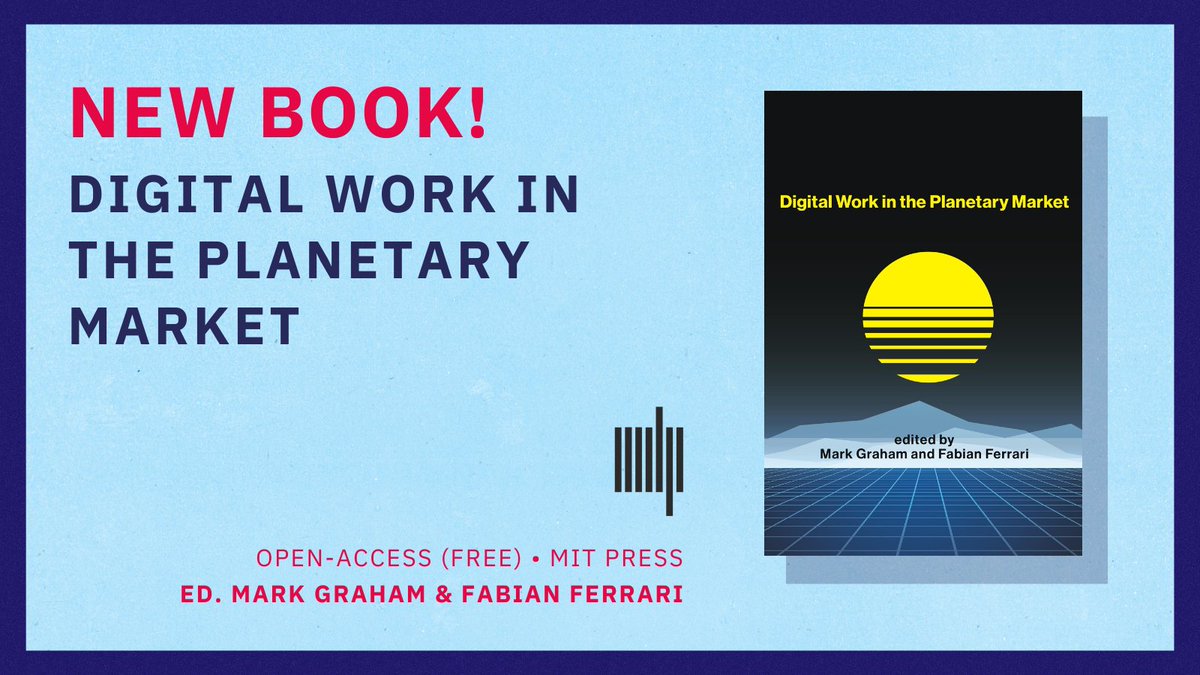
Our chapter, titled "Tilt the Scroll to Repair: Efficient Inhuman Workforce at Global Chains of Care" and co-written with artist-researcher Joana Moll, is finally out in the volume titled "Digital Work in the Planetary Market", edited by Mark Graham and Fabian Ferrari and published by MIT Press (2022) under fully open conditions:

https://direct.mit.edu/books/oa-edited-volume/5319/Digital-Work-in-the-Planetary-Market 

& accessible in different formats (pdf, html5, epub or order paper copies) right here --> https://www.idrc.ca/en/book/digital-work-planetary-market

Understanding the embedded and disembedded, material and immaterial, territorialized and deterritorialized natures of digital work. Many jobs today can be done from anywhere. Digital technology and widespread internet connectivity allow almost anyone, anywhere, to connect to anyone else to communicate and exchange files, data, video, and audio. In other words, work can be deterritorialized at a planetary scale. This book examines the implications for both work and workers when work is commodified and traded beyond local labor markets. Going beyond the usual “world is flat” globalization discourse, contributors look at both the transformation of work itself and the wider systems, networks, and processes that enable digital work in a planetary market, offering both empirical and theoretical perspectives.

The contributors—leading scholars and experts from a range of disciplines—touch on a variety of issues, including content moderation, autonomous vehicles, and voice assistants. They first look at the new experience of work, finding that, despite its planetary connections, labor remains geographically sticky and embedded in distinct contexts. They go on to consider how planetary networks of work can be mapped and problematized, discuss the productive multiplicity and interdisciplinarity of thinking about digital work and its networks, and, finally, imagine how planetary work could be regulated.

Contributors

Sana Ahmad, Payal Arora, Janine Berg, Antonio A. Casilli, Julie Chen, Christina Colclough, Fabian Ferrari, Mark Graham, Andreas Hackl, Matthew Hockenberry, Hannah Johnston, Martin Krzywdzinski, Johan Lindquist, Joana Moll, Brett Neilson, Usha Raman, Jara Rocha, Jathan Sadowski, Florian A. Schmidt, Cheryll Ruth Soriano, Nick Srnicek, James Steinhoff, Jara Rocha, JS Tan, Paola Tubaro, Moira Weigel, Lin Zhang


12.4.22

Naturoculturas son disturbios #8 Martino Morandi & Jara Rocha feat. The (de)Ontologi(ci)sts


Listen online at:

https://dublab.es/shows/naturoculturas/11-04-22

Tracklist:

  • The Flipping (de)Ontologi(ci)sts - The Flipping (de)Ontologi(ci)sts (2019)
  • Missy Eliot - Work It - Work It (2002)
  • chris dreier - P.S.Y.O.P (2021)
  • Karmen Ponikvar - Linear constructions (2022)
  • Jojo’s Skank - Chip on Fire - DISRUPT (2020)
  • Hyena - Floor 01 - Particle Decelerator (2020)
  • ATAMATOR - New approach to sort bits - Image Stitching (2014)
  • ATAMATOR - Addicted To Final Tunnels (2018)
  • Paratech - Gate Keepers (2018)
  • Jona - Cosmic Ocean ⬝ Episode III (2021)
  • Femke Snelting - How to Kill a Supercomputer - The Bitflipping Mixtape (2019)
  • Helen Pritchard - Alpha Ray, Alpha Decay - The Bitflipping Mixtape (2019)
  • Maria Dada - The Good Zero - The Bitflipping Mixtape (2019)
  • Martino Morandi - Flip-Flap-Flop - The Bitflipping Mixtape (2019)
  • Jara Rocha - Square Wave - The Bitflipping Mixtape (2019)

10.4.22

El inventario de Possible Bodies: la des-orientación y sus consecuencias

Traducción y republicación por parte de nmenos1, a invitación de Juan Covelli.


Cada uno a su modo, los ítems están relacionados con un mundo que está deviniendo oblicuo, donde dentro y fuera o arriba y abajo están cambiando posiciones, y donde nuevas perspectivas se hacen disponibles. Hablan de la mutua constitución de cuerpos y tecnologías, materia y semiótica, naturaleza y cultura; y de cómo se gestiona la orientación en las herramientas a través de la matriz tecnológica de la representación.

 +

Tratamos de experimentar su proceso de “hacer mundo” permaneciendo en la exigencia de “entrar” en el software. Manteniendo un equilibrio entre la comprensión y la confusión, utilizamos la sensación de desorientación creada por los conceptos cambiantes de la palabra “mundo” para medir lo que sucede cuando un término tan vertiginoso se extrae del lenguaje coloquial para ser re-normalizado y re-naturalizado. En el nauseabundo contexto semiótico del modelado de 3D, la palabra “mundo” comienza a funcionar en otro espacio, igualmente real pero abstracto.

+

Todo parece demasiado imponente, demasiado normativo en el sentido humanista, incluso demasiado esencialista. ¿Qué composiciones corporales comparten una base horizontal, qué entidades tienen el don de comportarse verticalmente? ¿Cómo afectan otras trayectorias a nuestras condiciones semióticas-materiales de posibilidad y, por lo tanto, a la misma política que los cuerpos co-componen?  

+

Puede que sea necesario dejar de lado la necesidad de “suelo” como elemento definidor de la propia existencia del cuerpo, aunque esto nos hace preguntarnos acerca de las agencias que trabajan en esta encarnación sin suelo. Si la tierra es para aquellos que la trabajan, entonces ¿quién trabaja el suelo?

Texto completo: https://www.nmenos1.xyz/public/texto/web

1.4.22

Figúratela | A propósito de "Physical Data" (Mario Santamaría, 2022)

No es una anécdota. Es la memoria oficial de cómo se estableció uno de los regímenes tecnosociales más nocivos del presente. La meticulosa cosecha de nubascos es una operación en parte de desvelamiento, en parte de confirmación. No es una anécdota. Es la confirmación personal de cómo se hace llegar uno de los regímenes tecnosociales más nocivos del presente a su pantalla. La meticulosa peregrinación del gestor de contenidos (aka aquel con la contraseña para editar http://www.mariosantamaria.net) es un procedimiento en parte de desvelamiento, en parte de confirmación.

Se ha levantado un régimen de turbocapital que orbita en torno a sobre todo tres ejes: la figuración de la nube, el software, la plataforma y la infraestructura como servicios (SaaS, PaaS e IaaS, respectivamente) y la escalabilidad vertical estandarizada (que permite la computación bajo demanda y la customización). Se ha levantado un régimen tecnocolonial que pendula en torno a sobre todo dos planos: el epistemicidio (la aniquilación por vía informática y a escala global de cosmovisiones, sensibilidades, saberes, códigos o sistemas de inscripción) y el extractivismo (el esquilme por vía matemática y a escala planetaria de atenciones, vinculaciones y tierras raras o no).

No es diversidad, es el aplanamiento de la espesura de lo que hay. Y por eso importa la atención a los modelos y su sencilla bidimensionalidad. Toda esa complejidad en un trazo esquemático, acaso con un intento de sombreado automático. Toda esa rugosidad en un contraste limpio, pulido, como si. No es diversidad, es aplastamiento de la distancia entre lo que hay. Y por eso importa la atención a los paquetes y su supuesta linealidad. Toda esa complejidad en una circulación eficaz, acaso con un intento de desterritorialización automática. Toda esa rugosidad en una entrega rápida, inmediata, como si.

No es solo el ordenador de un tercero, y eso lo cambia todo. El mapeo de la red de inter-dependencias desde los mulliditos recovecos de las representaciones de la llamada nube, o en el mundo que corre entre nodo y nodo de telecomunicación, se convierte en una tarea vaporosa y tediosa, con matices difusos y casi imposible de producir un posicionamiento. Casi, porque sí cabe figurarse la abolición de aquello que produce luz de gas al desposeer del relato de lo inaprensible y al limitar lo que en realidad sí se puede, pero de otros modos. Cabe figurarse la abolición de aquello que evita expresarse en toda su violencia, que requiere mil trazos para perfilar un asentamiento tan profundo y excluyente de los modos de entender, de existir, de ponerse en relación.


Jara Rocha, abril 2022


+ info sobre Physical Data en espai L de la Casa Canals https://agenda.cultura.gencat.cat/content/agenda/ca/article.html?c=eyJrZXl3b3JkcyI6Im5pdCIsImRhdGFPcHRpb24iOiIiLCJkYXRhRGVzZGUiOiIiLCJkYXRhRmluc2EiOiIiLCJlc3BhaSI6IiIsInBvYmxhY2lvIjoiIiwiYW1iaXRzIjpbXSwiY2F0ZWdvcmllcyI6W119&page=0&article=20220520016

+ info sobre trabajo de Mario Santamaría  https://mariosantamaria.net/

31.3.22

Son[i]a #350

Intensamente íntimo, balbuceante y difícil de compartir, pero aquí un podcast en Radio Web MACBA que se hizo hace un año y luego se paró y luego se retomó y circuló. Con todo el cariño y la complejidad al cuidado de Anna, Anna Irina, Albert y Ricardo <3

ESCUCHA aquí --> https://rwm.macba.cat/es/sonia/sonia-350-jara-rocha


  • 00:23 Las condiciones semiótico-materiales de posibilidad
  • 05:46 Maternar y cocriar en un espacio no solo nuclear
  • 13:53 Complejidades del nombrar
  • 19:02 Edadismo y adultocentrismo
  • 22:55 El teatro de la genética y el tabú de la no transferencia genética
  • 35:00 Juegos con el vocabulario: ensanchamiento de los posibles a través del lenguaje
  • 42:27 Disidencia lingüística y puesta en circulación
  • 46:32 Autodefensa bibliográfica
  • 47:26 Abrazar la complejidad
  • 52:05 Cortes parciales y uso táctico de las identidades
  • 58:58 Respons(h)abilidad
  • 64:40 Pedagogías críticas, Martino Morandi y la escuela de verano Relearn
  • 76:41 Detectar zonas de potencia
  • 79:44 Los problemas del solucionismo
  • 83:23 Tecnocolonialismo, turbocapitalismo y cadenas globales de cuidados
  • 91:11 Amazon Turkers: precarización, invisibilización y deslocalización del trabajo.
  • 95:06 Visión computacional. Nicolas Malevé y las promesas de los algoritmos
  • 101:38 El rigor en la investigación en formatos no académicos
  • 106:41 Sobre el tiempo: The Underground Division y "Figurations of Timely Extraction".
Conversación: Anna Irina Russell, Albert Tarrats, Ricardo Cárdenas y Anna Ramos. Guión: Anna Irina Russell. Producción: Albert Tarrats. Voz: Anna Ramos. Sonido: librería sonora de Albert Tarrats. 
 
+ info sobre RWM: https://rwm.macba.cat/es/sobre-rwm

28.3.22

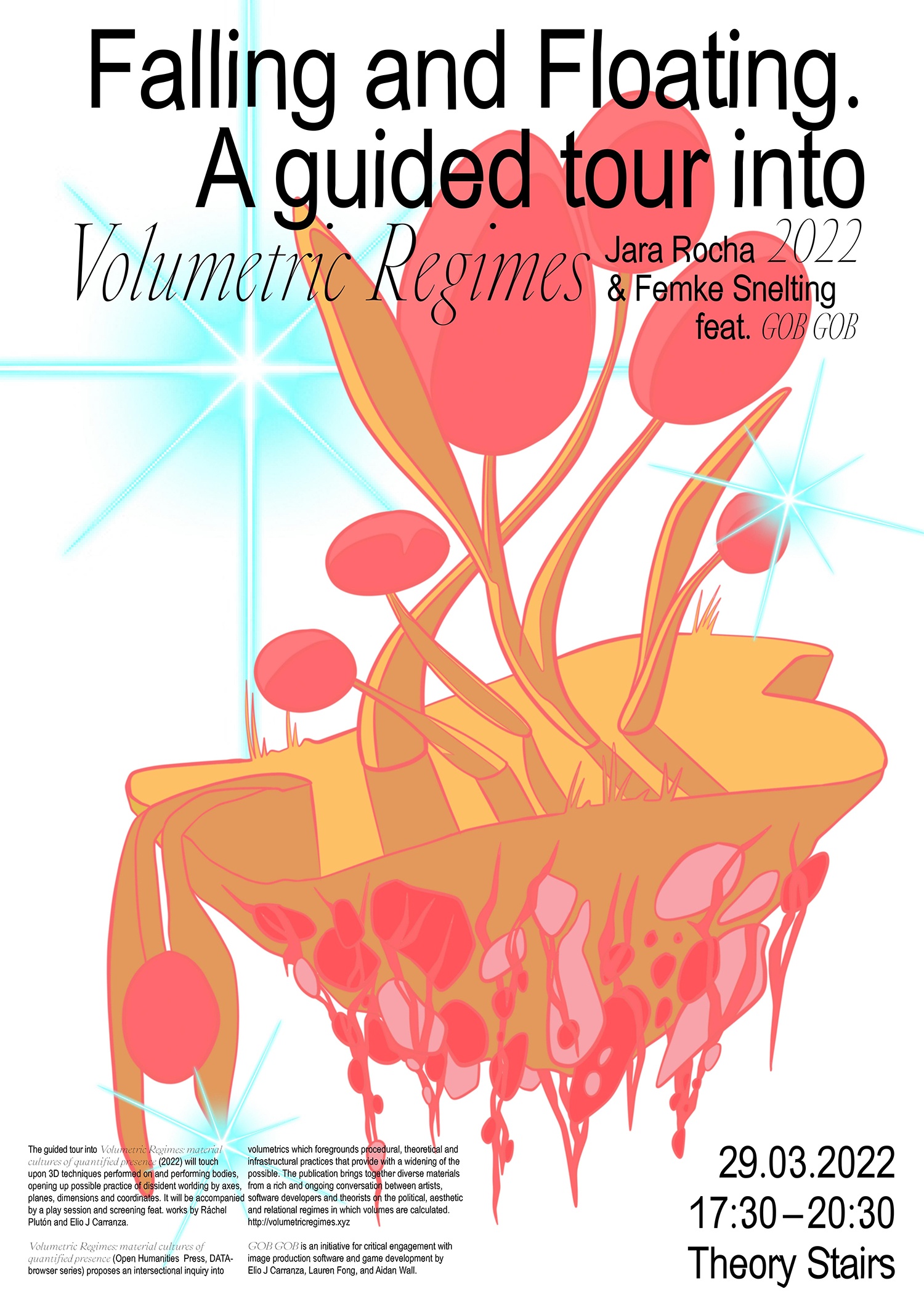
Falling and Floating. A guided tour into Volumetric Regimes feat. GOB GOB


29/03
17:30-20:30 
@Theory Stairs, FedLev Building (Sandberg Instituut)
 
Six years of trans*feminist disobedient action research on 3D technologies, paradigms and procedures are about to be published as “Volumetric Regimes: Material Cultures of Quantified Presence” (Open Humanities Press, DATA-browser series). The book foregrounds technological practices that provide with a widening of the possible and brings together diverse materials on the political, aesthetic and relational regimes in which volumes are calculated. The ongoing multi-local launch of Volumetric Regimes is made up of playful contributions, informal responses and interactive formats proposed by known and unknown comrades in the making of technosciences otherwise. 

The guided tour into Volumetric Regimes: material cultures of quantified presence (Open Humanities Press, 2022) at Sandberg Institute will touch upon 3D image production tools and the possible practice of dissident worlding by axes, planes, dimensions and coordinates. It will be matched with play session and screening feat. works by Ráchel Plutón and Elio J Carranza. 

Optional Reading: 

GOB GOB is an initiative for critical engagement with image production software and game development by Elio J Carranza, Lauren Fong, and Aidan Wall.
 

23.3.22

Rendering Research at ERG (BXL); Book launch feat. Elodie Mugrefya


Possible Bodies (Jara Rocha, Femke Snelting) feat. Elodie Mugrefya will present their upcoming book Volumetric Regimes: Material Cultures of Quantified Presence on Thursday 24th March at 17.30, at ERG (école de recherche graphique), 87 rue du Page – 1050 Bruxelles – as part of the Rendering Research workshop organized by DARC (Aarhus University), CSNI (London South Bank University) and transmediale festival for art and digital culture. All welcome.

The ongoing multi-local launch of Volumetric Regimes is made up of playful contributions, informal responses and interactive formats proposed by known and unknown comrades in the making of technosciences otherwise. For the occasion of Rendering Research we will be joined by Elodie Mugrefya, who we invited to re-interpret, critique, and/or remix materials from Volumetric Regimes through her sensibility for technocolonial knowledge production.
 
Elodie Mugrefya is a member of Constant, Brussels where she takes part in its artistic and collective researches while developing a writing practice that intersects with Constant's themes of interest; notably notions surrounding collectivity, technological infrastructures and socio-political troubles. Constant develops projects across art and technology and operates through its commitment to free/libre open source cultures and intersectional perspectives. https://constantvzw.org/
 
+ info: https://www.centreforthestudyof.net/?p=6230 
+ info on the overarching context of Rendering Research: https://transmediale.de/projects/aarhus-university-london-south-bank-university

22.3.22

A Traversal Network of Feminist Servers (+radio broadcast)


A Traversal Network of Feminist Servers (ATNOFS) is a collaborative project formed around intersectional feminist, ecological servers. Understanding servers as computers that host space and services for communities around them, this project exists inside, and in between, roaming servers and different networks. Our decentralized programme will occur in 5 locations (The Netherlands, Belgium, Romania, Greece, Austria) with the collaboration of 6 partners (Varia, LURK, Constant, HYPHA, Feminist Hack Meetings, and ESC).

In the first session, hosted in Varia, we will focus on tools and methods to make space for understanding what feminist publishing infrastructures could be. During the weekend of March 26 and 27, we will be experimenting with publishing infrastructures. The tools and methods that will emerge can later be used for further knowledge sharing as the project moves location and the programme evolves.

The session in Varia will kick-off with a public radio broadcast on the evening of Wednesday the 23rd of March. For this broadcast, we will be joined by two practitioners who have been working on and around feminist and activist servers: Spideralex and Danae Tapia

+ info at Varia's site <3 https://varia.zone/en/atnofs-varia.html 

16.3.22

Aalto Photo Talks


Thursday, March 17th 2022 on Zoom from 15:00 - 16:00

Doctoral Seminar - Open to everyone!

Date: 17th March 2022

Time: 15:00 - 16:00


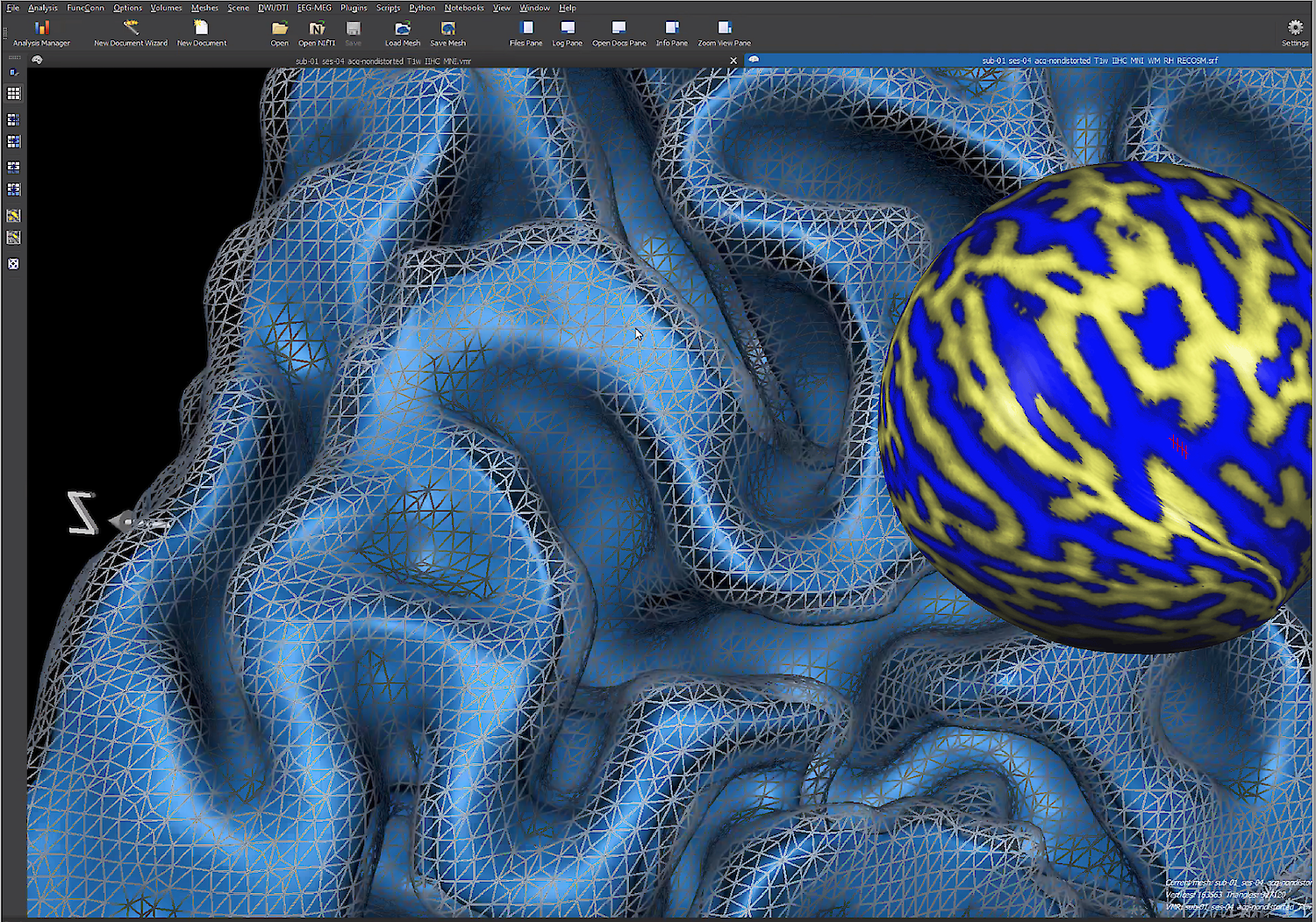
"For the second installation of Aalto Photo Talks, we have invited artist and researcher duo Femke Snelting and Jara Rocha as our guest speaker. In their forthcoming book Volumetric Regimes: material cultures of quantified presence (Open Humanities Press, 2022), authors Jara Rocha and Femke Snelting bring together several years of discussing and working with artists, software developers and theorists who detect, track, print, model and render volumes. During the talk, the duo will read and discuss the chapter “Invasive Imagination and its Agential Cuts”. The authors argue that tomography, a set of digital techniques which has become ubiquitous in the medical imaging field, produces “exclusionary boundaries,” i.e. that they generate outcomes according to pre-established categorizations and norms of the human body. Zooming in on the example of the Open Source “3-D Slicer” software, they show how digital cutting is part of a culture of quantification, and naturalised as a scientifically objective gesture. Rocha and Snelting challenge this dominant imagination of biomedical informatics and mount an “affirmative critique” by proposing technical tweaks and changes, thus opening up the possibility of “oblique, deviating, unfinished and queer cuts.”

https://volumetricregimes.xyz/

https://possiblebodies.constantvzw.org


The talk is open to public and we welcome Aalto students from the Department of Media and other disciplines to join us. Please also feel free to invite students from outside of Aalto.

Thank you Yiu Sheung for the invite!


26.1.22

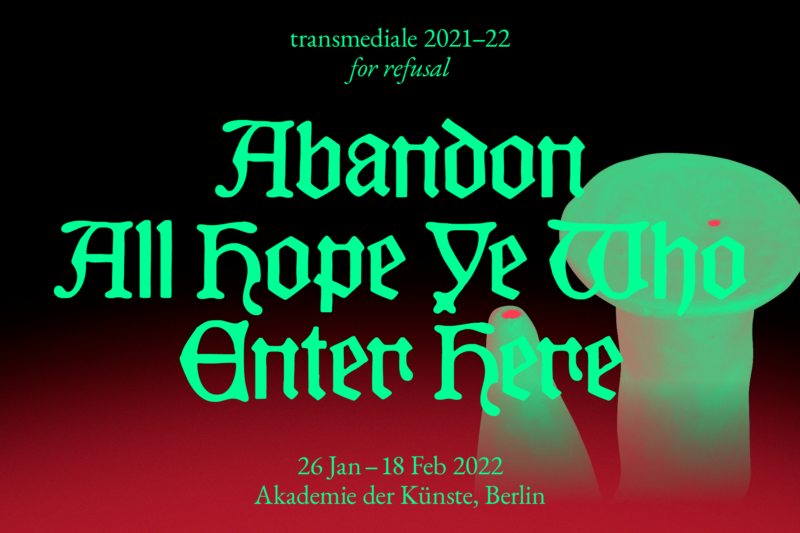
abandon all hope ye who enter here | Queering Damage / The Underground Division at transmediale 2022 exhibition


Conjuring artifice and dark humour in the face of extraction, financial fantasies, and the illusions of techno-solutionism, abandon all hope ye who enter here explores the limits of refusal in a computationally ordered and altered world. Bringing together nine artists and collectives, the works in the exhibition materialise the strange realities and cruel attachments that are often obscured beneath the veneers of shiny, seductive interfaces, and inside algorithmic black boxes. 

(...)

+ about exhibition: https://transmediale.de/projects/abandon-all-hope-ye-who-enter-here

+ about Queering Damage: https://transmediale.de/artworks/queering-damage


25.1.22

Slicing, Blackboxing and Queer Cutting


A MERIAN reading group on futures of biomedical 3-D imaging practices

Thursday, 24 February 2022
16:00 – 18:00 CET

Please join at the Jan van Eyck or online (details coming soon).
To take part and receive the texts, please register by sending an email to info@merianmaastricht.nl


During this public reading group, participants are welcome to discuss two texts from recent books on the politics of imaging, automation and 3-D computation.

Authors Jara Rocha, Femke Snelting and Silvia Casini will be present to discuss these texts with the reading group participants and to reflect together on medical imaging and experimental and artistic interventions into this field. The reading group is co-organized and chaired by Antye Guenther (MERIAN PhD candidate), Flora Lysen (Maastricht University, MERIAN) and Femke Snelting (Constant, MERIAN).

In their forthcoming book Volumetric Regimes: material cultures of quantified presence (Open Humanities Press, 2022), authors Jara Rocha and Femke Snelting bring together several years of discussing and working with artists, software developers and theorists who detect, track, print, model and render volumes.  We will read and discuss the chapter “Invasive Imagination and its Agential Cuts”. The authors argue that tomography, a set of digital techniques which has become ubiquitous in the medical imaging field, produces “exclusionary boundaries,” i.e. that they generate outcomes according to pre-established categorizations and norms of the human body. Zooming in on the example of the Open Source “3-D Slicer” software, they show how digital cutting is part of a culture of quantification, and naturalised as a scientifically objective gesture. Rocha and Snelting challenge this dominant imagination of biomedical informatics and mount an “affirmative critique” by proposing technical tweaks and changes, thus opening up the possibility of “oblique, deviating, unfinished and queer cuts.”

The second reading is from a recently published book by Silvia Casini, Giving Bodies Back to Data: Image Makers, Bricolage, and Reinvention in Magnetic Resonance Technology (MIT Press, 2021), which traces the development of the first nuclear magnetic images of a lemon and a mouse in the 1970s to very recent new scanning techniques that would allow for “personalized and predictive” medicine. Casini pays special attention to the work of artists who collaborate with image makers to reflect on the (often forgotten) craftsmanship that is key to making medical images, as well as the experiences and forms of the body that cannot be captured by quantitative data generated by the machine.

READING

1. Rocha, Jara, and Femke Snelting, “Invasive Imagination and Its Agential Cuts.” In Volumetric Regimes: Material Cultures of Quantified Presence. London: Open Humanities Press, 2021.2. Casini, Silvia. “Visualizing Uncertainty in MRI Reinvention.” In Giving Bodies Back to Data: Image Makers, Bricolage, and Reinvention in Magnetic Resonance Technology, 152–88. Cambridge: MIT Press, 2021. And 2. Casini, Silvia. “Intermezzo Lives in the Grid.” In Giving Bodies Back to Data: Image Makers, Bricolage, and Reinvention in Magnetic Resonance Technology, 189–202. Cambridge: MIT Press, 2021.

+ info: https://janvaneyck.nl/calendar/slicing-blackboxing-and-queer-cutting
 

19.1.22

Diagramática interseccional para una servidora móvil


Este jueves 20, a partir de las 19h, como parte de la exposición Como un mundo que se desmorona cuando nadie está mirando en Dilalica (Barcelona)


Sesión pública con Jara Rocha y Azahara Cerezo. Y con los comisarios, Bartlebooth, en remoto.


En el marco de la exposición que hemos tenido la oportunidad de comisariar en Dilalica (Trafalgar, 53) y propuesta como una activación de la pieza "Mobile Server" de Azahara Cerezo (2020), este jueves 20 de enero tendrá lugar en la galería una sesión de lectoescritura oblicua del Manifiesto de las servidoras feministas 0.01 (2013). Partiendo de la triangulación entre los términos colectivos compilados en el manifiesto, las diversas tensiones tecnopolíticas a las que el trabajo de Cerezo interpela, y una serie de gestos y materiales diagramáticos, esta sesión se plantea en un formato a medio camino entre una tertulia efímera y un taller de ensamblaje semiótico-material.


+ info: https://mailchi.mp/56df16428229/diseo-del-medio-ya-disponible-11357197